Skip to content

Cart

Your cart is empty

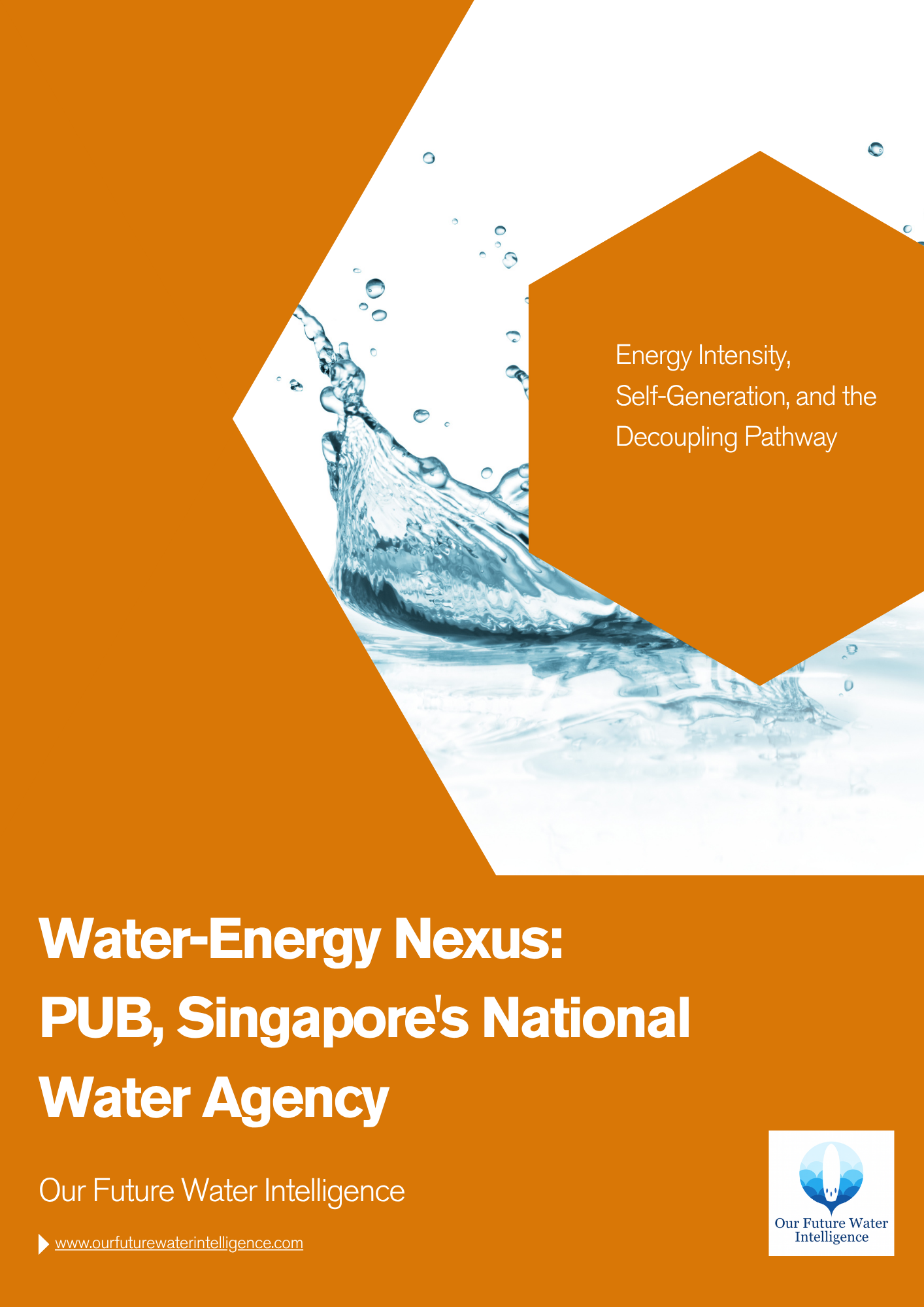
Water-Energy Nexus: PUB, Singapore's National Water Agency

Sale price$499.00

Water-Energy Nexus: PUB, Singapore's National Water Agency | Our Future Water Intelligence
Strategic Intelligence Report

Water-Energy Nexus: PUB, Singapore's National Water Agency

Singapore's water-energy nexus is the cost structure of supply independence — as desalination advances toward 30% and NEWater toward 55% of a doubling demand by 2061, the energy embedded in each cubic metre of supply rises continuously, and the strategic response is embedded energy efficiency across infrastructure co-location at Tuas Nexus, supply portfolio management, R&D-led technology improvement, and mandatory demand reduction.

Summary Insight: Desalination reverse osmosis requires approximately 3-4 kilowatt-hours per cubic metre for the membrane process — approximately 3-4 times the thermodynamic minimum of approximately 1.0 kilowatt-hours per cubic metre. NEWater production through microfiltration, reverse osmosis, and ultraviolet disinfection requires approximately 0.3-0.5 kilowatt-hours per cubic metre for the membrane process. Singapore's current water demand is approximately 440 million gallons per day, projected to reach approximately 880 million gallons per day by 2065. Non-domestic industrial consumption accounts for approximately 55% of current demand, projected at 70% of 880 million gallons per day by 2065.

This report is a premium, downloadable strategic intelligence briefing analysing how PUB, Singapore's National Water Agency operates as a system operator, with frameworks, governance models, and investment logic applicable to advanced water utilities globally.

Target Audience

  • Utility Executives & System Operators: Understand how PUB, Singapore's National Water Agency is deploying SGD 5 billion+ combined investment across Co-location of Tuas Water Reclamation Plant with Integrated Waste Management Facility; waste-to-energy electricity powers water reclamation; energy self-sufficiency target by 2027 operational commissioning through NEWater to deliver Singapore's water-energy nexus is the cost structure of supply independence — as desalination advances toward 30% and NEWater toward 55% of a doubling demand by 2061, the energy embedded in each cubic metre of supply rises continuously, and the strategic response is embedded energy efficiency across infrastructure co-location at Tuas Nexus, supply portfolio management, R&D-led technology improvement, and mandatory demand reduction.
  • Regulators & Policymakers: Examine how governance, compliance, and long-term planning are being aligned within a system-level utility transition.
  • Infrastructure Investors & Financiers: Assess how regulated investment logic, delivery sequencing, and resilience priorities interact inside a major utility system.

Report Deliverables

  • System Operator Transition: Analysis of how governance, oversight, and operating logic are shifting across the utility.
  • Digital Intelligence Layer: Assessment of how monitoring, telemetry, and operational visibility support system performance.
  • Capital & Financing Architecture: Review of how capital reserves, financing tools, and delivery sequencing support the investment programme.
  • Climate Infrastructure Strategy: Examination of resilience, asset stress, and infrastructure adaptation pathways under long-term pressure.
  • Demand & Resource Transition: Coverage of how demand management, supply efficiency, and resource transition interact across the utility.

The Five Strategic Pillars

  1. Architectures: Supply Portfolio Energy Management

    NEWater at 0.3-0.5 kWh/m³ versus desalination at 3-4 kWh/m³; NEWater targeted at 55% of demand to minimise average energy intensity; DTSS2 SGD 6.5B/98 km feedstock connection maximises reclamation feedstock from western catchment; each NEWater m³ substituting for desalinated water saves 2-3 kWh

  2. Enablement: Tuas Nexus Inter-Sectoral Energy Recovery

    Tuas WRP 176 MGD co-located with Integrated Waste Management Facility; waste-to-energy electricity powers adjacent water reclamation; biogas from sludge digestion adds second energy input; energy self-sufficiency target 2027; SGD 5B+ combined investment; first inter-sectoral circular energy economy at national utility scale in Asia-Pacific

  3. Resolution: Digital and Operational Energy Efficiency

    300,000 smart metres; IOCC real-time network monitoring; AI predictive maintenance contributing to 5% NRW; pump schedule optimisation using off-peak electricity tariffs; 500,000+ annual water quality tests; automated monitoring reducing operational cost of quality assurance

  4. Alignment: R&D-Led Technology Improvement

    9-domain R&D programme targeting energy and chemical reduction per unit produced; A*STAR + NUS + NTU partnerships; biomimetic membrane research toward 2 kWh/m³ desalination; SINGwater portal commercialisation pathway; 26 R&D centres and 180+ water companies generating SGD 2B+ sector revenues

  5. Capability Building: Mandatory Demand Reduction

    Mandatory 50% recycling for wafer fabrication from January 2024; Water Efficiency Fund SGD 5M cap; projected 15 Olympic swimming pools per day savings by 2035; Water Conservation Tax 60% non-domestic surcharge; WELS mandatory since 2009; domestic target 130 L/p/d by 2030 from 141 L/p/d current

Operational Excellence & Resilience

PUB, Singapore's National Water Agency is operating through a system transformation cycle anchored in NEWater and supported by clearer operational visibility. The report uses 3-4 kWh/m³, 0.3-0.5 kWh/m³ as visible markers of scale and system reach. It also situates digital, carbon, and delivery performance within named programmes including NEWater, Deep Tunnel Sewerage System Phase 2. This matters beyond one utility because it shows how governance, investment, and operational control can be aligned inside a stressed utility system.

About the Author

Robert C. Brears

Founder, Our Future Water Intelligence

Robert C. Brears is a globally recognised expert in water security, circular economy, and urban resilience. He is the author of multiple books on water management published by Oxford University Press, Palgrave Macmillan, and Springer Nature, and advises governments, utilities, and international organisations on strategic water investment and climate adaptation. His intelligence reports are used by utility executives, regulators, and infrastructure investors across Europe, Australasia, and the MENA region to benchmark performance and de-risk capital decisions.

Report Standards
Official utility & regulator data only No independent modelling or forecasting System-level analysis framework Benchmarkable across global utilities Cited by executives & policymakers

Expert Briefing: FAQs

How does Singapore fund the energy-intensive infrastructure required for supply independence?

Green bonds of SGD 1.125 billion fund the Tuas Water Reclamation Plant and Tuas NEWater Factory — the primary reclamation assets that produce NEWater at lower energy intensity than desalination. A capital reserve of SGD 5.3 billion provides internal financing for network efficiency and monitoring investments. The Coastal and Flood Protection Fund — SGD 5 billion initial, SGD 100 billion-plus over 100 years — finances dual-purpose coastal and water infrastructure. The Water Efficiency Fund at SGD 5 million per-project cap co-invests in industrial demand reduction, reducing the supply volume that must be produced from energy-intensive sources.

What makes Singapore's approach to the water-energy nexus structurally different from other cities' energy efficiency programmes?

Singapore's water-energy nexus cannot be resolved by efficiency improvements alone — the supply independence programme requires increasing climate-independent water production, and climate-independent sources are energy-intensive by their technical requirements. The structural response is threefold: maximise the share of NEWater over desalination (lower energy intensity per cubic metre), recover energy from co-located processes at Tuas Nexus (reducing net grid import), and deploy R&D to reduce energy intensity per unit of production. The Tuas Nexus inter-sectoral co-location — where waste-to-energy electricity powers water reclamation — is the most technically advanced expression of this embedded efficiency strategy.

How does Singapore's digital infrastructure reduce the energy cost of water supply?

The Integrated Operations Control Centre processes real-time data from 300,000 smart metres, pressure sensors, flow metres, and weather systems to enable pump schedule optimisation — running high-energy pumping during off-peak electricity tariff periods. Artificial intelligence-driven burst detection and predictive maintenance maintains non-revenue water at approximately 5%, eliminating the energy cost of producing the 22 million gallons per day that would otherwise be lost. Real-time demand forecasting improves treatment plant operating efficiency by aligning production rates with actual demand rather than design peak, reducing the energy cost of over-production.

How does Singapore manage the carbon footprint of a water system that is becoming more energy-intensive?

The primary decarbonisation instrument is supply portfolio management: each cubic metre of NEWater that substitutes for desalinated water saves approximately 2-3 kilowatt-hours of energy per cubic metre, substantially reducing the supply system's carbon intensity per unit of supply independence. Tuas Nexus reduces the carbon intensity of water reclamation directly — waste-to-energy electricity from the co-located Integrated Waste Management Facility and biogas from sludge digestion reduce net grid import. The R&D programme targets membrane technology that could reduce desalination energy to below 2 kilowatt-hours per cubic metre, further reducing the carbon cost of the growing desalination share of supply.

© 2026 Our Future Water Intelligence. All Rights Reserved.
Water-Energy Nexus: PUB, Singapore's National Water Agency
Water-Energy Nexus: PUB, Singapore's National Water Agency Sale price$499.00

ARTICLES

Governance of the Water-Energy Nexus: Singapore’s Fiscal & Policy Model
Climate-Resilient Infrastructure Finance

Governance of the Water-Energy Nexus: Singapore’s Fiscal & Policy Model

The Multi-Lever Governance Model. Singapore’s shift to an energy-intensive water portfolio isn't just an engineering feat—it's a masterclass in governance. This intelligence briefing analyzes how P...

Read more
Tuas Nexus Infrastructure Analysis: Singapore's $5B Energy Recovery Loop
DTSS Phase 2 Infrastructure Sequencing

Tuas Nexus Infrastructure Analysis: Singapore's $5B Energy Recovery Loop

The Blueprint for Inter-Sectoral Synergy. Tuas Nexus isn't just a treatment plant; it's a physical operating model for the water-energy nexus. With an SGD 5 billion investment, Singapore is buildin...

Read more
The Energy Price of Water Independence: PUB Singapore Analysis
Climate-Independent Water Supply Cost

The Energy Price of Water Independence: PUB Singapore Analysis

Resilience has a price. PUB Singapore has decoupled water supply from rain, but it has replaced climate risk with energy risk. This Infrastructure Intelligence briefing deconstructs the "Thermodyna...

Read more