
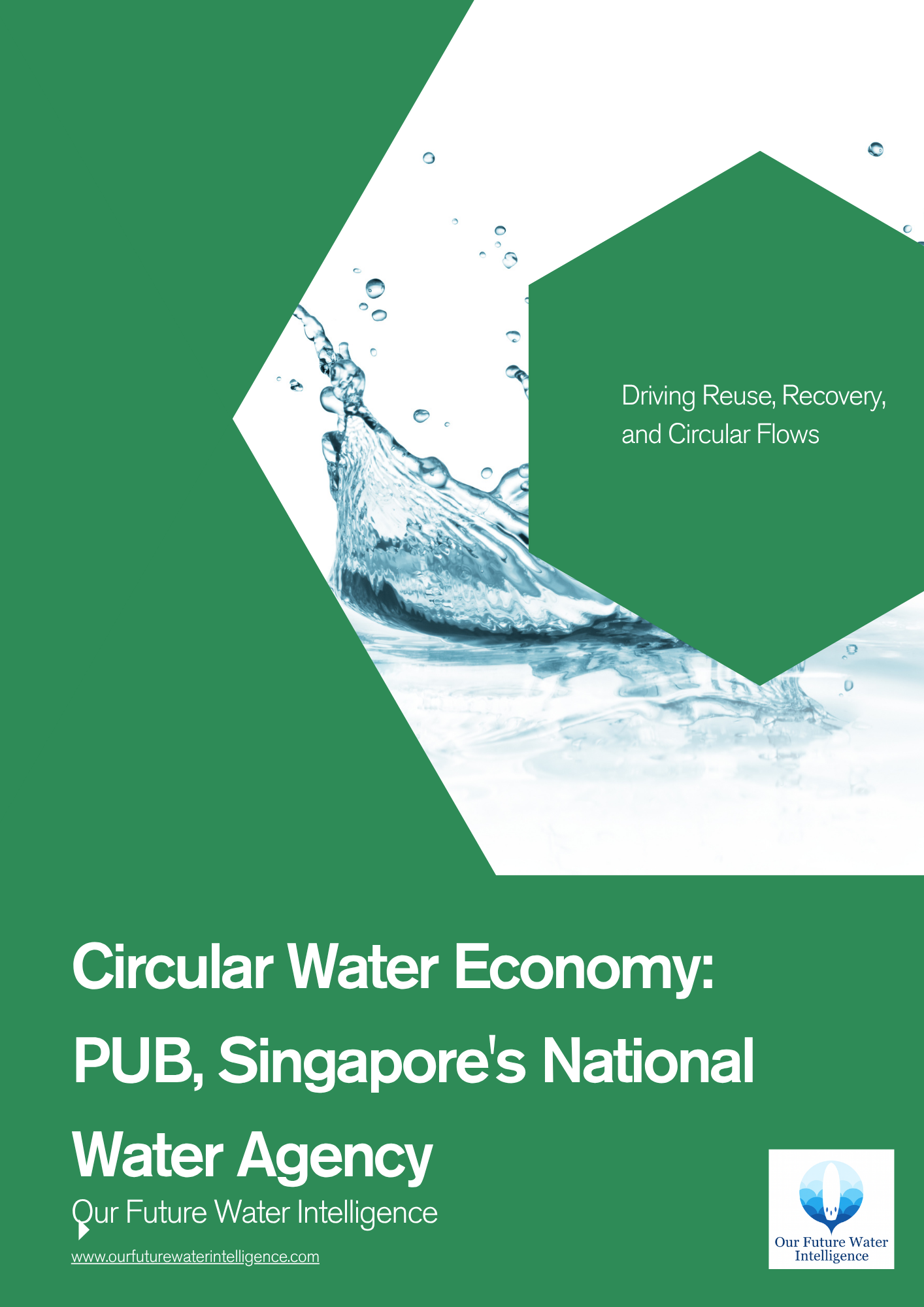
Circular Water Economy: PUB, Singapore's National Water Agency
Choose options
Circular Water Economy: PUB, Singapore's National Water Agency
This report evaluates how Singapore integrates demand reduction, direct reuse, water recycling, resource recovery, and ecological restoration within a national water-security system.
This Our Future Water Intelligence report provides an independent assessment of PUB’s circular system architecture, governance model, infrastructure investment, digital capability, industrial reuse strategy, resource recovery, and ecological restoration framework.
Target Audience
- Utility Executives & System Operators: Understand how deep-tunnel conveyance and reclamation infrastructure strengthen long-term recycling capacity.
- Regulators & Policymakers: Examine how industrial recycling mandates and efficiency incentives extend circular-economy discipline into demand governance.
- Infrastructure Investors & Financiers: Assess how green finance, public capital, and integrated infrastructure support large-scale circular-water assets.
Report Deliverables
- System Architecture Review: Analyses how reduction, reuse, recycling, recovery, and restoration operate within an integrated utility model.
- Governance and Policy Assessment: Delivers insight into regulatory mandates, tariff signals, public funding, and industrial obligations.
- Infrastructure Investment Evaluation: Assesses the backbone assets supporting NEWater, industrial reuse, conveyance, and resource recovery.
- Operational Performance Review: Examines efficiency, digital visibility, leakage management, treatment control, and resilience.
- Strategic Decision Framework: Connects supply independence, industrial recycling, ecological restoration, and lower-carbon water systems.
The Five Strategic Pillars
-
Architectures: Reduce — Network and Industrial Efficiency
Demand reduction is supported by mandatory efficiency standards, smart metering, leakage control, customer information, and industrial recycling requirements that preserve treated water within productive use circuits.
-
Enablement: Recycle — NEWater Production
NEWater transforms treated used water into a strategic national resource, while deep-tunnel conveyance and major reclamation assets provide the feedstock and treatment backbone required for expansion.
-
Resolution: Reuse — Industrial Precinct Loops
Industrial-grade reclaimed water enables direct reuse in water-intensive manufacturing, creating an efficient closed-loop supply without requiring the water to re-enter the potable distribution system.
-
Alignment: Recover — Tuas Nexus Integration
Co-location between water reclamation and solid-waste management aligns water, waste, sludge, and energy flows to reduce treatment demand and strengthen precinct-scale circular performance.
-
Capability Building: Restore — Waterways and Coastal Systems
Waterway restoration, stormwater management, reservoir integration, and coastal resilience extend circular performance beyond treatment plants into the wider urban environment.
Operational Excellence & Circular Resilience
PUB operates an integrated national water system supported by whole-of-cycle governance across supply, used water, stormwater, drainage, and coastal infrastructure. Operational performance is strengthened through smart metering, pressure management, predictive maintenance, automated water-quality monitoring, and centralised network oversight.
Reclamation and reuse infrastructure centred on major water-reclamation plants and the expanding deep-tunnel network strengthens feedstock security for NEWater. Tuas Nexus adds resource recovery by linking water treatment, sludge processing, waste management, and energy production within a shared precinct.
Deep Tunnel Sewerage System Phase 2 is the backbone infrastructure of Singapore’s circular water economy, linking western industrial used water flows to Tuas reclamation capacity and enabling NEWater expansion from around 40% toward 55% of demand.
Lead Analyst

Expert Analysis: FAQs
Singapore combines public capital, utility funding capacity, green financing, and targeted efficiency co-investment. This approach supports long-term infrastructure while linking eligible expenditure to resilience, resource efficiency, and environmental outcomes.
Circularity is embedded in the national supply system rather than added as a separate sustainability programme. Demand reduction, direct industrial reuse, NEWater, energy recovery, and ecological restoration operate within one coordinated utility architecture.
Smart metering, network monitoring, pressure analytics, predictive maintenance, and automated treatment systems provide the visibility required to manage demand, losses, water quality, reuse, and resource recovery across the full cycle.
The model reduces carbon intensity by prioritising reclaimed water, controlling demand, improving network efficiency, and recovering energy from treatment and waste streams. Integrated planning helps reduce reliance on more energy-intensive supply options.
ARTICLES
Integrated Operations Can Strengthen India's Water Resilience
India water resilience improves when digital systems, reuse, climate planning, asset management and workforce accountability operate as one service system.
Read more
India's Urban Water Investment Test Is Reliable Service
India urban water investment needs lifecycle finance, measured service outcomes, network accountability and affordability rather than capital approvals alone.
Read more
India's Groundwater Strategy Starts with Local Water Budgets
India groundwater management depends on local water budgets, agricultural incentives, aquifer evidence and accountable demand reduction across stressed regions.
Read more