
Choose options
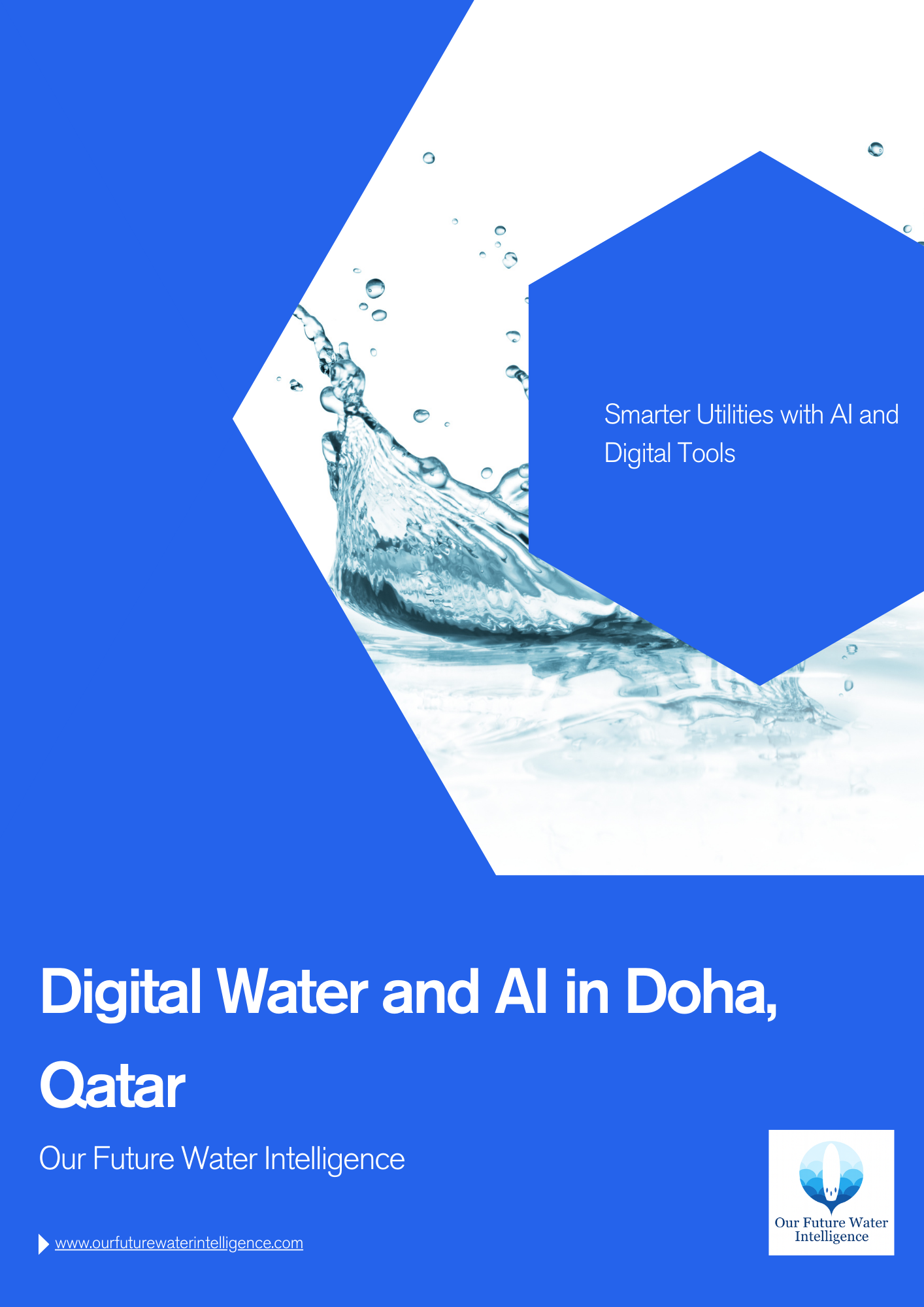
Digital Water and AI in Doha, Qatar
This report evaluates how smart metering, integrated utility data, Artificial Intelligence, desalination dependence, water-quality monitoring, infrastructure investment, and institutional capability shape water-system performance in Doha.
This Our Future Water Intelligence report provides an independent assessment of Doha’s digital water architecture, smart metering programme, operational control systems, water-quality monitoring, desalination-related risks, infrastructure priorities, financing mechanisms, Artificial Intelligence applications, and institutional capability requirements.
Target Audience
- Utility Executives & System Operators: Assess how smart metering, centralised control, water-quality monitoring, predictive maintenance, and advanced leak detection can support end-to-end digital operations in desalination-dependent systems.
- Regulators & Policymakers: Examine how water legislation, environmental strategy, digital capability, conservation requirements, and performance regulation can support resilient and technology-enabled water management.
- Infrastructure Investors & Financiers: Evaluate opportunities across desalination, smart metering, monitoring systems, control centres, digital platforms, and public-private infrastructure partnerships.
Report Deliverables
- Digital System Assessment: Reviews smart meters, SCADA, automated water-quality monitoring, customer interfaces, leak detection, and centralised operational control.
- Artificial Intelligence Use-Case Assessment: Examines predictive maintenance, anomaly-driven leakage detection, demand forecasting, asset-risk scoring, and automated operational decision support.
- Infrastructure Portfolio Assessment: Evaluates desalination, transmission, storage, distribution, water-quality monitoring, metering, and digital infrastructure as connected systems.
- Governance and Finance Assessment: Analyses national strategy alignment, water legislation, public-private partnerships, utility investment, innovation funding, data governance, and procurement requirements.
- Implementation and Capability Framework: Identifies sequencing priorities, data dependencies, workforce requirements, institutional responsibilities, and performance indicators for scalable digital transformation.
The Five Strategic Pillars
-
Architectures: Integrated desalination and network control
Examines the coordination of desalination plants, transmission pipelines, storage assets, pumping stations, distribution networks, and customer systems through centralised operational control and integrated utility data.
-
Enablement: Smart metering and precision monitoring
Evaluates extensive smart metering, automated water-quality monitoring, toxicity detection, customer interfaces, and operational sensors. These systems improve visibility across consumption, water quality, network conditions, and service performance.
-
Resolution: Artificial Intelligence and predictive asset management
Assesses Artificial Intelligence-ready data from smart meters, SCADA, leak detection tools, pumps, pipes, and valves. These data streams can support predictive maintenance, automated anomaly detection, targeted rehabilitation, and faster operational response.
-
Alignment: National strategy and water governance
Analyses the alignment of digital investment with Qatar National Vision 2030, the Third National Development Strategy 2024–2030, environmental priorities, and Law No. 23 of 2025 on water. Effective alignment connects technology deployment with conservation, efficiency, resilience, and regulatory accountability.
-
Capability Building: Workforce and analytical capacity
Maps how professional development, graduate training, national workforce policies, data governance, and technology partnerships can build the operational and analytical skills required for complex digital water systems.
Operational Excellence & Resilience
Operational resilience in Doha depends on coordination across desalination, electricity supply, transmission, strategic storage, distribution, smart metering, water-quality monitoring, customer services, maintenance, and infrastructure planning. The city’s dependence on desalinated water means that energy use, asset reliability, demand growth, network performance, and water quality must be managed as connected operational pressures.
Doha illustrates a highly digitised pathway for cities facing extreme water stress and dependence on energy-intensive supply. Combining smart metering, advanced sensors, centralised SCADA, automated quality monitoring, leak detection, and Artificial Intelligence-ready data platforms can shift utility operations from reactive intervention towards predictive and risk-based management.
Kahramaa is funding the rollout of more than 420,000 smart water meters at no installation cost to customers, alongside SCADA upgrades and automated monitoring systems, to modernise Doha’s infrastructure and strengthen climate-aligned water security.
Lead Analyst

Expert Analysis: FAQs
The report evaluates smart metering, SCADA, water-quality monitoring, leak detection, predictive maintenance, demand forecasting, desalination exposure, infrastructure investment, governance, financing mechanisms, and workforce capability as connected parts of Doha’s water-system transformation.
Digital infrastructure is primarily supported through utility investment in smart metering, centralised control, monitoring systems, and customer platforms. Major desalination and production assets are also supported through independent producer arrangements and long-term purchasing structures, while national strategies encourage private participation and innovation funding.
Doha’s approach connects extensive smart metering, continuous water-quality monitoring, centralised SCADA, customer systems, and advanced leak detection. This digital backbone supports predictive maintenance, anomaly detection, demand forecasting, and coordinated operational management across the water system.
Integrated data from meters, sensors, control systems, and customer applications can support early leak detection, targeted pipe replacement, asset-risk assessment, and more efficient desalination and network operations. Artificial Intelligence can extend these capabilities through predictive maintenance, demand forecasting, and automated anomaly detection.
The report supports utility executives, system operators, regulators, government agencies, infrastructure investors, development financiers, technology providers, and organisations evaluating digital transformation and water-related investment opportunities in desalination-dependent urban systems.
ARTICLES
Integrated Operations Can Strengthen India's Water Resilience
India water resilience improves when digital systems, reuse, climate planning, asset management and workforce accountability operate as one service system.
Read more
India's Urban Water Investment Test Is Reliable Service
India urban water investment needs lifecycle finance, measured service outcomes, network accountability and affordability rather than capital approvals alone.
Read more
India's Groundwater Strategy Starts with Local Water Budgets
India groundwater management depends on local water budgets, agricultural incentives, aquifer evidence and accountable demand reduction across stressed regions.
Read more