
Choose options
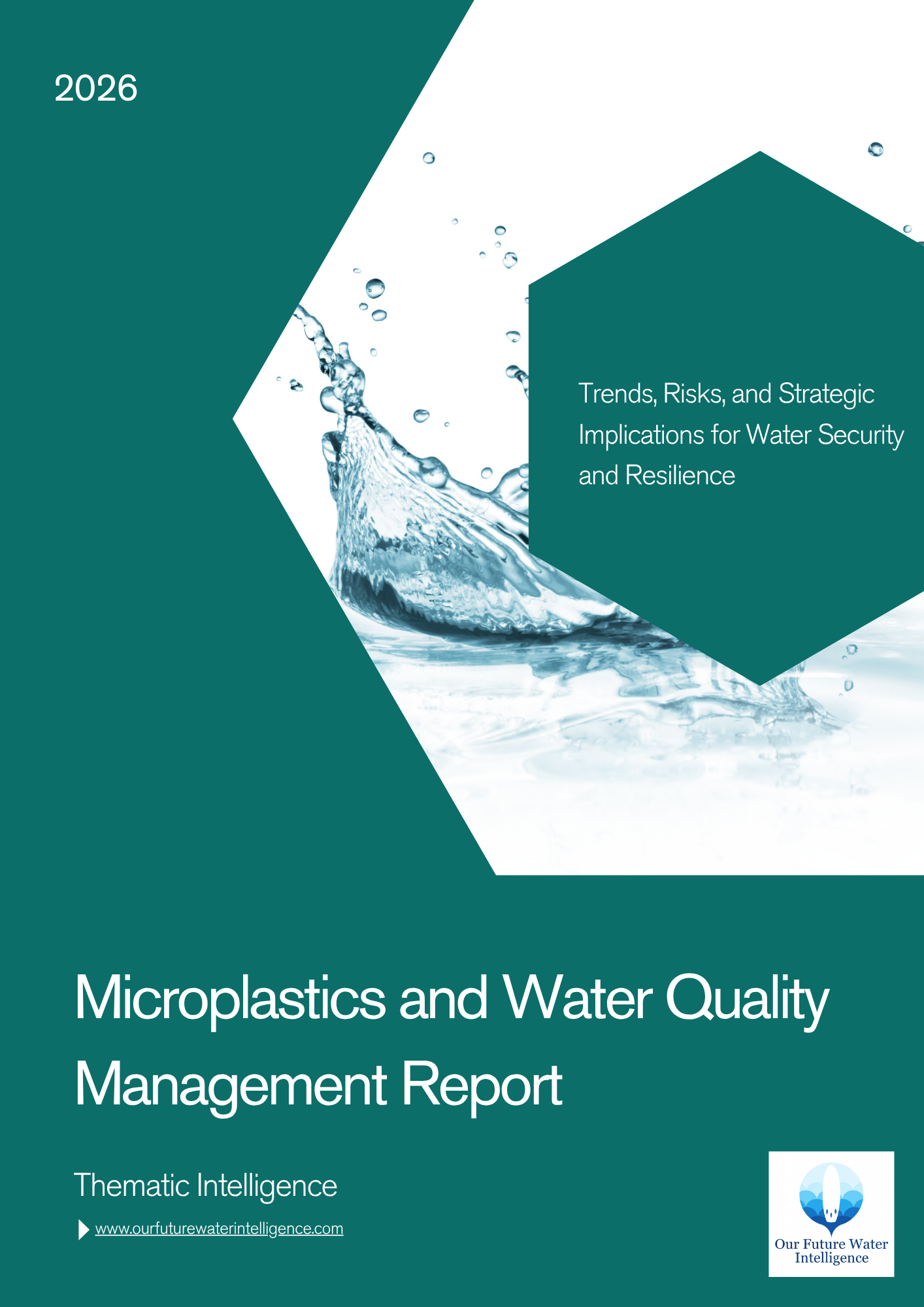
Thematic Intelligence: Microplastics and Water Quality Management
This Our Future Water Intelligence report evaluates how regulation, analytical detection, advanced treatment, biosolids controls, infrastructure finance, and delivery capacity are reshaping microplastics management across the water sector.
This report connects regulation, analytical detection, treatment performance, biosolids risk, infrastructure finance, energy trade-offs, and delivery capacity across the global water sector.
Target Audience
- Utility Executives & System Operators: Understand how membrane, oxidation, adsorption, and hybrid treatment systems support microplastics removal while creating operational, energy, and biosolids management trade-offs.
- Regulators & Policymakers: Examine how quantitative monitoring, standardized methods, source controls, and producer responsibility are reshaping water quality regulation.
- Infrastructure Investors & Financiers: Assess opportunities across analytical instruments, advanced treatment, sludge management, destruction technologies, and compliance infrastructure.
Report Deliverables
- Regulatory Landscape: Analysis of quantitative monitoring mandates and evolving compliance frameworks across major jurisdictions.
- Detection Technologies: Insight into spectroscopic, automated imaging, and mass-based analytical capabilities.
- Treatment Performance: Evaluation of conventional, membrane, oxidation, adsorption, and hybrid microplastics removal systems.
- Lifecycle Risk: Assessment of biosolids transfer pathways, destruction technologies, and permanent isolation options.
- Investment Frameworks: Guidance covering financing, workforce planning, supply chain resilience, and implementation sequencing.
The Five Strategic Pillars
-
Architectures: Quantitative regulation and standardized monitoring
Examines how water quality directives, contaminant monitoring programs, drinking water requirements, and source-reduction frameworks are creating a more structured regulatory architecture for microplastics.
-
Enablement: Automated and mass-based analytical detection
Analyzes how spectroscopy, automated particle imaging, chemical mapping, and thermal mass analysis can support comparable detection, polymer identification, and scalable compliance monitoring.
-
Resolution: Advanced aqueous treatment and energy trade-offs
Assesses how conventional treatment, membrane bioreactors, advanced oxidation, adsorption, filtration, and hybrid systems remove microplastics while affecting energy use, residuals, and operating costs.
-
Alignment: Biosolids destruction and lifecycle risk
Evaluates how captured polymers move into sewage sludge and how destruction, secure isolation, land-application controls, and source reduction influence whole-cycle environmental outcomes.
-
Capability Building: Financing, workforce, and delivery resilience
Reviews the financing structures, specialist skills, laboratory capacity, procurement strategies, supply chains, and institutional capabilities required for sustained implementation.
Operational Excellence & Resilience
Effective microplastics management requires coordinated monitoring, treatment, residuals control, and infrastructure delivery across the water cycle. Standardized sampling and analytical methods are essential for comparing results, establishing baselines, identifying polymer sources, and translating scientific evidence into enforceable compliance requirements.
Advanced treatment can achieve high removal from aqueous streams, but removal alone does not eliminate environmental risk. Captured particles may be transferred into sludge, concentrated residuals, or treatment by-products. Long-term resilience therefore depends on lifecycle controls, energy-aware treatment selection, source reduction, producer responsibility, workforce capability, and financing mechanisms that support both infrastructure upgrades and continuing analytical compliance.
Projected global market signal for microplastics detection, reflecting growing demand for standardized monitoring, advanced analytical systems, laboratory capacity, and compliance-ready water quality infrastructure.
Lead Analyst

Expert Briefing: FAQs
Membrane bioreactors can provide consistently high aqueous microplastics removal by combining biological treatment with membrane filtration. Actual performance depends on membrane characteristics, particle size, operating conditions, pretreatment, maintenance, and the composition of the incoming wastewater.
High aqueous removal often transfers captured particles into sewage sludge or other concentrated residuals rather than destroying them. If these residuals are applied to land or inadequately managed, microplastics may re-enter soils, waterways, food systems, and ecological pathways.
Investment is being driven by expanding monitoring requirements, the need for standardized and comparable results, growing public concern, and demand for faster polymer identification. These pressures are supporting laboratory expansion, automated analytical platforms, specialist services, and compliance-ready data systems.
Producer responsibility can shift qualifying treatment and monitoring costs toward the industries placing relevant substances or products on the market. This approach can diversify infrastructure finance, strengthen source-control incentives, and reduce the burden placed solely on utilities and water customers.
ARTICLES
Circular Supply Is Reframing China's Water Investment Agenda
Circular water is reshaping China's investment agenda through reuse, desalination, resource recovery, digital coordination, and resilient infrastructure.
Read more
Utility Resilience in China Depends on the Operating Model
Utility resilience in China depends on linking tariffs, network renewal, wastewater performance, digital operations, finance, and accountable service delivery.
Read more
China's Water Security Is Defined by Geography
China's water security depends on regional balance, basin coordination, groundwater recovery, diversified supply, and infrastructure matched to demand.
Read more