
Choose options
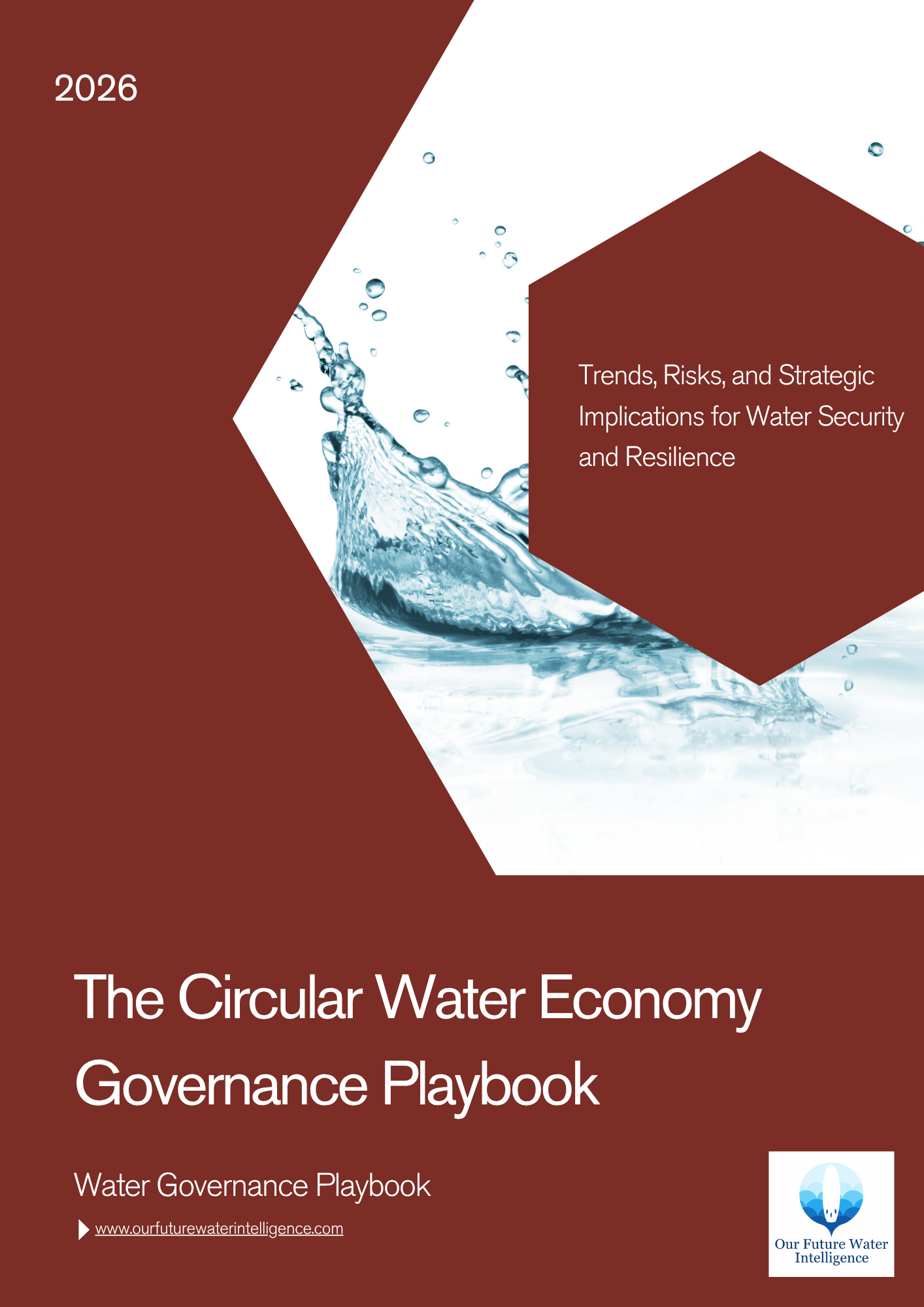
Water Governance Playbooks: The Circular Water Economy Governance Playbook
This Water Governance Playbook evaluates how policy design, institutional coordination, reuse regulation, tariff reform, infrastructure finance, stakeholder legitimacy, and digital accountability enable circular water implementation.
This Our Future Water Intelligence Water Governance Playbook provides an independent assessment of circular water governance, institutional architecture, regulatory design, infrastructure finance, stakeholder legitimacy, implementation readiness, and digital accountability.
Target Audience
- Utility Executives & System Operators: Understand how institutional mandates, operational accountability, resource recovery, and digital systems shape circular-water delivery.
- Regulators & Policymakers: Examine how reuse standards, allocation rules, tariff reform, monitoring, enforcement, and adaptive regulation create enabling conditions.
- Infrastructure Investors & Financiers: Assess how public-private partnerships, blended finance, performance incentives, tariffs, and institutional readiness affect bankability.
Report Deliverables
- Governance Framework: Structured analysis of policy design, institutional architecture, accountability, and implementation readiness.
- Regulatory Instrument Map: Coverage of reuse standards, allocation, economic instruments, monitoring, enforcement, and risk-based regulation.
- Financing and Partnership Lens: Assessment of performance-based partnerships, concession structures, blended finance, and incentive mechanisms.
- Stakeholder Implementation Guide: Guidance on public trust, private-sector participation, community engagement, capacity building, and reform sequencing.
- Digital Governance Outlook: Analysis of digital twins, artificial intelligence, monitoring systems, distributed reporting, cybersecurity, and data governance.
The Five Strategic Pillars
-
Architectures: Institutional Alignment
Integrated mandates, clear accountability, and coordination between basin, municipal, regulatory, and utility institutions reduce transaction costs and implementation failure.
-
Enablement: Risk-Based Reuse Rules
Water-quality classes, risk-management plans, abstraction controls, discharge requirements, and adaptive regulation enable the safe expansion of reuse.
-
Resolution: Market-Signal Reform
Cost-reflective tariffs, public-private partnerships, concession structures, blended finance, and outcome-linked incentives support bankable circular projects.
-
Alignment: Public Trust and Participation
Community engagement, transparent evidence, independent review, and the integration of local knowledge help secure legitimacy for reuse and resource recovery.
-
Capability Building: Monitoring and Cybersecurity
Sensors, digital twins, artificial intelligence, distributed reporting, open data, and cybersecurity protocols strengthen compliance, accountability, and operational resilience.
Operational Excellence & Governance Resilience
Circular-water performance depends on governance systems that connect institutional mandates, infrastructure operations, financial incentives, stakeholder responsibilities, and regulatory oversight. Risk-based regulation establishes the water-quality, monitoring, and management conditions required for safe reuse.
Performance-linked partnerships can align capital repayment with service quality and long-term operating outcomes. Digital twins, connected sensors, artificial intelligence, distributed reporting, and decision-support systems strengthen compliance and predictive asset management. Robust cybersecurity and data governance are required to protect interconnected infrastructure and maintain confidence in regulatory information.
The report identifies USD 4.5 trillion in potential global economic growth by 2030, USD 340 billion in targeted circular water investments, and USD 650 million unlocked through India’s Ganga River basin Hybrid Annuity Model.
Lead Analyst

Expert Analysis: FAQs
It covers institutional coordination, policy design, reuse regulation, financing, tariff reform, stakeholder engagement, digital governance, implementation readiness, and accountability.
Technology alone cannot resolve fragmented mandates, weak regulation, limited cost recovery, institutional resistance, insufficient monitoring, or low public trust. Governance determines whether proven technical solutions can be financed, accepted, implemented, and maintained.
The playbook examines performance-based public-private partnerships, concession structures, hybrid annuity arrangements, blended finance, outcome-linked instruments, tariff reform, and market-based mechanisms.
It is designed for policymakers, regulators, water agencies, utilities, municipalities, industry participants, development partners, and investors working on circular-water systems.
ARTICLES
Blue Finance Meets Brazil's Climate-Resilient Water Agenda
Brazil water investment is linking sustainable finance with sanitation expansion, loss reduction, reuse, watershed protection and climate adaptation priorities.
Read more
Reducing Brazil's Water Losses Through Digital Operations
Brazil water utilities can reduce distribution losses through smart metering, pressure control, trusted data and disciplined network renewal across regions.
Read more
Brazil Sanitation Concessions Enter the Delivery Decade
Brazil sanitation concessions are shifting attention from contract awards to capital delivery, regulatory discipline and measurable service outcomes nationwide.
Read more