
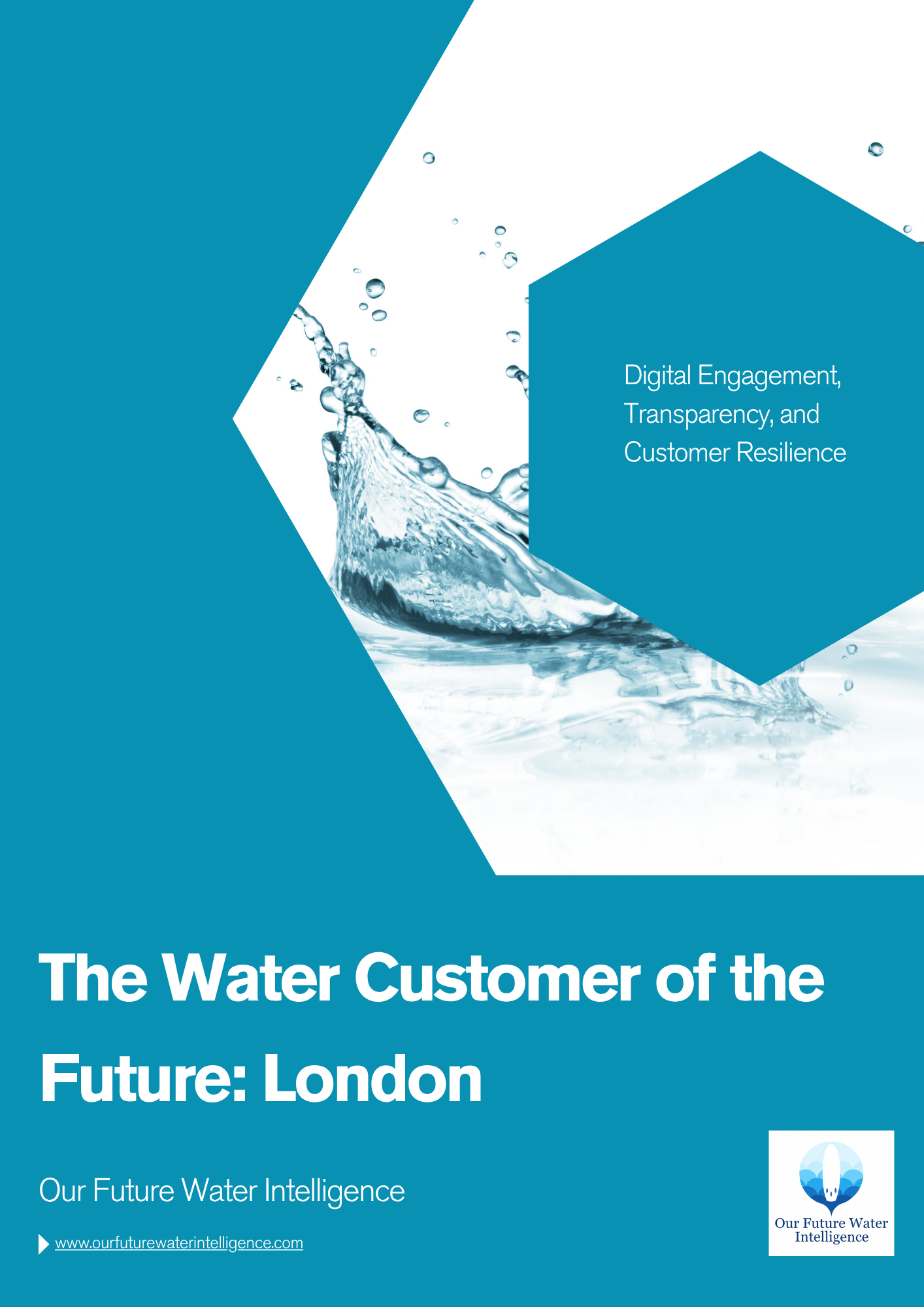
The Water Customer of the Future: Digital Transformation In London
Choose options
The Water Customer of the Future: London
This report evaluates how customer participation, digital services, demand management, and institutional trust are becoming central to London’s long-term water resilience.
This Our Future Water Intelligence report provides an independent assessment of how utilities, regulators, investors, and policymakers can align digital transformation with customer protection, infrastructure legitimacy, and climate-resilient water management across London and the Thames basin.
Target Audience
- Utility Executives & System Operators: Understand how customer-facing digital services can support demand management, leak identification, and operational resilience.
- Regulators & Policymakers: Examine how affordability, data governance, and performance transparency shape public confidence.
- Infrastructure Investors & Financiers: Assess how digital capability can improve capital prioritisation and reinforce the legitimacy of long-term investment.
Report Deliverables
- Demand Management Analysis: Provides insight into behavioural engagement, consumption visibility, and customer participation.
- Digital Capability Review: Evaluates smart metering, end-use disaggregation, predictive analytics, and digital twins.
- Trust and Affordability Assessment: Examines how transparency and targeted support can protect vulnerable customers.
- Cybersecurity Framework: Assesses the governance requirements associated with connected meters and customer data.
- Investment Alignment: Connects digital transformation with capital efficiency, regulatory objectives, and long-term resilience.
The Five Strategic Pillars
-
Architectures: Demand Visibility
Smart metering and end-use insight can provide customers and utilities with a clearer understanding of consumption patterns, abnormal use, and potential leakage.
-
Enablement: The Water Prosumer
Digital services can help reposition customers as active resilience participants who respond to timely information and support system balancing during periods of stress.
-
Resolution: Predictive Customer Intelligence
Artificial intelligence and customer segmentation can support earlier leak identification, more relevant interventions, and better-targeted affordability assistance.
-
Alignment: Infrastructure Legitimacy
Transparent reporting on leakage, environmental performance, service outcomes, and investment delivery can strengthen public confidence in long-term infrastructure decisions.
-
Capability Building: Integrated Digital Resilience
Customer-facing transformation must be integrated with cybersecurity, inclusive service design, climate adaptation, operational control, and basin-wide water-resource planning.
Operational Excellence & Customer Resilience
London’s future water system will depend on the effective integration of infrastructure investment, demand management, digital operations, and customer participation. Smart metering can improve consumption visibility, while analytical tools can help identify unusual demand, customer-side leaks, and emerging service risks.
Digital transformation also introduces material governance responsibilities. Utilities must protect customer information, minimise digital exclusion, explain how automated decisions are made, and ensure that vulnerable households receive appropriate support. Trust therefore becomes an operational capability as well as a communications objective.
The supply-demand shortfall identified for 2050. This briefing explores the digital transformation needed to support reductions toward the 110L resilience target.
Expert Analysis: Strategic FAQs
Customer demand management can combine timely consumption information, personalised guidance, leak alerts, and behavioural engagement. Its effectiveness depends on clear communication, accessible services, and interventions that customers consider practical and fair.
Digital transformation can connect customer consumption information with network operations and long-term resource planning. This improves demand visibility and supports more informed decisions about leakage control, infrastructure investment, and resilience measures.
The water prosumer model gives customers information and tools that help them participate in demand management. This can improve responsiveness during drought and other periods of system pressure while strengthening shared responsibility for water security.
The principal risks include cybersecurity exposure, misuse of customer data, automated decision bias, digital exclusion, and declining trust. These risks require strong governance, transparent consent, secure system design, and non-digital service alternatives.
Lead Analyst

ARTICLES
Integrated Operations Can Strengthen India's Water Resilience
India water resilience improves when digital systems, reuse, climate planning, asset management and workforce accountability operate as one service system.
Read more
India's Urban Water Investment Test Is Reliable Service
India urban water investment needs lifecycle finance, measured service outcomes, network accountability and affordability rather than capital approvals alone.
Read more
India's Groundwater Strategy Starts with Local Water Budgets
India groundwater management depends on local water budgets, agricultural incentives, aquifer evidence and accountable demand reduction across stressed regions.
Read more