
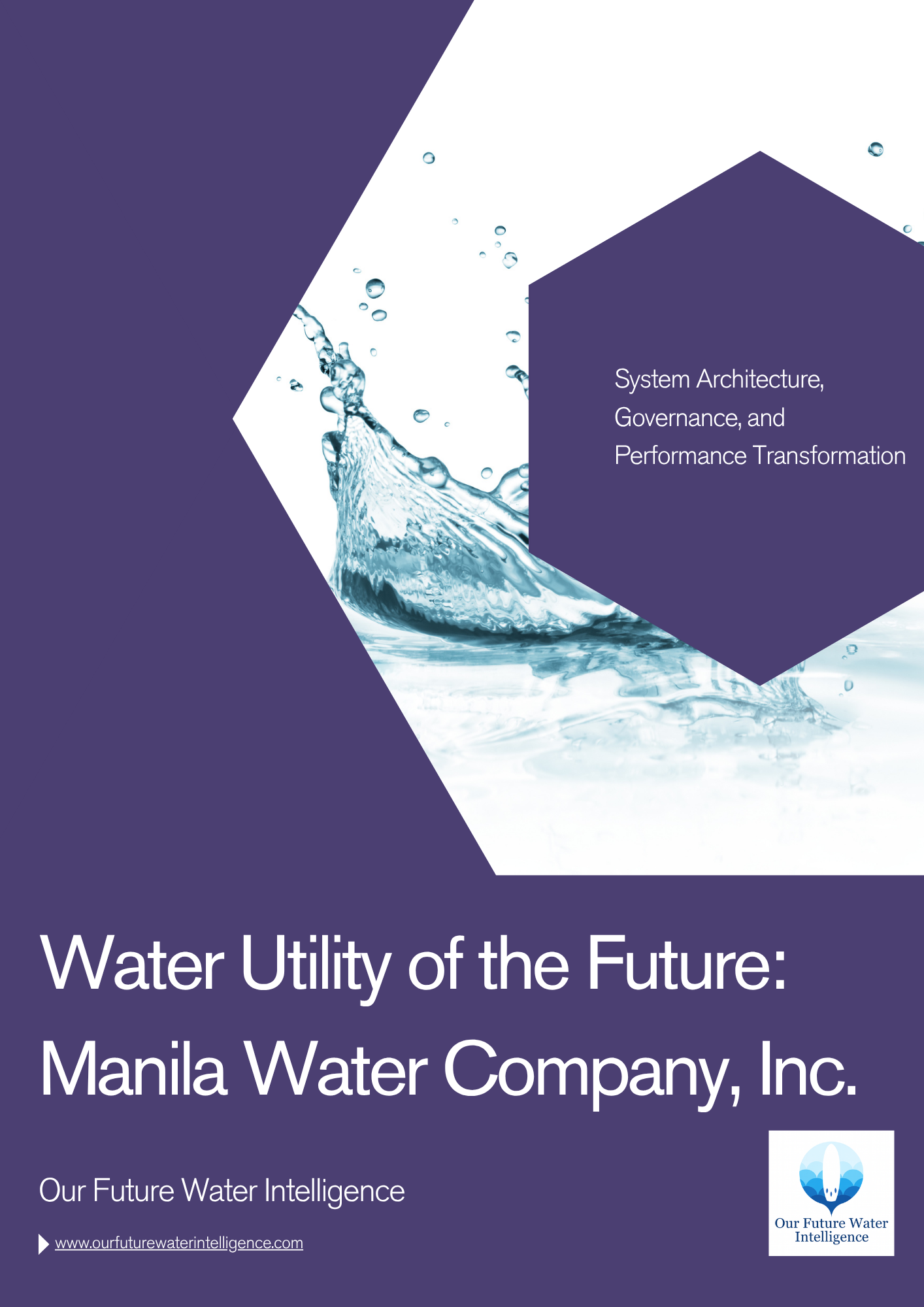
Water Utility of the Future: Manila Water Company, Inc.
Choose options
Water Utility of the Future: Manila Water Company, Inc.
This report evaluates how Manila Water Company, Inc. manages East Zone concession obligations, water-source diversification, network efficiency, wastewater expansion, capital investment, digital operations, and climate resilience.
This Our Future Water Intelligence report provides an independent assessment of Manila Water Company, Inc.’s concession governance, source-development strategy, network performance, wastewater investment, financial resilience, and long-term response to population growth and climate risk.
Target Audience
- Utility Executives & System Operators: Assess how Manila Water coordinates bulk allocations, alternative water sources, treatment facilities, transmission systems, district-metered networks, pumping assets, and wastewater infrastructure.
- Regulators & Policymakers: Examine MWSS oversight, rate rebasing, concession obligations, service standards, water security requirements, environmental compliance, and public-private risk allocation.
- Infrastructure Investors & Financiers: Evaluate concession duration, tariff-adjustment mechanisms, capital delivery, debt capacity, operating efficiency, environmental obligations, and long-term cash-flow resilience.
Report Deliverables
- Concession Governance Assessment: Reviews the Revised Concession Agreement, MWSS regulatory oversight, rate rebasing, service obligations, and investment-recovery mechanisms.
- Water Security Assessment: Examines Angat–La Mesa, Antipolo, Laguna Lake, and East Sources development under the Four Water System Masterplan.
- Network Performance Assessment: Evaluates district metering, pressure management, leakage control, asset rehabilitation, and non-revenue-water performance.
- Wastewater Investment Assessment: Reviews sewage-treatment capacity, interceptor networks, environmental compliance, sanitation coverage, and project sequencing.
- Capital and Resilience Assessment: Examines annual capital delivery, long-term funding, source diversification, emergency supply, and infrastructure adaptation.
The Five Strategic Pillars
-
Architectures: Four-system water security and source diversification
Examines how Manila Water coordinates the Angat–La Mesa, Antipolo, Laguna Lake, and East Sources systems to diversify supply. The analysis covers Cardona, East Bay, Calawis, deep wells, portable treatment, backwash recovery, storage, and transmission integration.
-
Enablement: District metering and network efficiency
Evaluates the district-metered-area model, pressure management, flow monitoring, leakage detection, network balancing, and asset rehabilitation practices used to maintain East Zone non-revenue water at approximately 14 percent.
-
Resolution: Wastewater treatment and sewerage expansion
Assesses the expansion of sewage-treatment plants, interceptor networks, conveyance systems, pumping infrastructure, and sanitation services required to meet concession commitments and environmental standards.
-
Alignment: Concession regulation and investment recovery
Analyses how MWSS rate rebasing, tariff adjustments, service targets, capital reviews, and concession rules link customer charges with approved expenditure and long-term infrastructure delivery.
-
Capability Building: Resilient assets and operational intelligence
Maps how telemetry, operational analytics, emergency sources, facility redundancy, climate-risk assessment, cybersecurity, and workforce capabilities strengthen continuity during droughts, typhoons, earthquakes, and network incidents.
Operational Excellence & Resilience
Manila Water holds the exclusive right to provide water and wastewater services across the eastern side of Metro Manila and parts of Rizal. The East Zone concession covers approximately 1,400 square kilometres, encompasses 24 cities and municipalities, and serves a population of more than seven million through an extensive treatment, transmission, distribution, sewerage, and customer-service system.
The report examines how the company balances increasing demand with fixed and climate-exposed bulk allocations, alternative source development, low water losses, water-quality control, wastewater compliance, and capital affordability. It also assesses how operational performance and project delivery interact with tariff adjustments and MWSS regulatory oversight.
Manila Water’s 2025 capital expenditure included PHP 23.64 billion for the East Zone concession, supporting major water-source, treatment, transmission, distribution, wastewater, information-technology, and service-improvement projects.
Lead Analyst

Expert Analysis: FAQs
Manila Water funds capital expenditure through internally generated cash, long-term debt, available credit facilities, and financing from local and international institutions. Long-lived water and wastewater assets are matched with longer-term funding, while approved investment recovery operates through the concession’s tariff and rate-rebasing mechanisms.
The concession establishes service obligations, performance standards, regulatory review processes, and mechanisms for recovering prudent expenditure. The approved extension of the Revised Concession Agreement to January 2047 provides a longer investment horizon for source-development, network, and wastewater projects with multi-decade asset lives.
The company combines district metering, network balancing, pressure management, leak detection, pipe rehabilitation, flow monitoring, and active maintenance. These measures kept East Zone non-revenue water below 14 percent at the end of 2025 while supporting continuous service across a dense metropolitan network.
Wastewater investment is required to expand sanitation coverage, meet concession commitments, and comply with environmental standards. Delivery therefore depends on coordinated investment in treatment capacity, sewer and interceptor networks, pumping facilities, land access, permitting, and connections to densely developed communities.
ARTICLES
Integrated Operations Can Strengthen India's Water Resilience
India water resilience improves when digital systems, reuse, climate planning, asset management and workforce accountability operate as one service system.
Read more
India's Urban Water Investment Test Is Reliable Service
India urban water investment needs lifecycle finance, measured service outcomes, network accountability and affordability rather than capital approvals alone.
Read more
India's Groundwater Strategy Starts with Local Water Budgets
India groundwater management depends on local water budgets, agricultural incentives, aquifer evidence and accountable demand reduction across stressed regions.
Read more