
Choose options
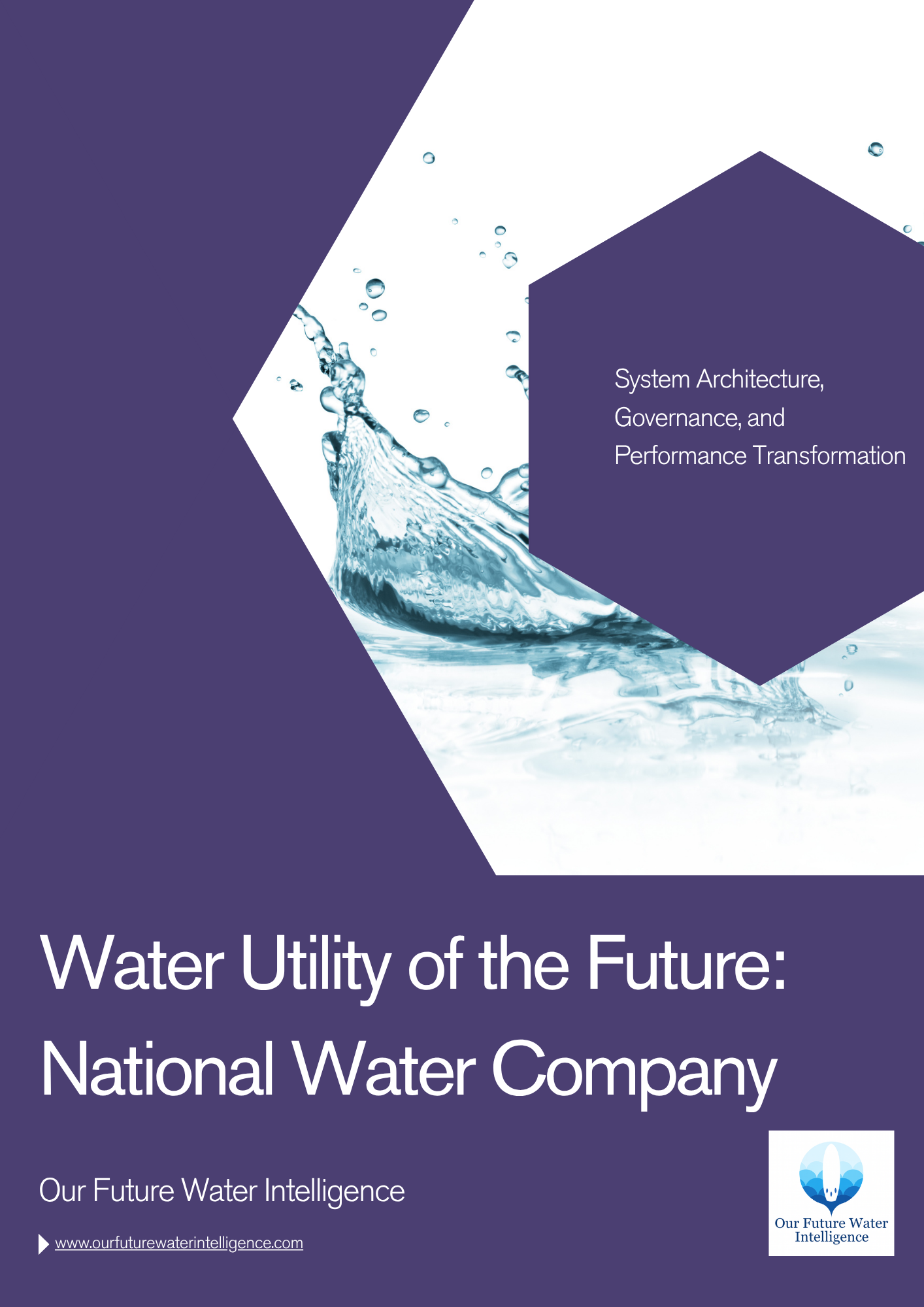
Water Utility of the Future: National Water Company
This report evaluates how National Water Company manages regional utility reform, water and sanitation investment, network efficiency, wastewater reuse, digital operations, private-sector participation, and water security across Saudi Arabia.
This Our Future Water Intelligence report provides an independent assessment of National Water Company’s governance model, regional operations, infrastructure programme, network modernisation, wastewater strategy, financial sustainability, and contribution to national water security.
Target Audience
- Utility Executives & System Operators: Assess how NWC coordinates drinking-water distribution, storage, pumping, sewerage collection, wastewater treatment, customer services, and asset maintenance across six regional clusters.
- Regulators & Policymakers: Examine the alignment between NWC’s performance, the National Water Strategy 2030, water-service regulation, affordability, environmental protection, and private-sector participation.
- Infrastructure Investors & Financiers: Evaluate project pipelines, public ownership, procurement structures, long-term operating contracts, delivery capacity, counterparty risk, and investment opportunities.
Report Deliverables
- Governance Assessment: Reviews NWC’s state ownership, joint-stock structure, six-cluster operating model, executive accountability, and strategic alignment.
- Capital Programme Assessment: Examines investment across water networks, reservoirs, pumping stations, sewerage systems, treatment facilities, and customer connections.
- Network Efficiency Assessment: Evaluates leakage reduction, pressure management, metering, hydraulic monitoring, asset rehabilitation, and non-revenue-water controls.
- Wastewater and Circularity Assessment: Reviews treatment capacity, sewerage expansion, treated-effluent reuse, sludge management, biogas recovery, and environmental compliance.
- Digital Operations Assessment: Examines SCADA, telemetry, geographic information, smart metering, water-quality monitoring, customer platforms, and operational analytics.
The Five Strategic Pillars
-
Architectures: Six-cluster regional operating model
Examines how National Water Company manages water distribution, sewerage collection, wastewater treatment, and customer services through six regional clusters covering Saudi Arabia’s 13 administrative regions.
-
Enablement: Capital delivery and service expansion
Evaluates NWC’s programme for water and sanitation networks, reservoirs, pumping and lifting stations, treatment facilities, household connections, and supporting assets required to extend reliable services.
-
Resolution: Network-loss reduction and digital control
Assesses how electronic metering, district monitoring, pressure management, leak detection, SCADA, telemetry, geographic information, and targeted rehabilitation improve distribution efficiency and asset performance.
-
Alignment: Wastewater treatment and resource circularity
Reviews sewerage and treatment expansion, treated-effluent reuse, industrial and landscape applications, sludge management, and biogas recovery as components of environmental protection and water-resource substitution.
-
Capability Building: Partnerships and performance management
Maps how management contracts, long-term operation and maintenance arrangements, supplier development, workforce capability, performance indicators, and innovation support service improvement and private-sector participation.
Operational Excellence & Resilience
National Water Company distributed more than 3.7 billion cubic metres of drinking water and treated more than 2.1 billion cubic metres of wastewater during 2024. Its nationwide operating environment requires the management of long transmission and distribution systems, high pumping requirements, intermittent local supply conditions, rapid urban growth, extreme heat, and geographically dispersed infrastructure.
The report examines how NWC combines regional control, network rehabilitation, storage expansion, pumping capacity, water-quality assurance, sewerage development, treatment performance, leakage reduction, and digital monitoring. It also assesses the role of private operating partners and long-term contracts in strengthening service quality and institutional capability.
National Water Company reported a capital portfolio exceeding SAR 51 billion across 677 water and sanitation projects, supporting wider service coverage, more efficient distribution, environmental protection, and improved service quality.
Lead Analyst

Expert Analysis: FAQs
National Water Company is a Saudi joint-stock company established in 2008 and wholly owned by the state through the Public Investment Fund. It provides water-distribution, sewerage-collection, and wastewater-treatment services through six regional clusters operating across the Kingdom.
NWC combines public capital projects with competitively procured construction, management, and long-term operation and maintenance contracts. These arrangements bring specialist operating and engineering capabilities into regional networks and treatment facilities while NWC retains strategic oversight and service accountability.
NWC uses electronic meters, network monitoring, SCADA, telemetry, leak detection, pressure management, and geographic asset information to identify abnormal flows and target interventions. These systems improve billing data, maintenance prioritisation, and the use of existing distribution assets.
Expanded sewerage and wastewater-treatment capacity protects public health and the environment while creating a substitute resource for irrigation, landscaping, and industrial applications. Treated-effluent reuse, sludge management, and biogas recovery also support circular-economy and resource-efficiency objectives.
ARTICLES
Integrated Operations Can Strengthen India's Water Resilience
India water resilience improves when digital systems, reuse, climate planning, asset management and workforce accountability operate as one service system.
Read more
India's Urban Water Investment Test Is Reliable Service
India urban water investment needs lifecycle finance, measured service outcomes, network accountability and affordability rather than capital approvals alone.
Read more
India's Groundwater Strategy Starts with Local Water Budgets
India groundwater management depends on local water budgets, agricultural incentives, aquifer evidence and accountable demand reduction across stressed regions.
Read more