01
Executive overview
Key findings
US$320 billion a year: World Bank estimate of government water supply and sanitation subsidies (range US$289–353 billion; IBNET 2010–2015, excluding China and India)
About 22%: share of Saudi Arabia's levelised desalination cost (US$3.1 billion) covered by water tariff revenue (US$0.65 billion) in 2025, a KAPSARC estimate
41%: Jordan's nationwide non-revenue water as of August 2026, 10.7 points lower than in 2022, according to the ministry
34 and 69: South African municipalities whose equitable share National Treasury withheld: 34 over unpaid water-board and Eskom bills (December 2024 to July 2025), 69 in July 2026
02
Buyer relevance
Who the report is for
Finance ministries and water regulators in the Gulf
Compare the Saudi, Omani and Egyptian regulator mandates and the 1 January 2027 Saudi tariff step before designing their own tariff and compensation sequence.
Development finance institutions
Use the Egyptian loan's US$18 million and US$10 million governance-linked allocations and Jordan's IMF targets as models for results-based support.
PPP investors and desalination developers
Assess how single-buyer offtake guarantees, such as SWPC's and Jordan's guarantee of at least 1% of GDP a year for 21 years, move subsidy risk onto the state.
Water operators bidding for management contracts
Benchmark against Jordan's four-year Yarmouk performance-based contract and the World Bank's documented NRW contracts in the Bahamas and Kuala Lumpur.
03
Decision scope
Questions answered
How much do governments spend on water subsidies?
The World Bank's estimate is about US$320 billion a year (range US$289–353 billion), built on utility data for 2010–2015 and excluding China and India.
Who benefits from untargeted water subsidies?
Across 10 countries studied by the World Bank, the wealthiest 20% captured 56% of water and sanitation subsidies and the poorest 20% captured 6%.
Is Oman phasing out its water subsidy?
APSR's stated policy is gradual withdrawal from January 2021 to 2031, while the 2026 Budget raises combined electricity, water and sewage subsidies by RO 65 million to RO 779 million; the report sets the two side by side.
Has Jordan's reform produced measurable results?
The ministry reports non-revenue water of 41% in August 2026, 10.7 points below 2022, and the IMF reports water-sector losses of 0.4% of GDP in 2025, though arrears targets were missed.
04
Inside the report
Inside the complete report
Executive Snapshot
1. Introduction
2. Foundations of Water Governance and Policy Design
3. Institutional Arrangements and Governance Models
4. Policy Instruments and Regulatory Frameworks
5. Stakeholder Engagement and Governance Implementation
6. Financing, Data, and Digital Governance
7. Future Outlook and Policy Recommendations
Source Register
05
Public preview
What to watch next
3.6 Cross-sector coordination and policy coherence
Cabinet approval of Egypt's executive regulations; the Saudi Water Authority's first published revenue-deficit or cost approval; AAC financial close; first published performance results under the Yarmouk contract; whether South Africa's withholding is extended to the long-standing arrears within the R24.58 billion owed to water boards.
4.5 Enforcement and monitoring
Publication of Saudi Arabia's residential tariff schedule and the qualifying categories for the SR500 allowance before 1 January 2027; any outcome of Kuwait's Decision 103/2025 committee; Egypt's low-consumption bracket studies; the next Jordan non-revenue water figure against the 2030 target.
5.6 Reform sequencing: documented pathways
Yarmouk's first published indicator results; whether Oman publishes the APSR tariff strategy or an annual subsidy-withdrawal schedule; South African municipalities' performance against the August and September 2026 irregular-expenditure targets.
6.6 Cybersecurity and information management
Ofwat's autumn 2026 artificial intelligence consultation and first guidance; publication of Yarmouk indicators; any Gulf regulator's first annual performance or deficit report; Water Forward compacts naming countries in the Middle East and North Africa.
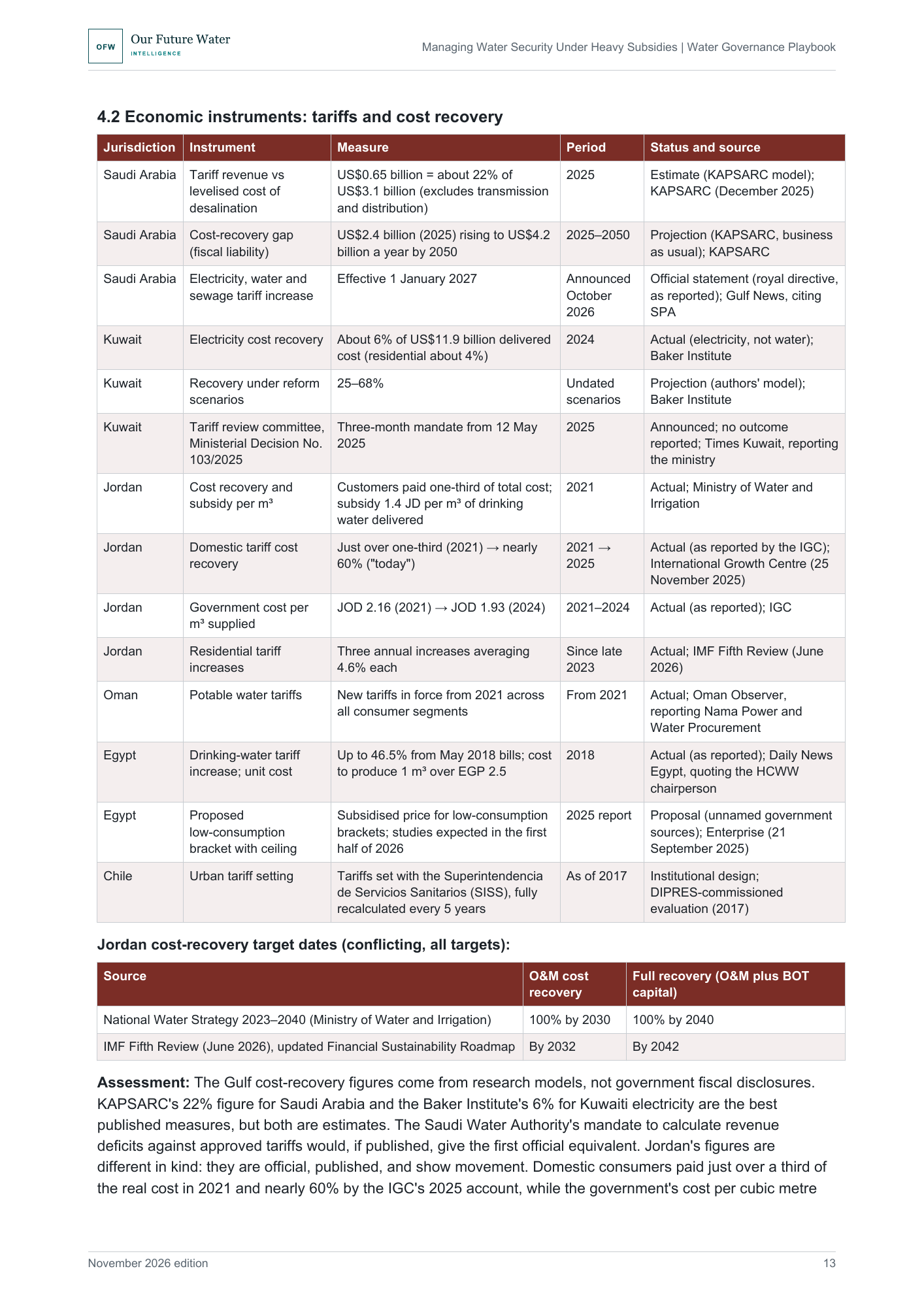
Economic instruments: tariff revenue, cost recovery and tariff steps across Saudi Arabia, Kuwait, Jordan, Oman, Egypt and Chile, each with period and status.
06
Included
What you receive
The complete PDF report: 28 pages, 9 sections, 26 tables and a register of 62 sources.
This edition
November 2026, First edition.
07
Evidence & method
Evidence and method
The report draws on IMF programme reviews and working papers, World Bank and OECD publications, government strategies, cabinet resolutions and treasury statements from Saudi Arabia, Oman, Jordan, Egypt, South Africa and Chile, and independent policy studies from KAPSARC and the Baker Institute. Time-sensitive statuses were re-checked on 23 November 2026.
Sources
62 sources, listed in the report's source register. Evidence current to 23 November 2026. Principal data periods: World Bank and IMF global subsidy estimates built on IBNET utility data for 2010–2015; country budgets and programme reviews for 2021–2026; announced reforms effective to January 2027; published targets to 2031, 2036, 2040 and 2042. Currencies are stated as published (US dollars, Saudi riyals, Kuwaiti dinars, Omani rials, Jordanian dinars, Egyptian pounds, South African rand, Chilean pesos, Indian rupees, Qatari riyals and pounds sterling).
Evidence boundaries
This report uses authoritative source material available at the stated research cutoff. It distinguishes published facts, calculated values and analytical interpretation. No independent modelling is performed. Forward-looking analysis reflects published plans, documented trends and stated uncertainties. It does not constitute legal, financial, investment or engineering advice.
08
Lead analyst
Robert C. Brears
Founder, Our Future Water Intelligence
Robert C. Brears is a water-security specialist and author whose work examines utility governance, infrastructure investment, climate resilience and long-term water-system change for executive and policy audiences.
- Decision-focused utility intelligence
- Published water-policy author
- Evidence-grounded system analysis
09
Buyer FAQs
Before you purchase
Who can use the report?
Licensed for internal use within one purchasing organization. The PDF and its contents may be shared with colleagues within that organization. External redistribution, resale and public publication are prohibited without permission.
How is the report delivered?
The PDF is available to download immediately after confirmed payment, through our secure delivery system.
Can my organization buy wider access?
Institutional purchasing: For invoice enquiries, multi-organization licensing or broader access requirements, contact Our Future Water Intelligence.
10
Managing Water Security Under Heavy Subsidies: Water Governance Playbook
- Format
- Length
- 28 pages
- Edition
- November 2026, First edition
- Price
- USD 749
11
Report details
Publication details
- Publisher
- Our Future Water Intelligence
- Report family
- Water Governance Playbook
- Report type
- Water Governance Playbook
- Edition
- November 2026, First edition
- Format
- Length
- 28 pages
- Reference
- OFW_EXT_MANAGING_WATER_SECURITY_UNDER_HEAVY_SUBSIDIES_GOVERNANCE_PLAYBOOK_77565bbbb6cd
- Evidence current to
- 23 November 2026