
01
Executive overview
Key findings
117%: water stress (SDG 6.4.2, 2023), renewable water withdrawn after environmental flows; above UN-Water's "Critical" band (above 100%)
72.40% and 31.70%: water and wastewater network coverage in Nama Water Services' licensed area (2025), against targets of 96% and 75% by 2040
RO 11.1 billion: Nama Water Services' Integrated Master Plan to 2050 (planned), 410 projects, of which RO 7.2 billion is for wastewater
About RO 900 million: 15-year performance-based water and wastewater services contract for Muscat and North and South Al Sharqiyah, awarded in June 2026 to a SUEZ-led consortium
02
Buyer relevance
Who the report is for
Companies new to Oman's water market
Identify the counterparties in one place: PWP for bulk supply, Nama Water Services outside Dhofar, Nama Dhofar Services in Dhofar and the APSR for licences and standards.
Contractors and PPP developers
See the main current projects at a glance, from the 300,000 m³-a-day Ghubrah III plant (93% complete) to the Al Ansab and Al Amerat expansions with bids due on 5 January 2027.
Investors and lenders
Understand the revenue base behind water contracts, where subsidy made up 40.5% of Nama Water Services' 2024 operating revenue and retail tariffs start at OMR 0.66.
Consultants and policy advisers
Brief clients on Oman's water position with sourced figures, from 117% water stress to service coverage of 72.40% (water) and 31.70% (wastewater) in 2025.
03
Decision scope
Questions answered
Where does Oman's drinking water come from?
Mainly from seawater desalination: national capacity was 1.73 million m³ a day from 93 plants at the end of 2024, and a 2026 report put desalination at roughly nine in ten cubic metres of drinking water.
Who runs water in Oman?
PWP buys desalinated water in bulk, Nama Water Services distributes it in every governorate except Dhofar and Nama Dhofar Services in Dhofar; all three sit in the Oman Investment Authority-owned Nama Group, regulated by the APSR.
What are the biggest projects under way?
Ghubrah III (300,000 m³ a day, operations expected Q2 2027), the Wadi Dayqah purification plant (65,000 m³ a day, 57% complete in October 2026) and a 15-year performance contract worth about RO 900 million awarded in June 2026.
Do tariffs cover the cost of water?
No: government subsidy was 40.5% of Nama Water Services' 2024 operating revenue, and official and multilateral sources give four different positions on the timing of subsidy reform.
04
Inside the report
Inside the complete report
Executive Snapshot
1. Country Water Profile
2. Water Resources and Supply
3. Institutions and Utilities
4. Infrastructure and Major Projects
5. Tariffs and Finance
6. Climate and Resilience
7. Outlook and What to Watch
Source Register
05
Public preview
What to watch next
3. Institutions and Utilities
NWS's 2026 loss outturn against its 30% target for 2026; the handover date for the SUEZ-led operator.
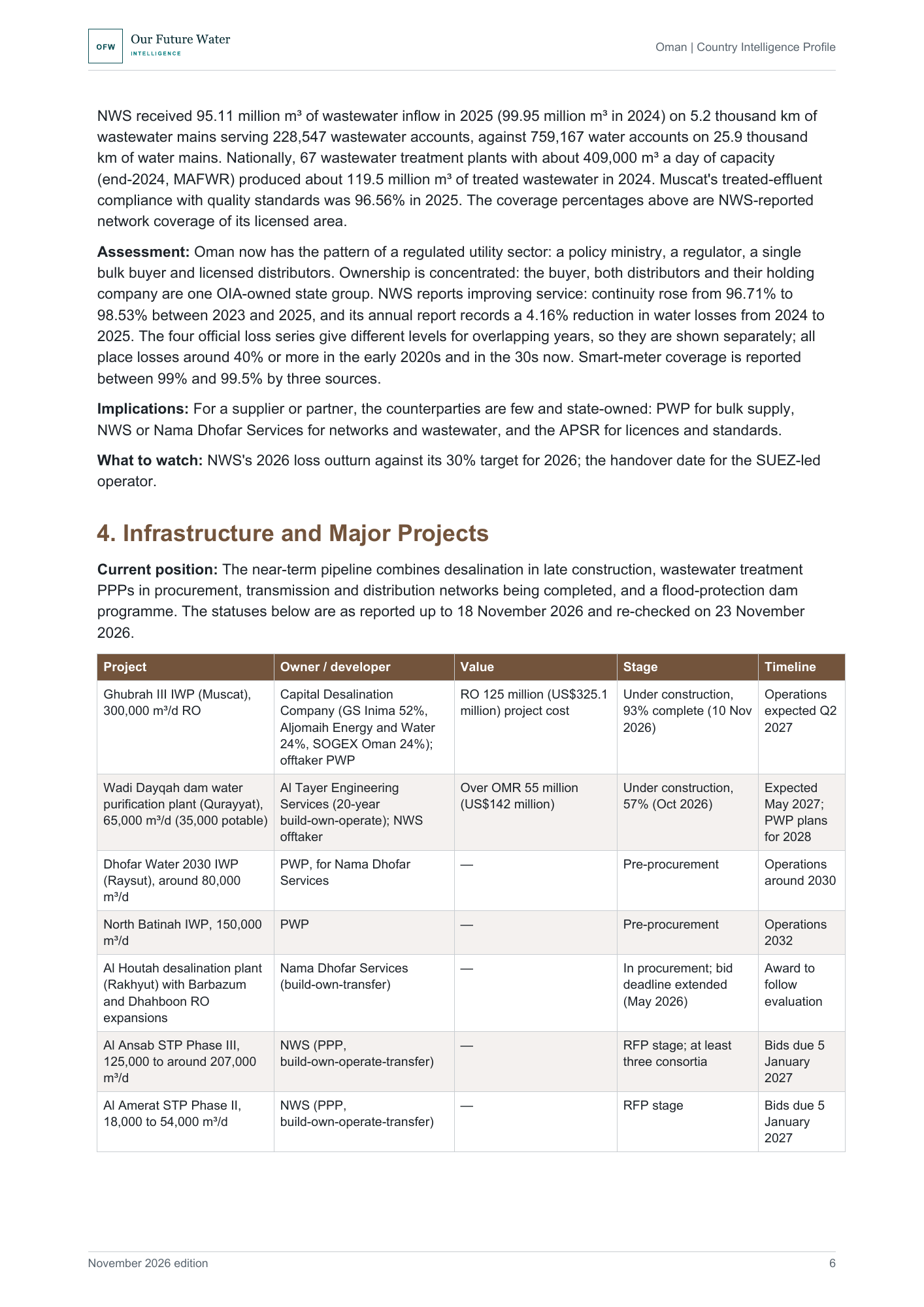
4. Infrastructure and Major Projects
Bids for Al Ansab and Al Amerat on 5 January 2027; an award on the Seeb–Barka pipeline; Ghubrah III's commercial operation; the launch of procurement for Dhofar Water 2030.
5. Tariffs and Finance
NWS's 2025 audited statements and subsidy line; a dated retail tariff or subsidy-reform decision; any change to the NWS or Nama Dhofar Services retail schedules.
7. Outlook and What to Watch
The 5 January 2027 bids; Ghubrah III's start in 2027; an APSR decision on water pricing; PWP's next 7-Year Statement.
Section 4: the major projects with owners, values, stages and timelines as of November 2026.
06
Included
What you receive
The complete PDF report: 14 pages, 9 sections, 14 tables and a register of 56 sources.
This edition
November 2026, First edition.
07
Evidence & method
Evidence and method
The profile draws on NCSI population statistics, PWP's statutory 7 Year Statement Water 2026–2032 and Bulk Supply Tariff, Nama Water Services' Annual Report 2025 and audited 2024 financial statements, MAFWR statements on desalination and dams, Royal Decrees 131/2020 and 40/2023, published tariff schedules, IMF and IEA assessments, and project and procurement reporting re-checked on 23 November 2026.
Sources
56 sources, listed in the report's source register. Evidence current to 23 November 2026. Principal data periods: NCSI registered population (October 2026); Nama Water Services Annual Report 2025; PWP 7 Year Statement Water 2026–2032; MAFWR desalination and dam statements (2024–2026); APSR annual briefing (March 2026); project and procurement status re-checked 23 November 2026. Currency: Omani rial (RO, also written OMR) and US dollars as sources give them.
Evidence boundaries
This report uses authoritative source material available at the stated research cutoff. It distinguishes published facts, calculated values and analytical interpretation. No independent modelling is performed. Forward-looking analysis reflects published plans, documented trends and stated uncertainties. It does not constitute legal, financial, investment or engineering advice.
08
Lead analyst
Robert C. Brears
Founder, Our Future Water Intelligence
Robert C. Brears is a water-security specialist and author whose work examines utility governance, infrastructure investment, climate resilience and long-term water-system change for executive and policy audiences.
- Decision-focused utility intelligence
- Published water-policy author
- Evidence-grounded system analysis
09
Buyer FAQs
Before you purchase
Who can use the report?
Licensed for internal use within one purchasing organization. The PDF and its contents may be shared with colleagues within that organization. External redistribution, resale and public publication are prohibited without permission.
How is the report delivered?
The PDF is available to download immediately after confirmed payment, through our secure delivery system.
Can my organization buy wider access?
Institutional purchasing: For invoice enquiries, multi-organization licensing or broader access requirements, contact Our Future Water Intelligence.
10
Oman Country Intelligence Profile
- Format
- Length
- 14 pages
- Edition
- November 2026, First edition
- Price
- USD 99
11
Report details
Publication details
- Publisher
- Our Future Water Intelligence
- Report family
- Country Intelligence Profile
- Edition
- November 2026, First edition
- Format
- Length
- 14 pages
- Reference
- OFW_EXT_OMAN_COUNTRY_INTELLIGENCE_PROFILE_a3fc36b9b832
- Evidence current to
- 23 November 2026
14
Explore this report family
More Country Intelligence Profiles
Explore the same report family covering other countries.
Kuwait Country Intelligence Profile
- Geography
- Kuwait
- Edition
- November 2026, First edition
- Length
- 14 pages
National Water Research and Reference
Saudi Arabia Country Intelligence Profile
- Geography
- Saudi Arabia
- Edition
- November 2026 edition
- Length
- 15 pages
National Water Research and Reference
Morocco Country Intelligence Profile
- Geography
- Morocco
- Edition
- October 2026, New edition
- Length
- 14 pages