
01
Executive overview
Key findings
38-86 cm: projected sea-level rise at Copenhagen by 2100 (55-189 cm by 2150); extreme storm-surge levels of up to 4 m in the north and 5 m in the south towards 2125
DKK 15.0 billion: Cloudburst Plan investment frame at 2026 prices if fully implemented (DKK 11 billion at 2015 prices)
About 9-10%: reduction in Copenhagen's flood risk achieved by cloudburst projects so far, protecting about 4,400 households and 750 business addresses
59 of 242: surface cloudburst projects expected to reach the 100-year standard under current funding rules
02
Buyer relevance
Who the report is for
Landscape, drainage and tunnel contractors
See which cloudburst works are secure, such as the six tunnels, and which surface projects depend on the extension bill planned for November 2026.
Property owners, developers and insurers
Check protection already delivered, about 4,400 households and 750 business addresses, against the remaining programme and sea-level projections.
Climate adaptation consultants
Follow the consolidated strategy's four themes and the financing chapter the committee required before adoption planned for early 2027.
Water-intensive businesses
Weigh drought exposure, with HOFOR's supply buffer at 11% in 2025 and peak demand in the 2026 heatwave the highest in over 20 years.
03
Decision scope
Questions answered
How much has Copenhagen's cloudburst programme achieved?
The city reports flood risk cut by about 9-10%, protecting about 4,400 households and 750 business addresses.
Why is the programme shrinking?
Rules in force since 2021 limit tariff funding to a 10-year service level for projects not started by 1 January 2027, so only 59 of 242 surface projects and DKK 1.9 billion of the DKK 4.7 billion surface frame are now expected.
How exposed is Copenhagen to the sea?
Sea level is projected to rise 38-86 cm by 2100 and 55-189 cm by 2150, with extreme storm surges of up to 4 m in the north and 5 m in the south towards 2125.
Is drought a real risk for a groundwater city?
Yes: HOFOR's supply buffer was 11% against a desired 20-30% in 2025, and on 25 June 2026 it asked customers to save water while running at full capacity.
04
Inside the report
Inside the complete report
Executive Snapshot
1. Why This Matters Now in Copenhagen
2. Current Position
3. Key Programmes, Projects and Investment
4. Policy, Regulation and Institutions
5. Risks and Constraints
6. Strategic Implications
7. What to Watch
Source Register
05
Public preview
What to watch next
1. Why This Matters Now in Copenhagen
Presentation of the draft strategy, which the city expected in October 2026 and which was not on the committee's 5 or 26 October 2026 agendas; public consultation and adoption, planned for early 2027.
3. Key Programmes, Projects and Investment
Kalvebod Brygge in service before the 2027 cloudburst season; the start of Harrestrup Å construction in summer 2027.
4. Policy, Regulation and Institutions
The Folketing's handling of the extension bill before 1 January 2027; the draft strategy and its financing chapter.
5. Risks and Constraints
Any update of DMI's projections in the new strategy; HOFOR's 2026 buffer.
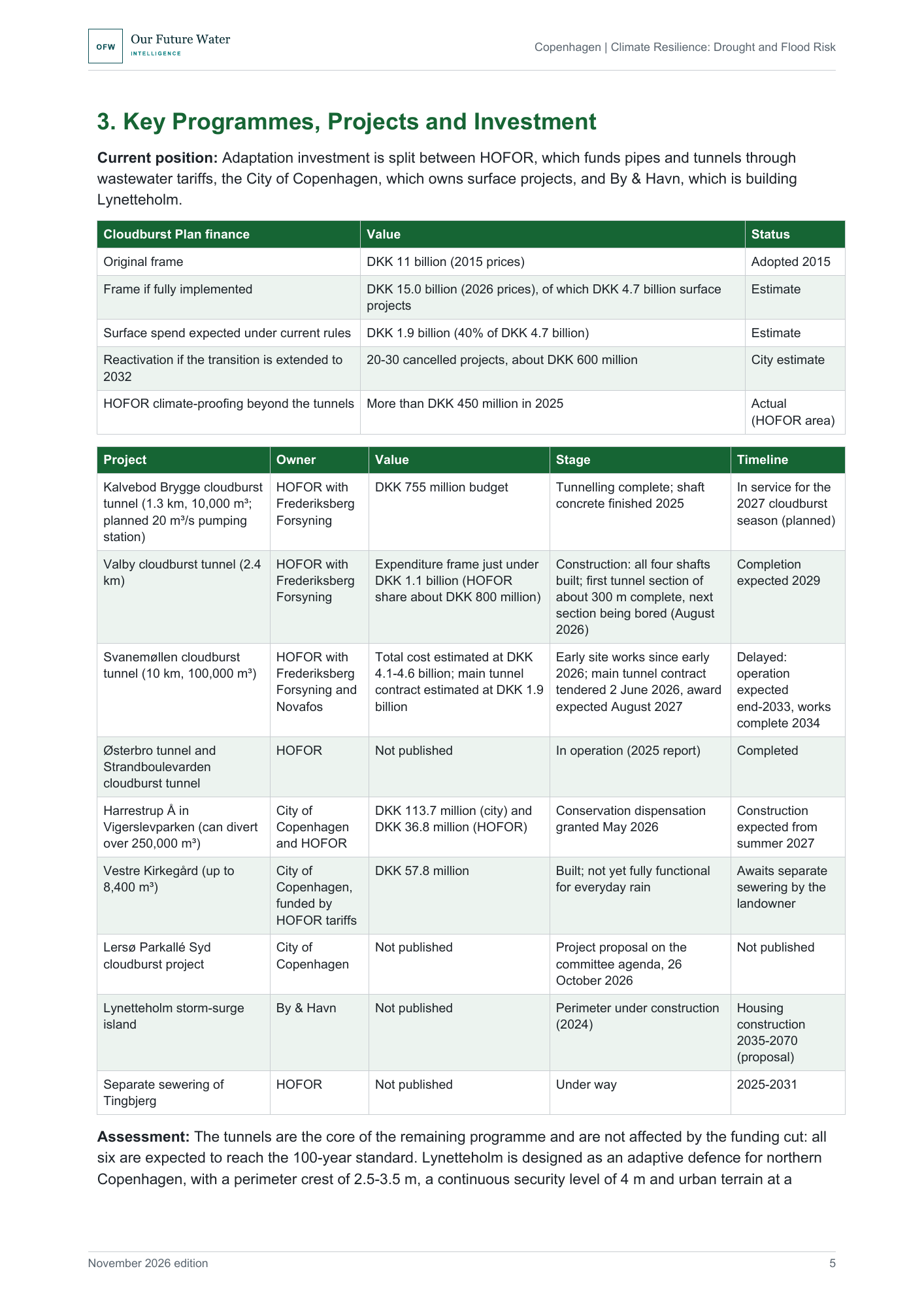
Section 3: Cloudburst Plan finance and the adaptation project table, with owner, value, stage and timeline.
06
Included
What you receive
The complete PDF report: 10 pages, 9 sections, 10 tables and a register of 12 sources.
This edition
November 2026, First edition.
07
Evidence & method
Evidence and method
The report draws on the City of Copenhagen's Climate Adaptation Report 2026, council papers on Lynetteholm and the new adaptation strategy, DMI's national climate projections, HOFOR's 2025 annual reports and 2026 drought statements, and the government's October 2026 legislative programme.
Sources
12 sources, listed in the report's source register. Evidence current to 3 November 2026. Principal data periods: DMI national climate projections (2023); Copenhagen sea-level and storm-surge figures (council answer of November 2024, citing Danish Coastal Authority and DMI work of February 2024); Climate Adaptation Report 2026; HOFOR supply and investment figures for 2025; 2026 drought events. All currency is Danish kroner (DKK)..
Evidence boundaries
This report uses authoritative source material available at the stated research cutoff. It distinguishes published facts, calculated values and analytical interpretation. No independent modelling is performed. Forward-looking analysis reflects published plans, documented trends and stated uncertainties. It does not constitute legal, financial, investment or engineering advice.
08
Lead analyst
Robert C. Brears
Founder, Our Future Water Intelligence
Robert C. Brears is a water-security specialist and author whose work examines utility governance, infrastructure investment, climate resilience and long-term water-system change for executive and policy audiences.
- Decision-focused utility intelligence
- Published water-policy author
- Evidence-grounded system analysis
09
Buyer FAQs
Before you purchase
Who can use the report?
Licensed for internal use within one purchasing organization. The PDF and its contents may be shared with colleagues within that organization. External redistribution, resale and public publication are prohibited without permission.
How is the report delivered?
The PDF is available to download immediately after confirmed payment, through our secure delivery system.
Can my organization buy wider access?
Institutional purchasing: For invoice enquiries, multi-organization licensing or broader access requirements, contact Our Future Water Intelligence.
10
Climate Resilience: Drought and Flood Risk in Copenhagen
- Format
- Length
- 10 pages
- Edition
- November 2026, First edition
- Price
- USD 249
11
Report details
Publication details
- Publisher
- Our Future Water Intelligence
- Report family
- Insight Brief
- Edition
- November 2026, First edition
- Format
- Length
- 10 pages
- Reference
- OFW_EXT_CLIMATE_RESILIENCE_DROUGHT_AND_FLOOD_RISK_IN_COPENHAGEN_ad01eeaf6a61
- Evidence current to
- 3 November 2026
14
Explore this report family
More Climate Resilience: Drought and Flood Risk briefs
Explore the same report family covering other cities.
Climate Resilience: Drought and Flood Risk in Amsterdam
- Geography
- Netherlands
- Edition
- November 2026, First edition
- Length
- 11 pages