
01
Executive overview
Key findings
11%: HOFOR's annual supply buffer in 2025, against a desired 20-30%
12 million m³ a year: additional production HOFOR says it needs to be sure of supplying everyone in 2040 (HOFOR analysis, May 2025)
8 of about 50: HOFOR wellfields with production cut because of contamination; Solhøj alone has lost 2 million m³ a year of a 5 million m³ permit since 2021
Under one-fifth: share of the groundwater-forming areas for HOFOR's regional waterworks protected by voluntary agreement after several decades
02
Buyer relevance
Who the report is for
Large water users and site selectors
Judge exposure to peak-period restrictions, which HOFOR's own analysis says may be needed for businesses as well as residents.
Water treatment suppliers
Follow PFAS and pesticide treatment needs, starting with the Thorsbro activated-carbon stage that would let 5 million m³ at Solhøj be used again.
Policy and regulatory advisers
Track the pesticide-ban bill planned for December 2026 and the abstraction-control bill planned for February 2027 against HOFOR's stated priorities.
Investors and lenders to Danish utilities
Weigh the 5-10 million m³ a year margin HOFOR needs against the named projects and their dates.
03
Decision scope
Questions answered
Does Copenhagen have enough water today?
On average yes, but HOFOR's 2025 supply buffer was 11% against a desired 20-30%, and in June 2026 it asked customers to save water while running at full capacity.
What is driving the shortfall?
Contamination has cut output at 8 of about 50 wellfields, including 2 million m³ a year at Solhøj, while HOFOR forecasts use rising by 2 to 8 million m³ by 2040.
Is Copenhagen building desalination or reuse plants?
No; desalination and industrial reuse are options being studied in the DKK 7.5 million Water 2050 project, not planned sources.
When will new supply arrive?
Three new boreholes are expected to add about 170,000 m³ a year from 2027 and the Regnemark waterworks is expected to supply from 2028; the Thorsbro PFAS stage has no published operating date.
04
Inside the report
Inside the complete report
Executive Snapshot
1. Why This Matters Now in Copenhagen
2. Current Position
3. Key Programmes, Projects and Investment
4. Policy, Regulation and Institutions
5. Risks and Constraints
6. Strategic Implications
7. What to Watch
Source Register
05
Public preview
What to watch next
1. Why This Matters Now in Copenhagen
Whether HOFOR reports the 2026 buffer below 11% in its next annual report, expected in spring 2027.
2. Current Position
HOFOR's 2026 production and delivery figures, and whether per-person use rose with the 2026 heat.
3. Key Programmes, Projects and Investment
Operating date for the Thorsbro carbon stage; first findings from Water 2050 (running to about late 2029).
4. Policy, Regulation and Institutions
The pesticide bill's introduction and passage; how abstraction permits are reviewed under the planned February 2027 bill.
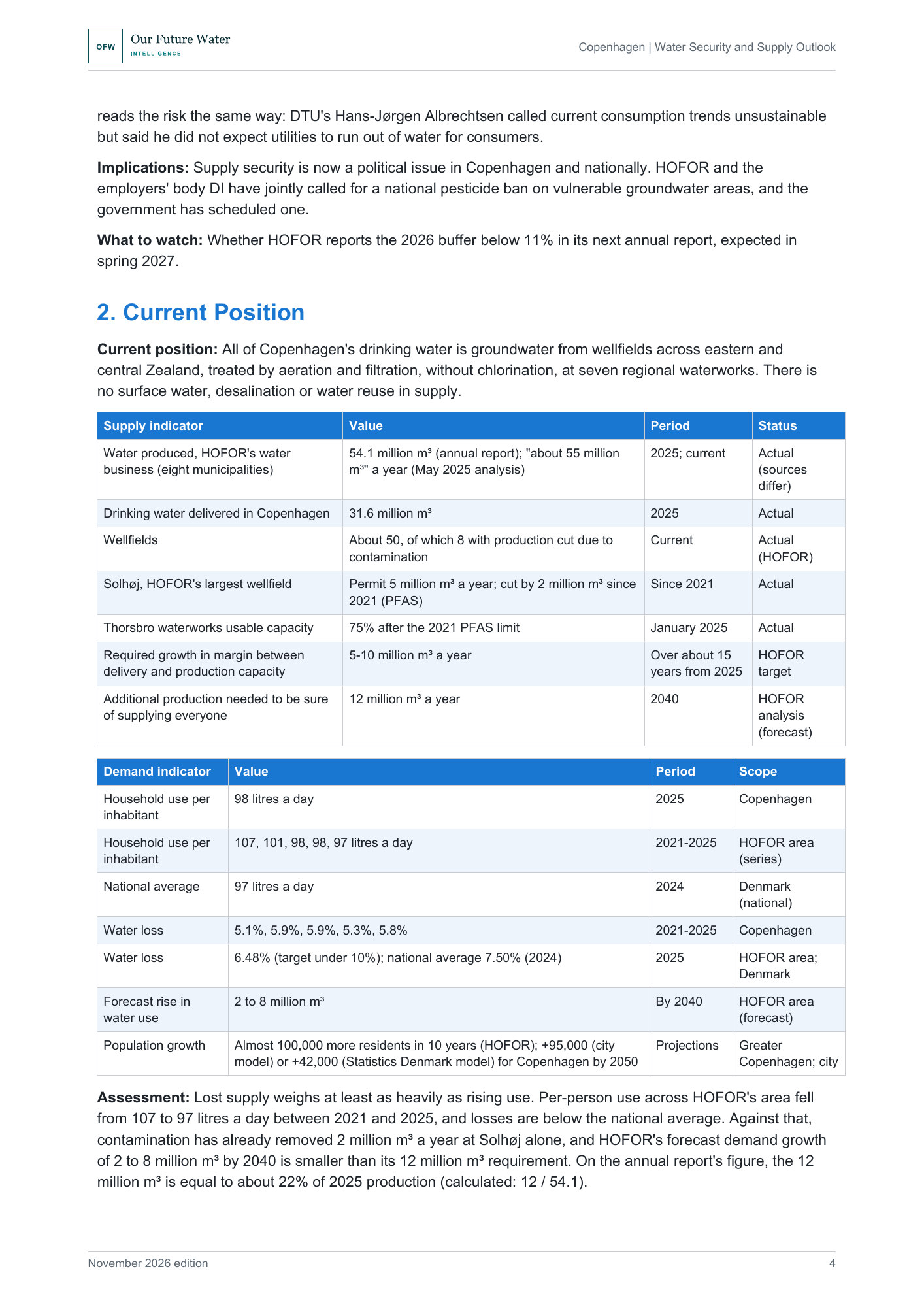
Section 2: supply and demand tables, with output, wellfield losses, per-person use, water loss and the 2040 requirement.
06
Included
What you receive
The complete PDF report: 10 pages, 9 sections, 10 tables and a register of 18 sources.
This edition
November 2026, First edition.
07
Evidence & method
Evidence and method
The report draws on HOFOR's 2025 annual report, its May 2025 supply analysis and white paper chapter, its June 2026 drought appeal, City of Copenhagen papers on groundwater afforestation, the Thorsbro procurement notice, DANVA benchmarking, DTU expert commentary and the government's October 2026 legislative programme.
Sources
18 sources, listed in the report's source register. Evidence current to 3 November 2026. Principal data periods: HOFOR operations for 2025; HOFOR supply analysis of May 2025 (horizon 2040); drought and demand statements of June and September 2026; groundwater protection figures to November 2025; national legislative programme of October 2026. All currency is Danish kroner (DKK)..
Evidence boundaries
This report uses authoritative source material available at the stated research cutoff. It distinguishes published facts, calculated values and analytical interpretation. No independent modelling is performed. Forward-looking analysis reflects published plans, documented trends and stated uncertainties. It does not constitute legal, financial, investment or engineering advice.
08
Lead analyst
Robert C. Brears
Founder, Our Future Water Intelligence
Robert C. Brears is a water-security specialist and author whose work examines utility governance, infrastructure investment, climate resilience and long-term water-system change for executive and policy audiences.
- Decision-focused utility intelligence
- Published water-policy author
- Evidence-grounded system analysis
09
Buyer FAQs
Before you purchase
Who can use the report?
Licensed for internal use within one purchasing organization. The PDF and its contents may be shared with colleagues within that organization. External redistribution, resale and public publication are prohibited without permission.
How is the report delivered?
The PDF is available to download immediately after confirmed payment, through our secure delivery system.
Can my organization buy wider access?
Institutional purchasing: For invoice enquiries, multi-organization licensing or broader access requirements, contact Our Future Water Intelligence.
10
Water Security and Supply Outlook in Copenhagen
- Format
- Length
- 10 pages
- Edition
- November 2026, First edition
- Price
- USD 249
11
Report details
Publication details
- Publisher
- Our Future Water Intelligence
- Report family
- Insight Brief
- Edition
- November 2026, First edition
- Format
- Length
- 10 pages
- Reference
- OFW_EXT_WATER_SECURITY_AND_SUPPLY_OUTLOOK_IN_COPENHAGEN_2dcf7880e913
- Evidence current to
- 3 November 2026
14
Explore this report family
More Water Security and Supply Outlook briefs
Explore the same report family covering other cities.
Water Security and Supply Outlook in Amsterdam
- Geography
- Netherlands
- Edition
- November 2026, First edition
- Length
- 10 pages