
01
Executive overview
Key findings
A$1,175.1 million: capital expenditure allowance for 1 July 2026 to 30 June 2030, against A$1,573.5 million proposed (approved, nominal)
About A$1.2 billion: what TasWater says it will invest over 2026–2030, with about A$500 million of works deferred (utility statement, September 2026)
A$371.7 million: total capital expenditure in FY 2024-25, including gifted assets and developer charges, against a target of A$386.6 million (actual)
56.3%: net debt to equity at 30 June 2025, up from 45.4% a year earlier (actual)
02
Buyer relevance
Who the report is for
Civil and wastewater contractors
Judge whether to pursue framework membership or subcontracting for work such as the Ti Tree Bend transformation, proposed at A$356 million and still in environmental assessment.
Dam engineering firms
Time an approach on Ridgeway Dam, where site investigations finished in October 2026 and a preferred option for a A$143.8 million proposal is still to be chosen.
SCADA, metering and ICT suppliers
Size the technology lines, such as electrical and SCADA renewals assumed at A$59 million against A$87 million proposed, and track open tenders like Service Desk as a Service, closing 19 November 2026.
Chemical and operational service suppliers
Follow the two-stage treatment chemicals tender, whose first stage closed on 5 August 2026, and other operational notices.
03
Decision scope
Questions answered
How much will TasWater spend on capital works to 2030?
The Regulator allowed A$1,175.1 million for 1 July 2026 to 30 June 2030; TasWater says it will invest about A$1.2 billion and has deferred about A$500 million of works.
How does TasWater buy capital work now?
Through seven delivery frameworks that replaced the Capital Delivery Office alliance after its agreements expired on 30 June 2025; GHD holds the A$100 million Engineering, Planning and Design Framework.
Which projects are largest?
Ti Tree Bend at A$356 million proposed, Ridgeway Dam at A$143.8 million and the Water Efficiency Program at A$101 million lead TasWater's proposal.
How strong are TasWater's finances?
Net debt to equity rose from 45.4% to 56.3% at 30 June 2025, the year capital expenditure reached A$371.7 million.
04
Inside the report
Inside the complete report
1. The Account at a Glance
2. Organisation and Decision-Making
3. Financial Position
4. Priorities and Pressures
5. How TasWater Buys
6. Opportunity Register
7. Commercial Priorities: Where to Focus First
8. Watch List: What to Monitor and What to Do
Source Register
05
Public preview
What to watch next
Which projects make up the A$500 million deferral
Determines which proposed projects are live before 2030.
Framework appointments
The Medium Projects partners are not yet announced; seven frameworks carry new capital work.
Ti Tree Bend environmental decision
Precedes any construction contract for the largest proposed project.
Ridgeway Dam preferred option
Sets scope and procurement route for a A$143.8 million proposal.
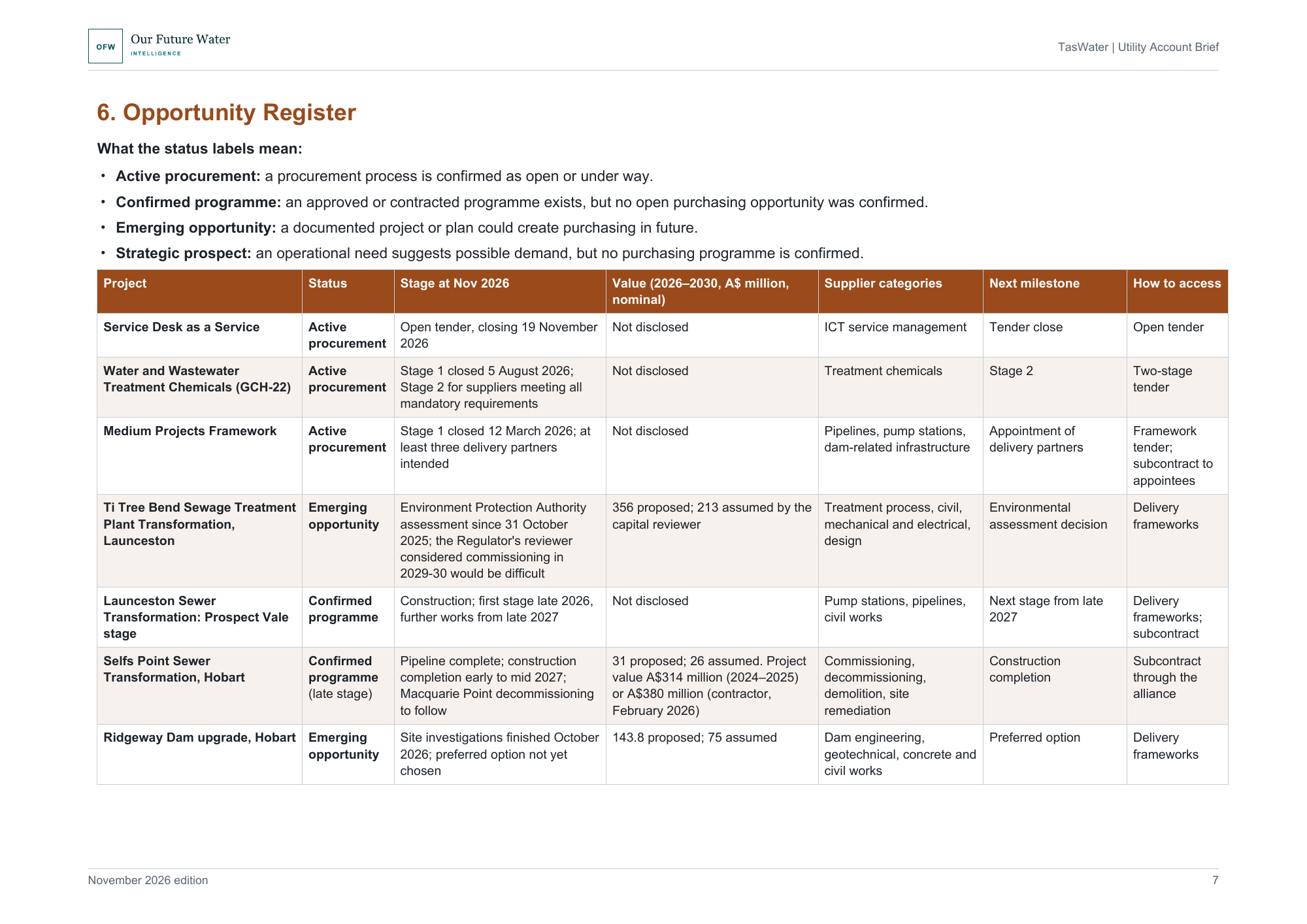
Section 6: the Opportunity Register, with each project's status, stage at November 2026, value and route to access.
06
Included
What you receive
The complete PDF report: 11 pages, 9 sections, 7 tables and a register of 26 sources.
This edition
November 2026, First edition.
07
Evidence & method
Evidence and method
The brief draws on the Tasmanian Economic Regulator's 2026 price determination and its independent capital and operating expenditure reviews, the Regulator's annual industry reports, TasWater's performance reports and Price and Service Plan, and Auditor-General reports, with procurement and project status checked against tender notices, contractor and TasWater project pages and news sources on 7 November 2026.
Sources
26 sources, listed in the report's source register. Evidence current to 7 November 2026. Principal data periods: FY 2024-25 results (year ended 30 June 2025); the price determination for 1 July 2026 to 30 June 2030 (30 April 2026). Project and procurement status checked against public sources on 7 November 2026. All currency is Australian dollars (A$)..
08
Lead analyst
Robert C. Brears
Founder, Our Future Water Intelligence
Robert C. Brears is a water-security specialist and author whose work examines utility governance, infrastructure investment, climate resilience and long-term water-system change for executive and policy audiences.
- Decision-focused utility intelligence
- Published water-policy author
- Evidence-grounded system analysis
09
Buyer FAQs
Before you purchase
Who can use the report?
Licensed for internal use within one purchasing organization. The PDF and its contents may be shared with colleagues within that organization. External redistribution, resale and public publication are prohibited without permission.
How is the report delivered?
The PDF is available to download immediately after confirmed payment, through our secure delivery system.
Can my organization buy wider access?
Institutional purchasing: For invoice enquiries, multi-organization licensing or broader access requirements, contact Our Future Water Intelligence.
10
TasWater: Utility Account Brief
- Format
- Length
- 11 pages
- Edition
- November 2026, First edition
- Price
- USD 499
11
Report details
Publication details
- Publisher
- Our Future Water Intelligence
- Report family
- Utility Account Brief
- Edition
- November 2026, First edition
- Format
- Length
- 11 pages
- Reference
- OFW_EXT_TASWATER_UTILITY_ACCOUNT_BRIEF_eede090eedce
- Evidence current to
- 7 November 2026
14
Explore this report family
More Utility Account Briefs
Explore the same report family covering other utilities.
Berliner Wasserbetriebe: Utility Account Brief
- Geography
- Berliner Wasserbetriebe
- Edition
- October 2026, First edition
- Length
- 12 pages
Department of Energy, Abu Dhabi Emirate: Utility Account Brief
- Geography
- Department of Energy, Abu Dhabi Emirate
- Edition
- October 2026, First edition
- Length
- 12 pages
Utility Account Brief
Denver Water: Utility Account Brief
- Geography
- Denver, United States
- Edition
- October 2026
- Length
- 10 pages