
01
Executive overview
Key findings
10 of 110: sewage treatment plants that met all environmental licence conditions (utility statement, 2025)
5 dams: above the national limit of tolerability for societal risk in each year from FY 2022-23 to FY 2024-25 (actual)
A$1,950.9 million: revenue allowance for 1 July 2026 to 30 June 2030, against A$2,252.4 million proposed (approved)
About A$500 million: capital works TasWater says it is deferring over 2026–2030 after the price decision (utility statement, September 2026)
02
Buyer relevance
Who the report is for
Wastewater treatment contractors and equipment suppliers
Follow the Hobart and Launceston consolidation projects: Selfs Point, due to finish construction in early to mid 2027, and Ti Tree Bend, proposed at A$356 million and still in environmental assessment.
Dam engineering and safety specialists
Track the five dams above the societal-risk limit, including Pet Dam, scheduled for construction to December 2027, and Ridgeway Dam, where a preferred option is still to be chosen.
Council owners and local government advisers
See how dividends of A$24 million a year, the State Government's minority stake and the 5.7% price path interact with a program trimmed by about A$500 million.
Infrastructure investors and policy analysts
Compare the A$1,175.1 million capital allowance with the A$1,673.5 million proposed and net debt to equity of 56.3% in FY 2024-25.
03
Decision scope
Questions answered
How many of TasWater's sewage treatment plants comply with their licences?
TasWater stated in 2025 that 10 of its 110 sewage treatment plants met all environmental licence conditions.
How much will TasWater invest from July 2026?
The Regulator allowed A$1,175.1 million of capital expenditure for 2026–2030; in September 2026 TasWater said it would invest about A$1.2 billion and defer about A$500 million of works.
Is Tasmania's drinking water safe?
TasWater achieved full microbiological compliance for the seventh consecutive year in FY 2024-25, and chemical compliance reached 99.7% of the population.
Which TasWater dams are above the safety limit?
Five dams were above the national limit of tolerability for societal risk from FY 2022-23 to FY 2024-25: Ridgeway, Pet, Blackmans Bay No. 2, Upper Prosser and Lower Prosser.
How much water does TasWater lose?
Unaccounted-for water was between 21.4% and 23% of sourced potable water in FY 2024-25, depending on the report, down from about 33% in FY 2015-16.
04
Inside the report
Inside the complete report
Executive Overview
1. Water Resource Profile
2. Governance and Institutional Framework
3. Infrastructure and Service Delivery
Strategic Outlook and Opportunities
Source Register
05
Public preview
What to watch next
1. Water Resource Profile
Unaccounted-for water against the 2026–2030 standard of 20.0% in 2026-27; whether the per person use target is adopted; any recurrence of chemical exceedances in individual systems.
2. Governance and Institutional Framework
The Public Accounts Committee report; owners' decisions on dividends under the new price path; the State Government's remaining equity contributions under the 2018 arrangement.
3. Infrastructure and Service Delivery
The number of plants meeting all licence conditions in the FY 2025-26 performance report; sewer break rates against the new standard of 60 per 100 km; capital expenditure in FY 2025-26, the last year of the 2022–2026 period.
Strategic Outlook and Opportunities
Which projects make up the A$500 million deferral; the final scope of the Ti Tree Bend transformation; the preferred option for Ridgeway Dam; Selfs Point completion in 2027; the permanent solution for non-residential sewerage charges and its revenue effect; TasWater's FY 2025-26 annual results, including net debt to equity.
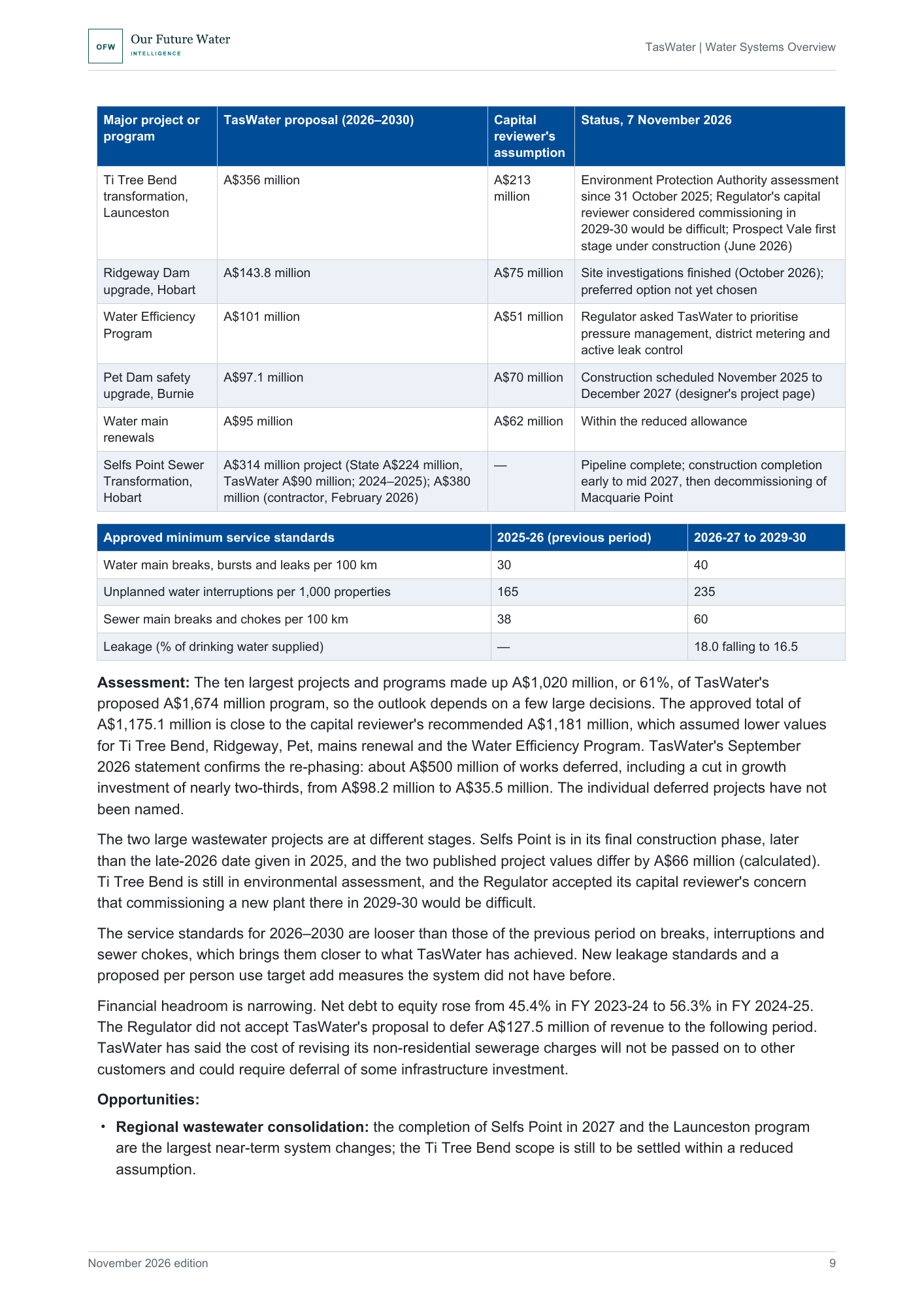
Strategic Outlook: TasWater's major projects for 2026–2030, proposal against the capital reviewer's assumption, with status at 7 November 2026.
06
Included
What you receive
The complete PDF report: 12 pages, 6 sections, 16 tables and a register of 30 sources.
This edition
November 2026, First edition.
07
Evidence & method
Evidence and method
The report draws on the Tasmanian Economic Regulator's annual industry reports from FY 2015-16 to FY 2024-25, TasWater's annual performance reports and Price and Service Plans, the 2026 price determination with its independent capital and operating expenditure reviews, and Auditor-General reports, with 2026 project and pricing developments checked against TasWater, contractor, news and parliamentary sources.
Sources
30 sources, listed in the report's source register. Evidence current to 7 November 2026. Principal data periods: FY 2015-16 to FY 2024-25 regulatory and performance results (years ended 30 June); the price determination for 1 July 2026 to 30 June 2030 (30 April 2026); developments to 7 November 2026. All currency is Australian dollars (A$)..
Evidence boundaries
This report uses authoritative source material available at the stated research cutoff. It distinguishes published facts, calculated values and analytical interpretation. No independent modelling is performed. Forward-looking analysis reflects published plans, documented trends and stated uncertainties. It does not constitute legal, financial, investment or engineering advice.
08
Lead analyst
Robert C. Brears
Founder, Our Future Water Intelligence
Robert C. Brears is a water-security specialist and author whose work examines utility governance, infrastructure investment, climate resilience and long-term water-system change for executive and policy audiences.
- Decision-focused utility intelligence
- Published water-policy author
- Evidence-grounded system analysis
09
Buyer FAQs
Before you purchase
Who can use the report?
Licensed for internal use within one purchasing organization. The PDF and its contents may be shared with colleagues within that organization. External redistribution, resale and public publication are prohibited without permission.
How is the report delivered?
The PDF is available to download immediately after confirmed payment, through our secure delivery system.
Can my organization buy wider access?
Institutional purchasing: For invoice enquiries, multi-organization licensing or broader access requirements, contact Our Future Water Intelligence.
10
Water Systems Overview: TasWater
- Format
- Length
- 12 pages
- Edition
- November 2026, First edition
- Price
- USD 499
11
Report details
Publication details
- Publisher
- Our Future Water Intelligence
- Report family
- Water Utility Intelligence Report
- Edition
- November 2026, First edition
- Format
- Length
- 12 pages
- Reference
- OFW_EXT_WATER_SYSTEMS_OVERVIEW_TASWATER_bd232e02e08f
- Evidence current to
- 7 November 2026
14
Explore this report family
More Water Systems Overview reports
Explore the same report family covering other utilities.
Water Systems Overview: Aguas Andinas
- Geography
- Greater Santiago, Metropolitan Region, Chile
- Edition
- November 2026, corrected edition
- Length
- 11 pages
Water Systems Overview: Berliner Wasserbetriebe
- Geography
- Berliner Wasserbetriebe
- Edition
- October 2026, First edition
- Length
- 11 pages
Water Systems Overview: Department of Energy, Abu Dhabi Emirate
- Geography
- Department of Energy, Abu Dhabi Emirate
- Edition
- October 2026, First edition
- Length
- 14 pages