01
Executive overview
Key findings
50,000 acre-feet: Nevada's reduction in each of 2027 and 2028 under the federal decision of August 21, 2026, assuming the Lower Basin sharing agreement, against 21,000 acre-feet under the current Tier 1 shortage
About 198,000 acre-feet: Southern Nevada's Colorado River use in 2025, down from about 212,000 acre-feet in 2024
US$2.0–2.7 billion: current estimated construction cost of the whole Horizon Lateral Program; Phase I construction is expected to start in early 2027
US$705.3 million: capital sources in the FY 2026-27 tentative budget, including a projected US$512.1 million debt issue
02
Buyer relevance
Who the report is for
Engineering and construction firms
Locate the transmission, pumping and storage work in the Horizon Lateral Program, now estimated at US$2.0–2.7 billion, and the Garnet Valley systems.
Municipal bond analysts
Set the October 2026 bond sale and 5.47 times FY 2024 debt coverage against the Colorado River constraints KBRA lists as a credit risk.
Colorado River basin agencies and policy teams
Compare Southern Nevada's 2023–2025 river use with the 50,000 acre-foot reduction Nevada faces in 2027 and 2028.
Water technology and treatment suppliers
Understand the scale of a system with two ozone treatment facilities, 1,000 mgd of ozone capacity and 28 pumping plants.
03
Decision scope
Questions answered
How much Colorado River water does Southern Nevada use against its allocation?
About 198,000 acre-feet in 2025, against an allocation of 250,000 acre-feet after Nevada's 50,000 acre-foot reduction in 2027 and 2028, if the Lower Basin sharing agreement is implemented.
Who governs the Southern Nevada Water Authority?
A Board with one director from each of seven member agencies; the Authority has no employees of its own and cannot levy property taxes.
What does the Horizon Lateral now cost?
The Authority estimates US$2.0–2.7 billion for the whole program, against US$1,596.7 million in the 2020 capital plan, with Phase I construction expected from early 2027.
How large is the capital budget?
Capital sources in the FY 2026-27 tentative budget are US$705.3 million, including a projected US$512.1 million debt issue.
04
Inside the report
Inside the complete report
Executive Overview
1. Water Resource Profile
2. Governance and Institutional Framework
3. Infrastructure and Service Delivery
Strategic Outlook and Opportunities
Source Register
05
Public preview
What to watch next
1. Water Resource Profile
Reclamation's monthly 24-Month Study projections for Lake Mead; the Lower Basin sharing agreement on which Nevada's 50,000 acre-foot figure depends; Southern Nevada's calendar 2026 Colorado River use against the 2026 Tier 1 allocation.
2. Governance and Institutional Framework
Court rulings on the preliminary injunction and class certification before the January 1, 2027 turf deadline; ratings commentary on the allocation risk KBRA flagged; any change to the Wholesale Delivery Charge (the latest verified rate is the FY 2024 figure).
3. Infrastructure and Service Delivery
Start of Horizon Lateral Phase I construction in early 2027; FY 2025 statistical updates to deliveries and population; Lake Mead elevations against the operating range of the intakes and the low-lake pumping station.
Strategic Outlook and Opportunities
An updated Major Construction and Capital Plan with current Horizon Lateral costs; the FY 2027-28 budget and any change to Authority charges; the Phase I construction start; negotiated volumes and prices under the San Diego agreement; Reclamation's next operating guidelines for 2029 and later.
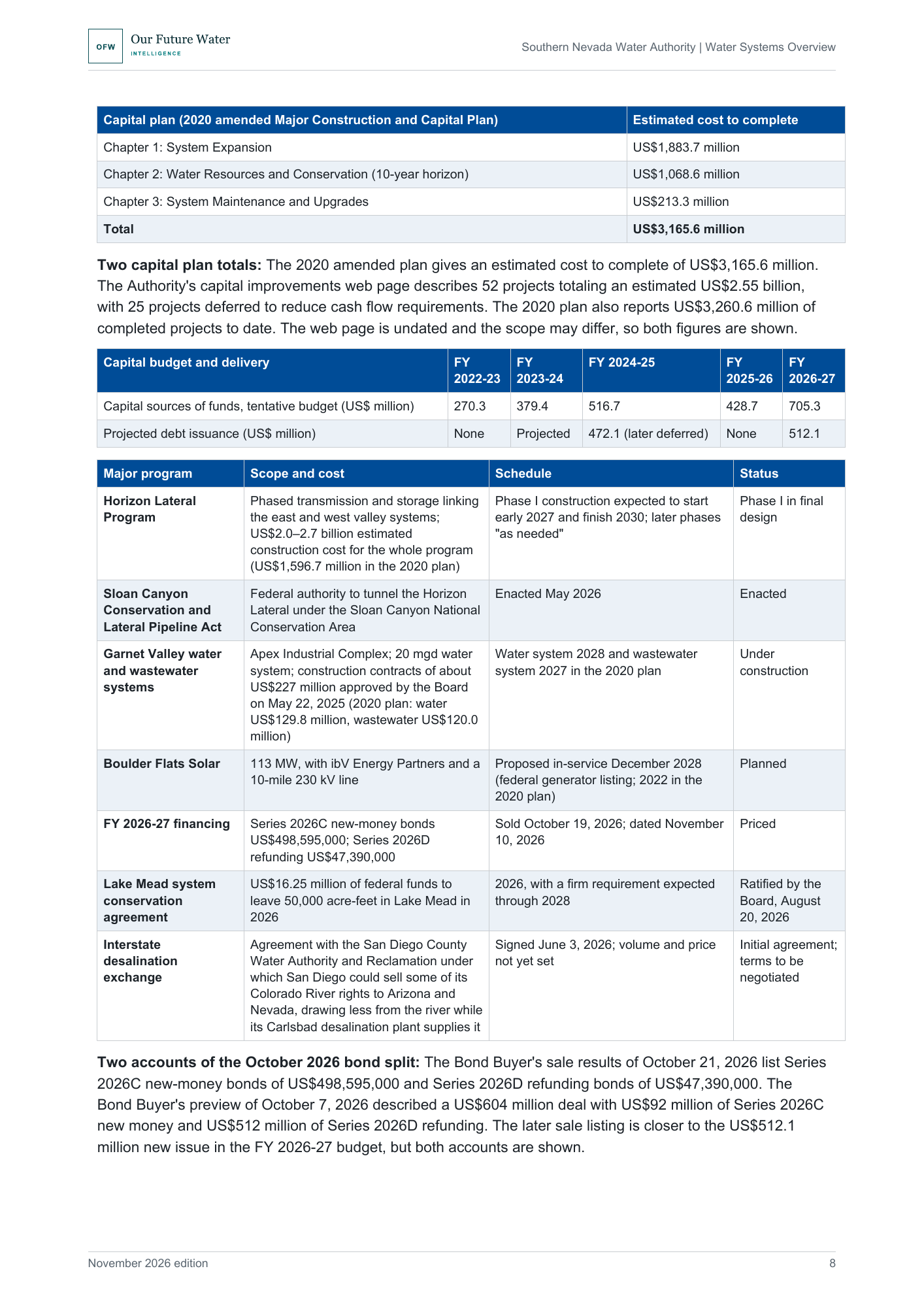
Strategic Outlook: capital budgets FY 2022-23 to FY 2026-27 and the status of the Authority's major programs.
06
Included
What you receive
The complete PDF report: 11 pages, 6 sections, 11 tables and a register of 25 sources.
This edition
November 2026, First edition.
07
Evidence & method
Evidence and method
The report draws on the Authority's audited annual financial reports for FY 2021 to FY 2025, its operating and capital budgets, the 2020 amended Major Construction and Capital Plan, its water resource and conservation plans and 2026 water quality summaries. It also uses US Bureau of Reclamation and Colorado River Commission of Nevada publications, rating agency releases and 2026 news reports on bonds, litigation and Lake Mead.
Sources
25 sources, listed in the report's source register. Evidence current to 4 November 2026. Principal data periods: FY 2025 audited results (year ended June 30, 2025); FY 2026-27 budget; calendar 2024 and 2025 Colorado River use; federal Colorado River decisions to August 2026. All currency is US dollars..
Evidence boundaries
This report uses authoritative source material available at the stated research cutoff. It distinguishes published facts, calculated values and analytical interpretation. No independent modelling is performed. Forward-looking analysis reflects published plans, documented trends and stated uncertainties. It does not constitute legal, financial, investment or engineering advice.
08
Lead analyst
Robert C. Brears
Founder, Our Future Water Intelligence
Robert C. Brears is a water-security specialist and author whose work examines utility governance, infrastructure investment, climate resilience and long-term water-system change for executive and policy audiences.
- Decision-focused utility intelligence
- Published water-policy author
- Evidence-grounded system analysis
09
Buyer FAQs
Before you purchase
Who can use the report?
Licensed for internal use within one purchasing organization. The PDF and its contents may be shared with colleagues within that organization. External redistribution, resale and public publication are prohibited without permission.
How is the report delivered?
The PDF is available to download immediately after confirmed payment, through our secure delivery system.
Can my organization buy wider access?
Institutional purchasing: For invoice enquiries, multi-organization licensing or broader access requirements, contact Our Future Water Intelligence.
10
Water Systems Overview: Southern Nevada Water Authority
- Format
- Length
- 11 pages
- Edition
- November 2026, First edition
- Price
- USD 499
11
Report details
Publication details
- Publisher
- Our Future Water Intelligence
- Report family
- Water Utility Intelligence Report
- Edition
- November 2026, First edition
- Format
- Length
- 11 pages
- Reference
- OFW_EXT_WATER_SYSTEMS_OVERVIEW_SOUTHERN_NEVADA_WATER_AUTHORITY_0d99ccd34b8d
- Evidence current to
- 4 November 2026
14
Explore this report family
More Water Systems Overview reports
Explore the same report family covering other utilities.
Water Systems Overview: Aguas Andinas
- Geography
- Greater Santiago, Metropolitan Region, Chile
- Edition
- November 2026, corrected edition
- Length
- 11 pages
Water Systems Overview: Berliner Wasserbetriebe
- Geography
- Berliner Wasserbetriebe
- Edition
- October 2026, First edition
- Length
- 11 pages
Water Systems Overview: Department of Energy, Abu Dhabi Emirate
- Geography
- Department of Energy, Abu Dhabi Emirate
- Edition
- October 2026, First edition
- Length
- 14 pages