
01
Executive overview
Key findings
40%: cut in network water losses targeted by 2035 under the DoE's Integrated Water Sector Strategy (November 2025), alongside a 32% demand-efficiency improvement by 2030
6% → 45%: reverse osmosis share of water generation at EWEC-contracted plants, 2014 to 2025 (actual); the DoE aims for reverse osmosis to supply nearly all desalination by 2035 (as reported in September 2026)
AED 250 billion: committed over 10 years to power, water and district cooling networks (DoE Chairman, September 2026); Semafor separately reports 300 billion dirhams by 2035
500 million m³: targeted cut in groundwater abstraction by 2030; projects covering half of it had been identified by October 2026
02
Buyer relevance
Who the report is for
Network contractors and technology suppliers
Size the distribution control, monitoring and loss-reduction work implied by the 40% loss target for 2035 and track when the next price control sets its funding.
Desalination and power developers and lenders
Follow the status of Mirfa 2, Shuweihat S4, Saadiyat Island, Future RO and the solar, storage and gas projects contracted by EWEC through 2029.
Agricultural water and metering suppliers
Read the farm-side commitments, from the 80-meter pilot and 18 model farms to the 500 million m³ groundwater cut by 2030.
Government and regulatory strategy teams
Compare the Department of Energy's 2030 and 2035 targets with its regulatory instruments, the RC2 allowances and the AED 250 billion network commitment.
03
Decision scope
Questions answered
What has the Department of Energy committed to for water networks?
A 40% cut in network water losses by 2035 under the Integrated Water Sector Strategy launched in November 2025; transmission losses were 2.34% in 2023 against a 2% threshold.
How far has the shift to reverse osmosis gone?
Reverse osmosis rose from 6% of water generation at EWEC-contracted plants in 2014 to 45% in 2025, and the Department of Energy aims for nearly all desalination to use it by 2035.
How large is the investment commitment?
The Department of Energy Chairman committed AED 250 billion over 10 years to power, water and district cooling networks in September 2026; Semafor separately reported 300 billion dirhams by 2035.
What happens to the network price control?
RC2 runs to December 31, 2026, with capex allowances of AED 16,202 million over 2023–2026; no RC3 consultation or decision published as of November 15, 2026.
04
Inside the report
Inside the complete report
Executive Snapshot
1. From Service Provider to System Operator
2. System Intelligence and Digital Control
3. Energy, Carbon, and Resource Decoupling
4. Infrastructure Strategy for a Non-Stationary Climate
5. Customers, Demand, and the Water Prosumer
6. Governance, Regulation, and Institutional Reform
7. Capital Planning and Financial Architecture
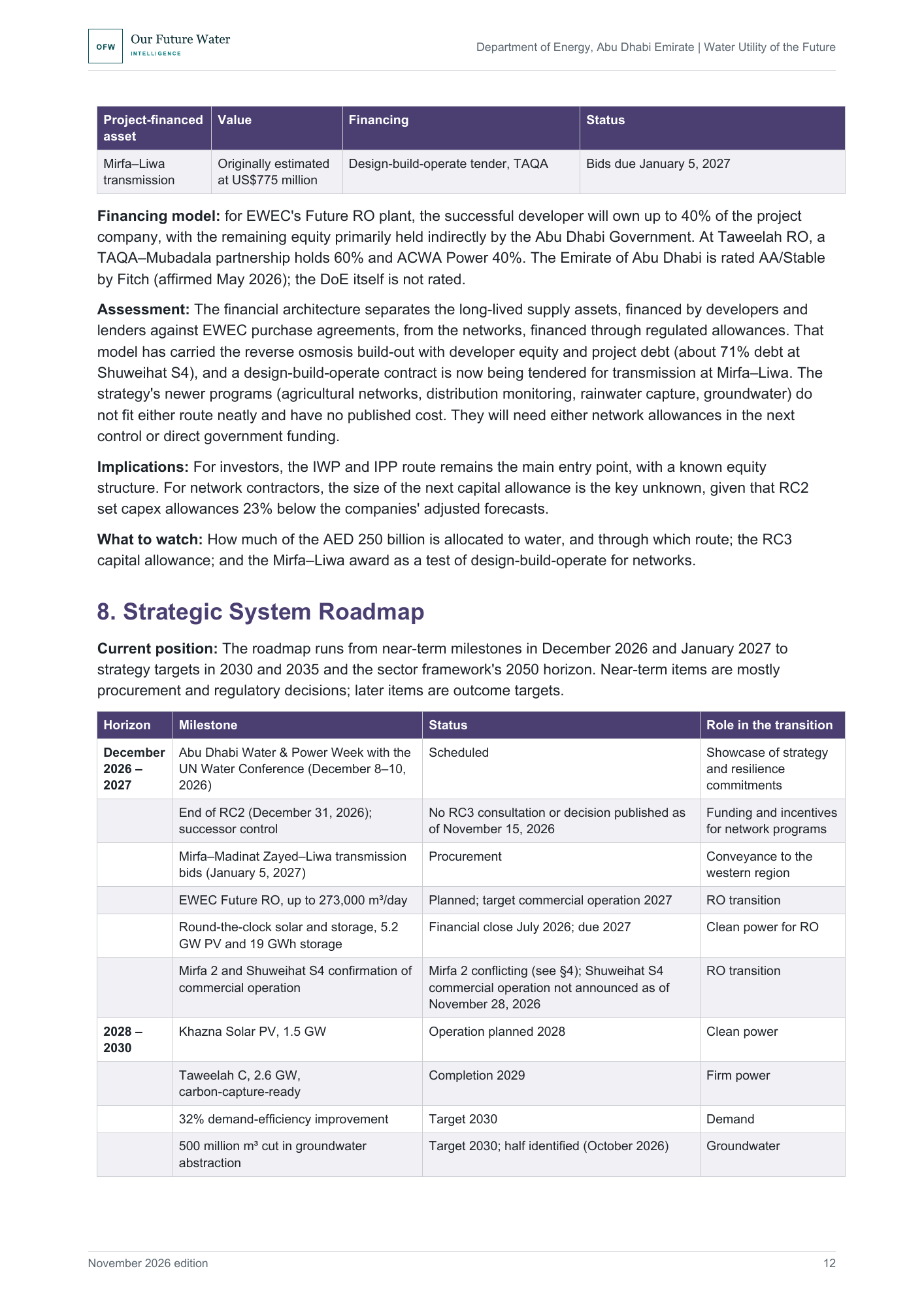
8. Strategic System Roadmap
Conclusion
Source Register
05
Public preview
What to watch next
1. From Service Provider to System Operator
Publication of the strategy's five programs with owners and budgets; the outcomes announced at Abu Dhabi Water & Power Week in December 2026; and whether the next price control carries the 2035 loss target as a regulatory obligation.
4. Infrastructure Strategy for a Non-Stationary Climate
Confirmation of commercial operation at Mirfa 2 and Shuweihat S4; any EWEC decision on Saadiyat Island; the Mirfa–Liwa bid outcome after January 5, 2027; and a published baseline and progress figure for the groundwater target.
6. Governance, Regulation, and Institutional Reform
The RC3 consultation and decision, especially capital allowances, cost of capital and any loss or monitoring incentives; how a successor control treats the merged TAQA Distribution business; and the measures attached to the resilience framework's governance pillar.
7. Capital Planning and Financial Architecture
How much of the AED 250 billion is allocated to water, and through which route; the RC3 capital allowance; and the Mirfa–Liwa award as a test of design-build-operate for networks.
The strategic system roadmap, from the December 2026 milestones to the 2035 targets and the 2050 framework.
06
Included
What you receive
The complete PDF report: 16 pages, 11 sections, 18 tables and a register of 25 sources.
This edition
November 2026, New edition.
07
Evidence & method
Evidence and method
The report draws on EWEC statistical reports for 2024 and 2025, EWEC capacity statements and its 2023 decarbonisation report, the Department of Energy's annual technical reports and price control decisions, and Department of Energy and Abu Dhabi Media Office releases on the 2025 water strategy, the 2026 resilience framework and digital programs. Project and procurement status comes from EWEC, developer and trade press sources checked on November 28, 2026.
Sources
25 sources, listed in the report's source register. Evidence current to 28 November 2026. Principal data periods: calendar 2025 EWEC production, carbon and demand statistics (forecasts to 2033); calendar 2023 DoE technical report (networks, service performance, recycled water); RC2 price control 2023–2026; Integrated Water Sector Strategy (November 2025) and its October 2026 progress review; project, procurement and policy status checked on November 28, 2026. Currency is UAE dirhams (AED); US dollar (US$) values are given where the source reports them.
Evidence boundaries
This report uses authoritative source material available at the stated research cutoff. It distinguishes published facts, calculated values and analytical interpretation. No independent modelling is performed. Forward-looking analysis reflects published plans, documented trends and stated uncertainties. It does not constitute legal, financial, investment or engineering advice.
08
Lead analyst
Robert C. Brears
Lead Analyst, Our Future Water Intelligence
Robert C. Brears is a water-security specialist and author whose work examines utility transformation, infrastructure, governance, finance and climate resilience for executive and policy audiences.
- Evidence-led water intelligence
- Decision-focused system analysis
- Report-specific treatment of scope and terminology
09
Buyer FAQs
Before you purchase
Who can use the report?
Licensed for internal use within one purchasing organization. The PDF and its contents may be shared with colleagues within that organization. External redistribution, resale and public publication are prohibited without permission.
How is the report delivered?
The PDF is available to download immediately after confirmed payment, through our secure delivery system.
Can my organization buy wider access?
Institutional purchasing: For invoice enquiries, multi-organization licensing or broader access requirements, contact Our Future Water Intelligence.
10
Water Utility of the Future: Department of Energy, Abu Dhabi Emirate
- Format
- Length
- 16 pages
- Edition
- November 2026, New edition
- Price
- USD 499
11
Report details
Publication details
- Publisher
- Our Future Water Intelligence
- Report family
- Water Utility Intelligence Report
- Report type
- Water Utility of the Future
- Edition
- November 2026, New edition
- Format
- Length
- 16 pages
- Reference
- OFW-WUF-DOE-ABU-DHABI_af410908acaa
- Evidence current to
- 28 November 2026
14
Explore this report family
More Water Utility of the Future reports
Explore the same report family covering other utilities.
Water Utility of the Future
Water Utility of the Future: Water and Sanitation Directorate, City of Cape Town
- Geography
- Cape Town, South Africa
- Edition
- November 2026, New edition
- Length
- 14 pages
Water Utility of the Future
Water Utility of the Future: Electricity and Water Authority
- Geography
- Bahrain, Middle East
- Edition
- November 2026, New edition
- Length
- 15 pages
Water Utility of the Future
Water Utility of the Future: Watercare Services
- Geography
- New Zealand, Oceania
- Edition
- November 2026, New edition
- Length
- 17 pages