
01
Executive overview
Key findings
1,833 GWh vs 1,747 GWh: renewable electricity K-Water generated against its own on-site consumption; RE100 achievement certified by CDP in May 2026 (utility statement)
56 dams and weirs: covered by K-Water's digital twin water management platform by 2025, from a first basin in 2021
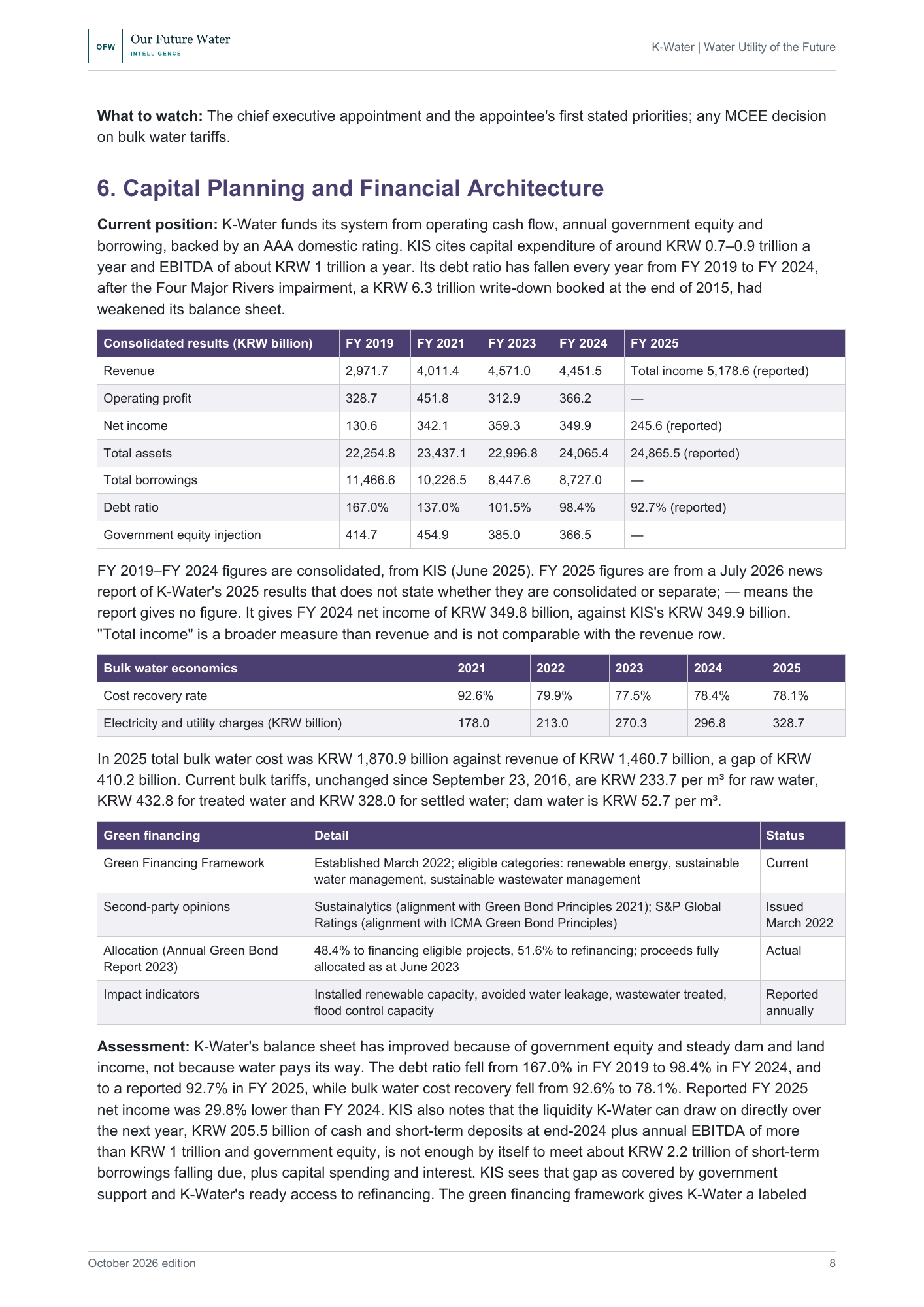
78.1%: bulk water cost recovery in 2025, down from 92.6% in 2021; bulk tariffs unchanged since September 23, 2016
KRW 2.2 trillion: planned total cost of the Yongin semiconductor cluster integrated water supply to 2034, for 1,072,000 tonnes a day; phase 1 construction began September 18, 2026
02
Buyer relevance
Who the report is for
Water and energy ministry officials and board members
Weigh the 2025 bulk water cost gap of KRW 410.2 billion against the tariff frozen since September 23, 2016.
Floating solar developers and power buyers
Plan against the four published 2030 targets, from about 500 MW of floating solar to 10 GW of renewables, side by side.
Contractors bidding on industrial water supply
Track Yongin phase 1 lots of KRW 275.6 billion and KRW 344.9 billion against the May 2029 supply date.
Credit and green bond investors
Follow the debt ratio from 167.0% in FY 2019 to a reported 92.7% in FY 2025 alongside falling water margins.
03
Decision scope
Questions answered
How far has K-Water's digital control gone?
Its digital twin covered 56 dams and weirs by 2025, and 43 multi-regional treatment plants run autonomous operation, with about KRW 11 billion of operating cost saved in 2025 as reported.
Is K-Water's water business paying its way?
No. Bulk water recovered 78.1% of its cost in 2025, down from 92.6% in 2021, and the water supply segment's FY 2024 operating margin was -3.6%.
What happened to the 14 new climate-response dams?
The August 27, 2026 review approved 5 for further study, shifted 2 to alternatives and scrapped 7, cutting estimated cost from KRW 4.75 trillion to about KRW 1.67 trillion.
How much renewable power does K-Water produce?
It produced 1,833 GWh against 1,747 GWh of its own use, and CDP certified its RE100 achievement in May 2026.
04
Inside the report
Inside the complete report
Executive Snapshot
1. From Service Provider to System Operator
2. System Intelligence and Digital Control
3. Energy, Carbon, and Resource Decoupling
4. Infrastructure Strategy for a Non-Stationary Climate
5. Governance, Regulation, and Institutional Reform
6. Capital Planning and Financial Architecture
7. Workforce, Capability, and Organisational Change
8. Strategic System Roadmap
Conclusion
Source Register
05
Public preview
What to watch next
1. From Service Provider to System Operator
Segment results in the FY 2025 and FY 2026 audited accounts, especially whether the water supply margin stays negative.
5. Governance, Regulation, and Institutional Reform
The chief executive appointment and the appointee's first stated priorities; any MCEE decision on bulk water tariffs.
6. Capital Planning and Financial Architecture
FY 2025 audited consolidated accounts and the 2027 budget; any MCEE tariff decision; the next KIS review; green bond issuance and allocation reports.
8. Strategic System Roadmap
Yongin award results and construction progress; a reconciled renewable target; MCEE decisions on tariffs and the five dams.
Capital planning: consolidated results FY 2019 to FY 2025 and bulk water cost recovery
06
Included
What you receive
The complete PDF report: 13 pages, 11 sections, 13 tables and a register of 26 sources.
This edition
October 2026, First edition.
07
Evidence & method
Evidence and method
The report draws on K-Water's sustainability reports, green financing framework and green bond reporting, the June 2025 KIS credit opinion with consolidated FY 2019 to FY 2024 results, and ministry announcements on dams, floating solar and the Yongin supply project. Project, leadership and policy status was checked against Korean news reports to October 31, 2026.
Sources
26 sources, listed in the report's source register. Evidence current to 31 October 2026. Principal data periods: FY 2019–FY 2024 consolidated results (years ended December 31); FY 2025 reported results; 2025–2026 plans and decisions. Project and policy status checked on October 31, 2026. All currency is Korean won (KRW)..
Evidence boundaries
This report uses authoritative source material available at the stated research cutoff. It distinguishes published facts, calculated values and analytical interpretation. No independent modelling is performed. Forward-looking analysis reflects published plans, documented trends and stated uncertainties. It does not constitute legal, financial, investment or engineering advice.
08
Lead analyst
Robert C. Brears
Founder, Our Future Water Intelligence
Robert C. Brears is a water-security specialist and author whose work examines utility governance, infrastructure investment, climate resilience and long-term water-system change for executive and policy audiences.
- Decision-focused utility intelligence
- Published water-policy author
- Evidence-grounded system analysis
09
Buyer FAQs
Before you purchase
Who can use the report?
Licensed for internal use within one purchasing organization. The PDF and its contents may be shared with colleagues within that organization. External redistribution, resale and public publication are prohibited without permission.
How is the report delivered?
The PDF is available to download immediately after confirmed payment, through our secure delivery system.
Can my organization buy wider access?
Institutional purchasing: For invoice enquiries, multi-organization licensing or broader access requirements, contact Our Future Water Intelligence.
10
Water Utility of the Future: K-Water
- Format
- Length
- 13 pages
- Edition
- October 2026, First edition
- Price
- USD 499
11
Report details
Publication details
- Publisher
- Our Future Water Intelligence
- Report family
- Water Utility Intelligence Report
- Edition
- October 2026, First edition
- Format
- Length
- 13 pages
- Reference
- OFW_EXT_WATER_UTILITY_OF_THE_FUTURE_K_WATER_843565c63e2e
- Evidence current to
- 31 October 2026
14
Explore this report family
More Water Utility of the Future reports
Explore the same report family covering other utilities.
Water Utility of the Future
Water Utility of the Future: Thames Water
- Geography
- United Kingdom, Europe
- Edition
- October 2026 edition
- Length
- 15 pages
water utility of the future
Water Utility of the Future: Denver Water
- Geography
- Denver, United States
- Edition
- October 2026, Second edition
- Length
- 13 pages
Water Utility of the Future
Water Utility of the Future: Berliner Wasserbetriebe
- Geography
- Berlin, Germany
- Edition
- 2026 · v3
- Length
- 19 pages