
01
Executive overview
Why this report matters
Summary Insight: Manila Water Company, Inc. is expanding and diversifying the East Zone water system while maintaining low non-revenue water and accelerating wastewater infrastructure delivery. This report examines how the concessionaire implements its MWSS-approved service improvement programme, develops alternative sources under the Four Water System Masterplan, strengthens transmission and distribution capacity, and aligns long-term investment recovery with regulatory rate-rebasing and concession requirements.
This Our Future Water Intelligence report provides an independent assessment of Manila Water Company, Inc.’s concession governance, source-development strategy, network performance, wastewater investment, financial resilience, and long-term response to population growth and climate risk.
Manila Water’s 2025 capital expenditure included PHP 23.64 billion for the East Zone concession, supporting major water-source, treatment, transmission, distribution, wastewater, information-technology, and service-improvement projects.
02
Buyer relevance
Who the report is for
- Utility Executives & System Operators: Assess how Manila Water coordinates bulk allocations, alternative water sources, treatment facilities, transmission systems, district-metered networks, pumping assets, and wastewater infrastructure.
- Regulators & Policymakers: Examine MWSS oversight, rate rebasing, concession obligations, service standards, water security requirements, environmental compliance, and public-private risk allocation.
- Infrastructure Investors & Financiers: Evaluate concession duration, tariff-adjustment mechanisms, capital delivery, debt capacity, operating efficiency, environmental obligations, and long-term cash-flow resilience.
03
Decision scope
Questions answered
How does Manila Water finance its infrastructure programme?
Manila Water funds capital expenditure through internally generated cash, long-term debt, available credit facilities, and financing from local and international institutions. Long-lived water and wastewater assets are matched with longer-term funding, while approved investment recovery operates through the concession's tariff and rate-rebasing mechanisms.
How does the concession framework support long-term investment?
The concession establishes service obligations, performance standards, regulatory review processes, and mechanisms for recovering prudent expenditure. The approved extension of the Revised Concession Agreement to January 2047 provides a longer investment horizon for source-development, network, and wastewater projects with multi-decade asset lives.
How does Manila Water maintain low non-revenue water?
The company combines district metering, network balancing, pressure management, leak detection, pipe rehabilitation, flow monitoring, and active maintenance. These measures kept East Zone non-revenue water below 14 percent at the end of 2025 while supporting continuous service across a dense metropolitan network.
Why is wastewater infrastructure a major capital priority?
Wastewater investment is required to expand sanitation coverage, meet concession commitments, and comply with environmental standards. Delivery therefore depends on coordinated investment in treatment capacity, sewer and interceptor networks, pumping facilities, land access, permitting, and connections to densely developed communities.
04
Inside the report
Analytical coverage
Architectures: Four-system water security and source diversification
Examines how Manila Water coordinates the Angat–La Mesa, Antipolo, Laguna Lake, and East Sources systems to diversify supply. The analysis covers Cardona, East Bay, Calawis, deep wells, portable treatment, backwash recovery, storage, and transmission integration.
Enablement: District metering and network efficiency
Evaluates the district-metered-area model, pressure management, flow monitoring, leakage detection, network balancing, and asset rehabilitation practices used to maintain East Zone non-revenue water at approximately 14 percent.
Resolution: Wastewater treatment and sewerage expansion
Assesses the expansion of sewage-treatment plants, interceptor networks, conveyance systems, pumping infrastructure, and sanitation services required to meet concession commitments and environmental standards.
Alignment: Concession regulation and investment recovery
Analyses how MWSS rate rebasing, tariff adjustments, service targets, capital reviews, and concession rules link customer charges with approved expenditure and long-term infrastructure delivery.
Capability Building: Resilient assets and operational intelligence
Maps how telemetry, operational analytics, emergency sources, facility redundancy, climate-risk assessment, cybersecurity, and workforce capabilities strengthen continuity during droughts, typhoons, earthquakes, and network incidents.
05
Included
What you receive
Complete digital report
The full analysis in a professionally formatted PDF.
Decision-focused analysis
Evidence interpreted around the report’s central strategic and operational questions.
Supporting evidence
Relevant data, documented developments and source material used throughout the assessment.
Analytical frameworks
Structured interpretation of the financial, operational, governance, resilience or resource issues relevant to the report.
Forward priorities
Key developments, risks and issues to monitor following publication.
06
Evidence & method
Built for defensible decisions
The report is grounded in documented public, institutional, regulatory, utility and sector evidence appropriate to its stated scope. Source periods, definitions and reported claims are retained within the complete analysis.
07
Lead analyst
Robert C. Brears
Lead Analyst, Our Future Water Intelligence
Robert C. Brears is a water-security specialist and author whose work examines utility transformation, infrastructure, governance, finance and climate resilience for executive and policy audiences.
- Evidence-led water intelligence
- Decision-focused system analysis
- Report-specific treatment of scope and terminology
08
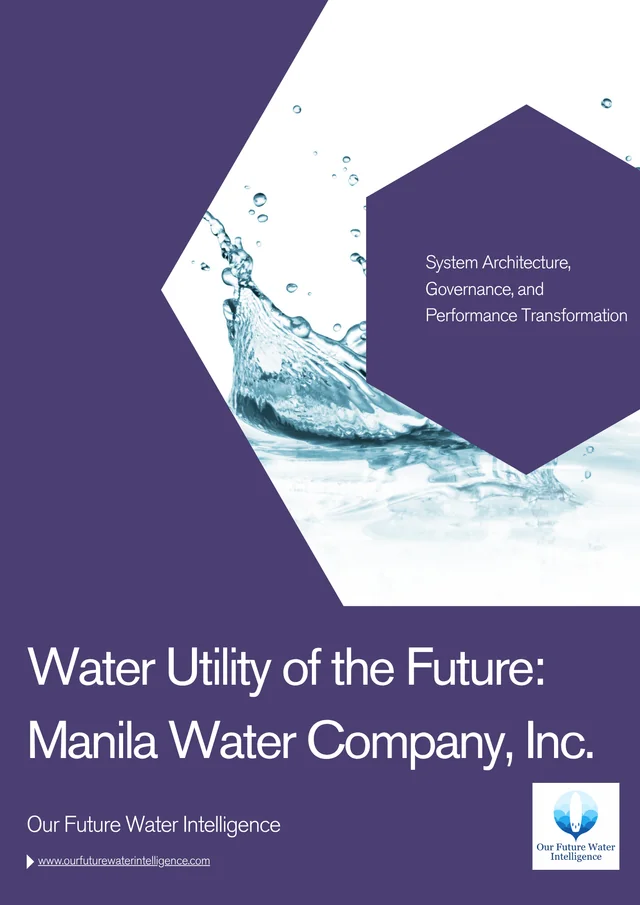
Water Utility of the Future: Manila Water Company, Inc.
- Format
- Digital report · PDF
- Length
- 23 pages
- Edition
- 2026
- Price
- USD 499
09
Report details
Publication details
- Publisher
- Our Future Water Intelligence
- Report family
- Water Utility Intelligence Report
- Report type
- Water Utility of the Future
- Edition
- 2026
- Format
- Digital report · PDF
- Length
- 23 pages
- Reference
- OFW-MWC-PH-WUTF-2026
12
Explore this report family
More Water Utility of the Future reports
Explore the same report family covering other utilities.
Water Utility of the Future
Water Utility of the Future: Department of Energy, Abu Dhabi Emirate
- Geography
- Abu Dhabi, United Arab Emirates
- Edition
- November 2026, New edition
- Length
- 16 pages
Water Utility of the Future
Water Utility of the Future: Water and Sanitation Directorate, City of Cape Town
- Geography
- Cape Town, South Africa
- Edition
- November 2026, New edition
- Length
- 14 pages
Water Utility of the Future
Water Utility of the Future: Electricity and Water Authority
- Geography
- Bahrain, Middle East
- Edition
- November 2026, New edition
- Length
- 15 pages