
01
Executive overview
Why this report matters
Summary Insight: The assessment connects network intelligence, source diversification, circular water, customer strategy, regulation, capital planning, and workforce capability. It frames these elements as one integrated utility transformation agenda.
Independent intelligence for evaluating Maynilad’s operating architecture, governance, financing, resilience, and implementation choices.
The year-end result frames the scale of the utility’s network-efficiency transition.
02
Buyer relevance
Who the report is for
- Utility Executives & System Operators: Assess source dependencies, network controls, treatment assets, loss reduction, service continuity, and phased operating priorities.
- Regulators & Policymakers: Examine franchise duties, tariff structures, coverage obligations, governance controls, and institutional accountability.
- Infrastructure Investors & Financiers: Evaluate capital sequencing, sustainable finance, lifecycle obligations, operating performance, and climate exposure.
03
Decision scope
Questions answered
What does the Water Utility of the Future: Maynilad Water Services cover?
It covers utility transformation, digital network control, energy and carbon, source diversification, customers, regulation, finance, workforce capability, and a phased strategic roadmap.
How does Maynilad strengthen utility resilience?
The report examines source dependency, storage, treatment redundancy, leakage management, digital monitoring, climate exposure, and the operating systems required to sustain service.
What infrastructure and governance risks affect Maynilad?
The assessment considers concentrated supply, climate and seismic exposure, aging networks, franchise and concession obligations, tariff structures, board oversight, and delivery capability.
How does the report assess investment in Maynilad’s transformation?
It assesses capital priorities across storage, network renewal, circular treatment, diversified sources, digital systems, decarbonisation, coverage, and workforce capability.
04
Inside the report
Analytical coverage
Architectures: Diversified sources and resilient networks
Examines source diversification, storage, treatment, conveyance, and network redundancy as one connected operating architecture for metropolitan water service. It links long-lived asset choices with climate exposure, seismic disruption, service continuity, and recovery requirements.
Enablement: Predictive network intelligence
Analyzes telemetry, predictive analytics, satellite leak detection, and digital customer systems as operating enablers. It links data capability with loss reduction, maintenance, and service reliability.
Resolution: Circular water and decarbonisation
Assesses direct potable reuse, wastewater recovery, renewable energy, carbon management, and resource efficiency as connected responses to concentrated operational pressures. It shows how circular systems can reduce source dependence, energy exposure, emissions, and vulnerability to climate variability.
Alignment: Franchise regulation and accountability
Evaluates the legislative franchise, concession oversight, tariff design, coverage duties, public reporting, and institutional controls that define the utility mandate. It clarifies how public obligations shape investment priorities, affordability choices, performance assurance, and long-term accountability.
Capability Building: Capital workforce and delivery
Reviews sustainable finance, capital sequencing, safety, workforce development, procurement, commissioning, and organisational change as practical delivery capabilities. It links funding capacity with execution discipline, technology absorption, operational readiness, and long-term utility performance.
05
Included
What you receive
Complete digital report
The full analysis in a professionally formatted PDF.
Decision-focused analysis
Evidence interpreted around the report’s central strategic and operational questions.
Supporting evidence
Relevant data, documented developments and source material used throughout the assessment.
Analytical frameworks
Structured interpretation of the financial, operational, governance, resilience or resource issues relevant to the report.
Forward priorities
Key developments, risks and issues to monitor following publication.
06
Evidence & method
Built for defensible decisions
The report is grounded in documented public, institutional, regulatory, utility and sector evidence appropriate to its stated scope. Source periods, definitions and reported claims are retained within the complete analysis.
07
Lead analyst
Robert C. Brears
Lead Analyst, Our Future Water Intelligence
Robert C. Brears is a water-security specialist and author whose work examines utility transformation, infrastructure, governance, finance and climate resilience for executive and policy audiences.
- Evidence-led water intelligence
- Decision-focused system analysis
- Report-specific treatment of scope and terminology
08
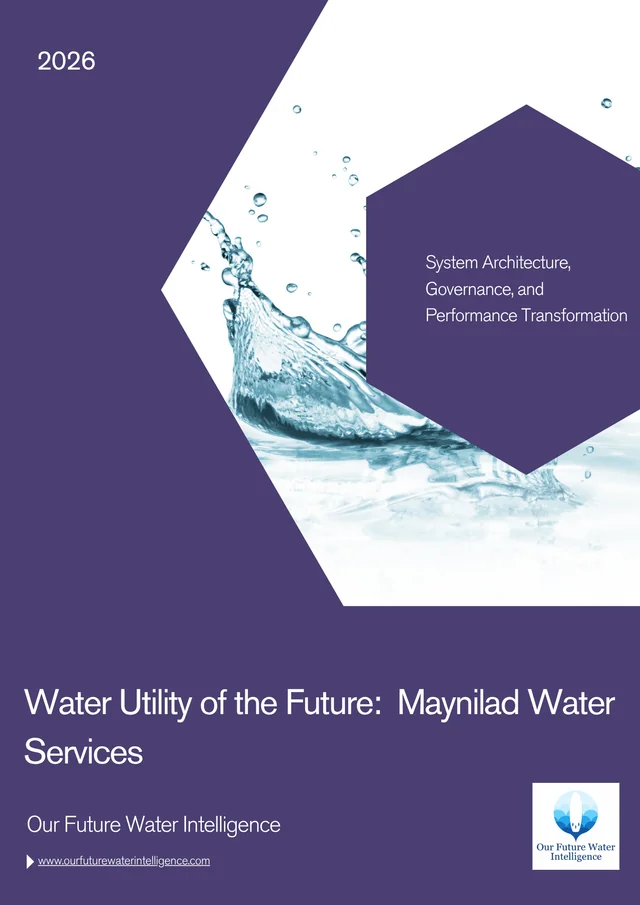
Water Utility of the Future: Maynilad Water Services
- Format
- Digital report · PDF
- Length
- 23 pages
- Edition
- 2026
- Price
- USD 499
09
Report details
Publication details
- Publisher
- Our Future Water Intelligence
- Report family
- Water Utility Intelligence Report
- Report type
- Water Utility of the Future
- Edition
- 2026
- Format
- Digital report · PDF
- Length
- 23 pages
- Reference
- WUI-MAYNILAD-PH
12
Explore this report family
More Water Utility of the Future reports
Explore the same report family covering other utilities.
Water Utility of the Future
Water Utility of the Future: Department of Energy, Abu Dhabi Emirate
- Geography
- Abu Dhabi, United Arab Emirates
- Edition
- November 2026, New edition
- Length
- 16 pages
Water Utility of the Future
Water Utility of the Future: Water and Sanitation Directorate, City of Cape Town
- Geography
- Cape Town, South Africa
- Edition
- November 2026, New edition
- Length
- 14 pages
Water Utility of the Future
Water Utility of the Future: Electricity and Water Authority
- Geography
- Bahrain, Middle East
- Edition
- November 2026, New edition
- Length
- 15 pages