
01
Executive overview
Why this report matters
Summary Insight: Nama Water Services operates Oman’s water and wastewater systems across all governorates except Dhofar following the consolidation established by Royal Decree No. 131/2020. The company must integrate regional assets, reduce non-revenue water, expand smart metering, strengthen transmission and distribution, increase treated-effluent utilisation, diversify water sources, and deliver regulated services across urban, rural, coastal, and mountainous areas.
This Our Future Water Intelligence report provides an independent assessment of Nama Water Services’ governance, regulated operating model, infrastructure renewal, digital transformation, resource resilience, and long-term capital-delivery strategy.
The 20-year Build-Own-Operate partnership will deliver a water purification plant with 65,000 cubic metres per day of capacity, supplying 35,000 cubic metres per day to the potable-water network and 30,000 cubic metres per day for agricultural irrigation.
02
Buyer relevance
Who the report is for
- Utility Executives & System Operators: Evaluate water production, transmission, distribution, pumping, wastewater collection, treatment, network losses, and regional operating performance.
- Regulators & Policymakers: Assess APSR licensing, permitted tariffs, service quality, sector consolidation, treated-effluent policy, water security, and Oman Vision 2040 priorities.
- Infrastructure Investors & Financiers: Evaluate public-private partnerships, sustainable finance, performance-based contracts, project delivery, regulated revenue, and long-term infrastructure risk.
03
Decision scope
Questions answered
How is Nama Water Services regulated?
The Authority for Public Services Regulation licenses and regulates Oman’s water and wastewater sector, including service, performance, and tariff requirements. The report evaluates how this framework affects corporate planning, investment, reporting, operating efficiency, and customer outcomes.
How has sector consolidation changed Nama Water Services?
Royal Decree No. 131/2020 consolidated water and wastewater responsibilities across Oman, except Dhofar, within the Oman Water and Wastewater Services Company. The report assesses how this structure supports common standards, central oversight, regional investment, and integrated asset management.
How does digital infrastructure support non-revenue water reduction?
Smart meters, remote readings, customer alerts, flow and pressure monitoring, geographic information systems, supervisory control, and network analytics improve visibility over consumption and asset performance. The report evaluates how these tools support leak detection, targeted maintenance, and more accurate billing.
How do alternative water sources strengthen regional resilience?
Dam-water treatment, desalination, wells, treated-effluent reuse, and emergency network interconnections provide different supply and resource-management options. The report reviews how these assets can reduce pressure on individual sources and support potable, industrial, and agricultural demand.
04
Inside the report
Analytical coverage
Architectures: Sector consolidation and regulated governance
Examines how Nama Water Services integrates water and wastewater operations across multiple governorates under a unified corporate structure, APSR licensing, common standards, and central performance oversight.
Enablement: Regional infrastructure and asset renewal
Evaluates how Nama Water Services sequences transmission lines, distribution networks, reservoirs, pumping stations, wastewater systems, and rural connections across geographically diverse service areas.
Resolution: Digital operations and non-revenue water
Assesses how Nama Water Services uses smart meters, remote readings, flow and pressure data, geographic information systems, supervisory control, network analytics, and performance-based operations to reduce water losses.
Alignment: Treated-effluent reuse and source diversification
Reviews how Nama Water Services expands treated-effluent utilisation, dam-water treatment, desalination, wells, emergency interconnections, and agricultural supply to strengthen resource resilience.
Capability Building: Sustainable finance and delivery partnerships
Explains how Nama Water Services uses sustainable-finance frameworks, public-private partnerships, Build-Own-Operate projects, performance-based contracts, workforce development, and knowledge transfer to expand delivery capacity.
05
Included
What you receive
Complete digital report
The full analysis in a professionally formatted PDF.
Decision-focused analysis
Evidence interpreted around the report’s central strategic and operational questions.
Supporting evidence
Relevant data, documented developments and source material used throughout the assessment.
Analytical frameworks
Structured interpretation of the financial, operational, governance, resilience or resource issues relevant to the report.
Forward priorities
Key developments, risks and issues to monitor following publication.
06
Evidence & method
Built for defensible decisions
The report is grounded in documented public, institutional, regulatory, utility and sector evidence appropriate to its stated scope. Source periods, definitions and reported claims are retained within the complete analysis.
07
Lead analyst
Robert C. Brears
Lead Analyst, Our Future Water Intelligence
Robert C. Brears is a water-security specialist and author whose work examines utility transformation, infrastructure, governance, finance and climate resilience for executive and policy audiences.
- Evidence-led water intelligence
- Decision-focused system analysis
- Report-specific treatment of scope and terminology
08
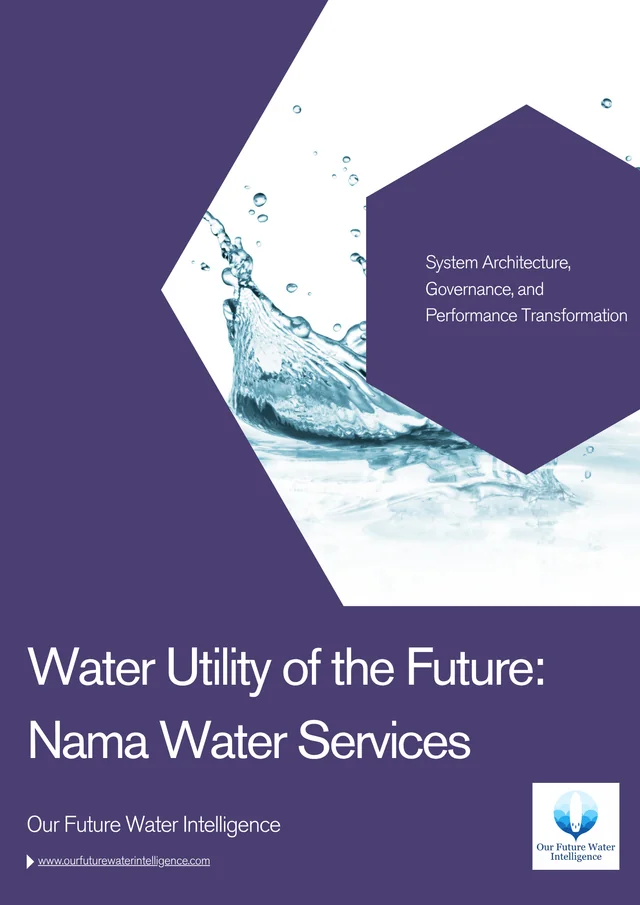
Water Utility of the Future: Nama Water Services
- Format
- Digital report · PDF
- Length
- 23 pages
- Edition
- 2026
- Price
- USD 499
09
Report details
Publication details
- Publisher
- Our Future Water Intelligence
- Report family
- Water Utility Intelligence Report
- Report type
- Water Utility of the Future
- Edition
- 2026
- Format
- Digital report · PDF
- Length
- 23 pages
- Reference
- OFW-NWS-OM-WUTF-2026
12
Explore this report family
More Water Utility of the Future reports
Explore the same report family covering other utilities.
Water Utility of the Future
Water Utility of the Future: Department of Energy, Abu Dhabi Emirate
- Geography
- Abu Dhabi, United Arab Emirates
- Edition
- November 2026, New edition
- Length
- 16 pages
Water Utility of the Future
Water Utility of the Future: Water and Sanitation Directorate, City of Cape Town
- Geography
- Cape Town, South Africa
- Edition
- November 2026, New edition
- Length
- 14 pages
Water Utility of the Future
Water Utility of the Future: Electricity and Water Authority
- Geography
- Bahrain, Middle East
- Edition
- November 2026, New edition
- Length
- 15 pages