
01
Executive overview
Why this report matters
Summary Insight: Office National de l'Électricité et de l'Eau Potable is expanding Morocco’s drinking-water system as drought and declining reservoir availability increase pressure on conventional supplies. ONEE is scaling desalination, reinforcing bulk conveyance, maintaining urban and rural access, mobilising public and private investment, and adapting its role as regional multi-service companies assume responsibility for electricity, drinking-water, sanitation, and distribution services.
This Our Future Water Intelligence report provides an independent assessment of ONEE’s bulk water strategy, desalination expansion, regional governance transition, infrastructure investment, financial resilience, and long-term climate-risk response.
ONEE’s integrated equipment plan covers electricity and drinking-water investment through 2030. MAD 177 billion is allocated to the electricity sector, with the wider programme supporting water-production expansion, desalination, transmission, renewable energy, and system resilience.
02
Buyer relevance
Who the report is for
- Utility Executives & System Operators: Evaluate drinking-water production, treatment plants, desalination facilities, bulk pipelines, pumping, storage, rural supply, and wastewater operations.
- Regulators & Policymakers: Assess Law No. 83.21, regional multi-service companies, wholesale and distribution responsibilities, public oversight, rural access, and national water-security policy.
- Infrastructure Investors & Financiers: Evaluate public-private partnerships, international finance, sovereign support, capital sequencing, construction risk, and long-term infrastructure requirements.
03
Decision scope
Questions answered
How does ONEE finance major water infrastructure?
The report evaluates ONEE investment, public funding, international financial institution loans, grants, private capital, and public-private partnerships as mechanisms for financing treatment, desalination, conveyance, rural supply, and wastewater infrastructure.
How does Law No. 83.21 affect ONEE’s role?
The law establishes regional multi-service companies responsible for regional electricity, drinking-water, sanitation, and distribution services. The report assesses how service transfers alter ONEE’s responsibilities, contractual interfaces, asset management, bulk supply relationships, and institutional accountability.
How is ONEE reducing exposure to drought and reservoir decline?
ONEE is expanding desalination, reinforcing treatment and bulk conveyance, protecting existing resources, and supporting regional supply connections. The report evaluates how these investments diversify supply without eliminating the continuing importance of dams and conventional water sources.
How does ONEE’s electricity mandate support water operations?
ONEE’s combined mandate creates a direct planning relationship between electricity supply, renewable generation, pumping, treatment, and desalination. The report reviews how this institutional structure can support energy planning and cost control without assuming that every water facility receives dedicated renewable power.
04
Inside the report
Analytical coverage
Architectures: Desalination and diversified bulk supply
Examines how ONEE integrates dams, conventional treatment, desalination, groundwater, storage, and long-distance conveyance to strengthen national drinking-water security under increasing hydrological stress.
Enablement: Regional service reform under Law No. 83.21
Evaluates how the creation of regional multi-service companies changes the institutional interfaces between national production, bulk transmission, regional distribution, sanitation, customer services, and public oversight.
Resolution: Public, private, and international finance
Assesses how ONEE combines internal investment, public finance, international development funding, commercial structures, and public-private partnerships to deliver large water and electricity assets.
Alignment: Regional transfers, reuse, and resource protection
Reviews how ONEE aligns bulk conveyance, regional system reinforcement, wastewater treatment, reuse, groundwater protection, and rural water programmes with national resource priorities.
Capability Building: Water-energy integration and operating capacity
Explains how ONEE uses its combined electricity and water mandate to coordinate energy supply, renewable generation, desalination requirements, technical assurance, workforce capability, and infrastructure planning.
05
Included
What you receive
Complete digital report
The full analysis in a professionally formatted PDF.
Decision-focused analysis
Evidence interpreted around the report’s central strategic and operational questions.
Supporting evidence
Relevant data, documented developments and source material used throughout the assessment.
Analytical frameworks
Structured interpretation of the financial, operational, governance, resilience or resource issues relevant to the report.
Forward priorities
Key developments, risks and issues to monitor following publication.
06
Evidence & method
Built for defensible decisions
The report is grounded in documented public, institutional, regulatory, utility and sector evidence appropriate to its stated scope. Source periods, definitions and reported claims are retained within the complete analysis.
07
Lead analyst
Robert C. Brears
Lead Analyst, Our Future Water Intelligence
Robert C. Brears is a water-security specialist and author whose work examines utility transformation, infrastructure, governance, finance and climate resilience for executive and policy audiences.
- Evidence-led water intelligence
- Decision-focused system analysis
- Report-specific treatment of scope and terminology
08
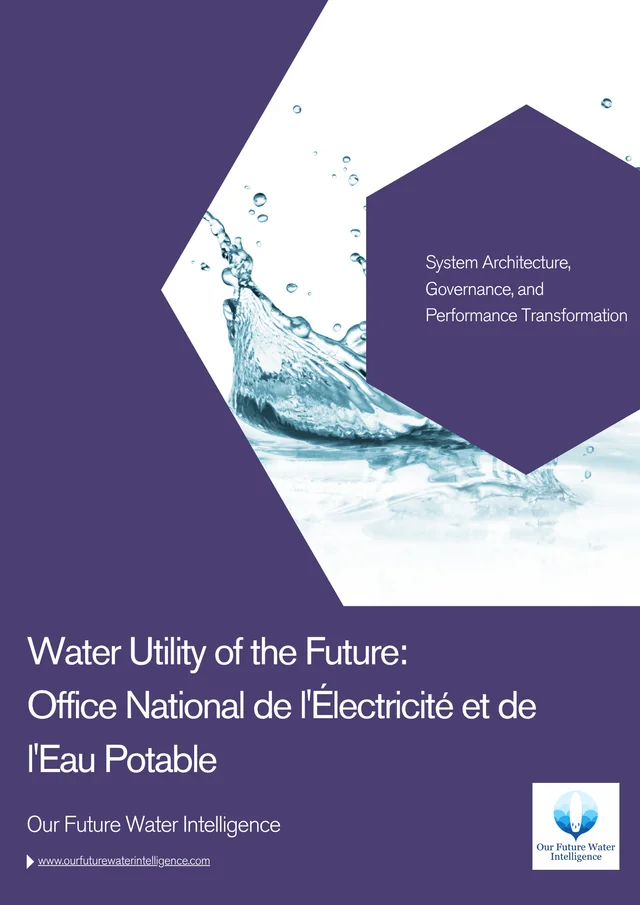
Water Utility of the Future: Office National de l'Électricité et de l'Eau Potable
- Format
- Digital report · PDF
- Length
- 25 pages
- Edition
- 2026
- Price
- USD 499
09
Report details
Publication details
- Publisher
- Our Future Water Intelligence
- Report family
- Water Utility Intelligence Report
- Report type
- Water Utility of the Future
- Edition
- 2026
- Format
- Digital report · PDF
- Length
- 25 pages
- Reference
- OFW-ONEE-MA-WUTF-2026
12
Explore this report family
More Water Utility of the Future reports
Explore the same report family covering other utilities.
Water Utility of the Future
Water Utility of the Future: Department of Energy, Abu Dhabi Emirate
- Geography
- Abu Dhabi, United Arab Emirates
- Edition
- November 2026, New edition
- Length
- 16 pages
Water Utility of the Future
Water Utility of the Future: Water and Sanitation Directorate, City of Cape Town
- Geography
- Cape Town, South Africa
- Edition
- November 2026, New edition
- Length
- 14 pages
Water Utility of the Future
Water Utility of the Future: Electricity and Water Authority
- Geography
- Bahrain, Middle East
- Edition
- November 2026, New edition
- Length
- 15 pages