
01
Executive overview
Why this report matters
Summary Insight: This report examines the operating architecture connecting PPWSA's production expansion, digital network control, resource efficiency and customer-service development. It evaluates how governance, capital planning and workforce capability affect the sequencing and resilience of the utility's transition toward a regional system-operator model.
This Our Future Water Intelligence report provides an independent assessment of Phnom Penh Water Supply Authority within Cambodia's capital-region water system.
The collection result anchors the utility's operating and financial discipline.
02
Buyer relevance
Who the report is for
- Utility Executives & System Operators: Assess production, network intelligence, maintenance, resource efficiency and service-area expansion as one operating system.
- Regulators & Policymakers: Examine public-enterprise governance, tariff authority, social access and institutional accountability across the utility mandate.
- Infrastructure Investors & Financiers: Evaluate debt structure, capital sequencing, covenant exposure, project delivery and long-term operating resilience.
03
Decision scope
Questions answered
What does Water Utility of the Future: Phnom Penh Water Supply Authority assess?
It assesses operating transformation, digital control, resource efficiency, climate resilience, customers, governance, finance, workforce capability and the strategic roadmap.
Which operating factors shape PPWSA's system transformation?
The report examines production, transmission, telemetry, asset information, maintenance, pumping, loss management, customer systems and regional network expansion.
Which infrastructure and governance risks affect Phnom Penh's utility system?
The assessment considers source conditions, climate exposure, tariff authority, ministerial approvals, debt covenants, liquidity and implementation capacity.
What strategic and investment priorities does the report evaluate?
It evaluates sequenced treatment and network investment alongside digital capability, resource efficiency, regulatory reform, balance-sheet resilience and workforce development.
04
Inside the report
Contents
From Service Provider to System Operator
System Intelligence and Digital Control
Energy, Carbon, and Resource Decoupling
Infrastructure Strategy for a Non-Stationary Climate
Customers, Demand, and the Water Prosumer
Governance, Regulation, and Institutional Reform
Capital Planning and Financial Architecture
Workforce, Capability, and Organizational Change
05
Public preview
Strategic themes examined
Architectures: Regional production and network control
Examines treatment, transmission, distribution and service-area expansion as one operating architecture for Phnom Penh and adjoining districts. It links asset configuration with source conditions, network visibility, service continuity and regional demand.
Enablement: Telemetry and field execution
Analyzes supervisory control, geographic information, maintenance systems and customer data as operational enablers. It connects digital visibility with leak response, pressure management, pumping decisions and coordinated field work.
Resolution: Resource intensity and climate exposure
Assesses energy efficiency, chemical substitution, renewable power and resilient intake design as responses to operating pressure. It clarifies how resource choices affect cost exposure, safety, emissions and dependable abstraction.
Alignment: Public mandate and economic regulation
Evaluates ministerial guardianship, board accountability, tariff approval and capital-market obligations within the utility's public-enterprise model. It connects institutional authority with affordability, cost recovery, investment approval and financial resilience.
Capability Building: Capital sequencing and organizational capacity
Reviews debt structure, project delivery, workforce development and leadership continuity as practical implementation capabilities. It links financing choices with commissioning readiness, technical skills, operating accountability and long-term performance.
06
Included
What you receive
Complete digital report
The full analysis in a professionally formatted PDF.
Decision-focused analysis
Evidence interpreted around the report’s central strategic and operational questions.
Supporting evidence
Relevant data, documented developments and source material used throughout the assessment.
Analytical frameworks
Structured interpretation of the financial, operational, governance, resilience or resource issues relevant to the report.
Forward priorities
Key developments, risks and issues to monitor following publication.
07
Evidence & method
Built for defensible decisions
The report is grounded in documented public, institutional, regulatory, utility and sector evidence appropriate to its stated scope. Source periods, definitions and reported claims are retained within the complete analysis.
08
Lead analyst
Robert C. Brears
Lead Analyst, Our Future Water Intelligence
Robert C. Brears is a water-security specialist and author whose work examines utility transformation, infrastructure, governance, finance and climate resilience for executive and policy audiences.
- Evidence-led water intelligence
- Decision-focused system analysis
- Report-specific treatment of scope and terminology
09
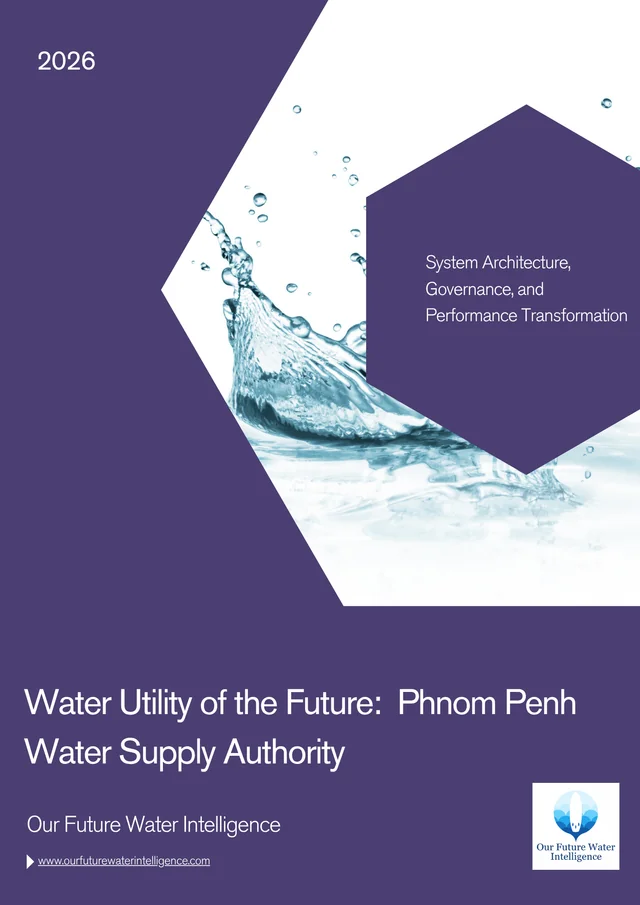
Water Utility of the Future: Phnom Penh Water Supply Authority
- Format
- Digital report · PDF
- Length
- 25 pages
- Edition
- 2026
- Price
- USD 499
10
Report details
Publication details
- Publisher
- Our Future Water Intelligence
- Report family
- Water Utility Intelligence Report
- Report type
- Water Utility of the Future
- Edition
- 2026
- Format
- Digital report · PDF
- Length
- 25 pages
- Reference
- WUI-PPWSA-KH
13
Explore this report family
More Water Utility of the Future reports
Explore the same report family covering other utilities.
Water Utility of the Future
Water Utility of the Future: Department of Energy, Abu Dhabi Emirate
- Geography
- Abu Dhabi, United Arab Emirates
- Edition
- November 2026, New edition
- Length
- 16 pages
Water Utility of the Future
Water Utility of the Future: Water and Sanitation Directorate, City of Cape Town
- Geography
- Cape Town, South Africa
- Edition
- November 2026, New edition
- Length
- 14 pages
Water Utility of the Future
Water Utility of the Future: Electricity and Water Authority
- Geography
- Bahrain, Middle East
- Edition
- November 2026, New edition
- Length
- 15 pages