01
Executive overview
Key findings
+1.7 °C: rise in Germany's mean air temperature, 1881–2022
Up to EUR 30 billion: ceiling of the federal and Länder reconstruction fund created after the July 2021 floods
About 72%: summer 2026 rainfall as a share of normal (171 of 239 l/m²); the Rhine at Kaub fell below its lowest level known before 2026
7–30%: climate-driven share of water supply investment over the next ten years across four pilot utilities
02
Buyer relevance
Who the report is for
Water and wastewater utilities
Benchmark their own climate-driven investment against the 7–30% range found across four pilot utilities.
Flood-protection and civil engineering firms
Track the National Flood Protection Programme, with about 110 measures and EUR 127 million a year of federal GAK budget planned to 2029.
Insurers and risk analysts
Use exposure data such as the about 2.1 million residents in coastal flood-risk areas and the 2026 low-water record.
Development lenders and public funders
See how adaptation is financed, from the up to EUR 30 billion reconstruction fund to EIB loans of EUR 500 million for Emscher-Lippe.
03
Decision scope
Questions answered
How much has Germany's climate changed?
Mean air temperature rose 1.7 °C from 1881 to 2022, and hot days of 30 °C or more rose from about 3 to about 10 a year.
Was 2026 a drought year for water?
Summer 2026 rainfall was about 72% of normal, and the Rhine at Kaub fell below its lowest level known before 2026.
What will adaptation cost water utilities?
A pilot study for BDEW and DVGW puts the climate-driven share of supply investment at 7–30%, which BDEW extrapolates to EUR 3.2–13.5 billion over ten years.
Is there a federal adaptation fund for water?
No standing fund: a joint federal–Länder task for climate adaptation has not been created, and federal money flows mainly through flood protection (EUR 127 million a year in GAK) and nature-based programmes.
04
Inside the report
Inside the complete report
Executive Snapshot
1. Why This Matters Now in Germany
2. Current Position
3. Key Programmes, Projects and Investment
4. Policy, Regulation and Institutions
5. Risks and Constraints
6. Strategic Implications
7. What to Watch
Source Register
05
Public preview
What to watch next
1. Why This Matters Now in Germany
Groundwater recovery after the 2026 drought, and whether the National Water Strategy status report due in early 2027 reports climate-driven investment nationally.
3. Key Programmes, Projects and Investment
A representative follow-up to the BDEW/DVGW pilot, which the study itself recommends.
4. Policy, Regulation and Institutions
Whether the environment ministers propose a joint federal–Länder task for climate adaptation, implementing rules under the KRITIS umbrella act, and the strategy status report due in early 2027.
5. Risks and Constraints
Any change to the special fund's eligible investment areas, and Länder funding programmes for municipal water adaptation.
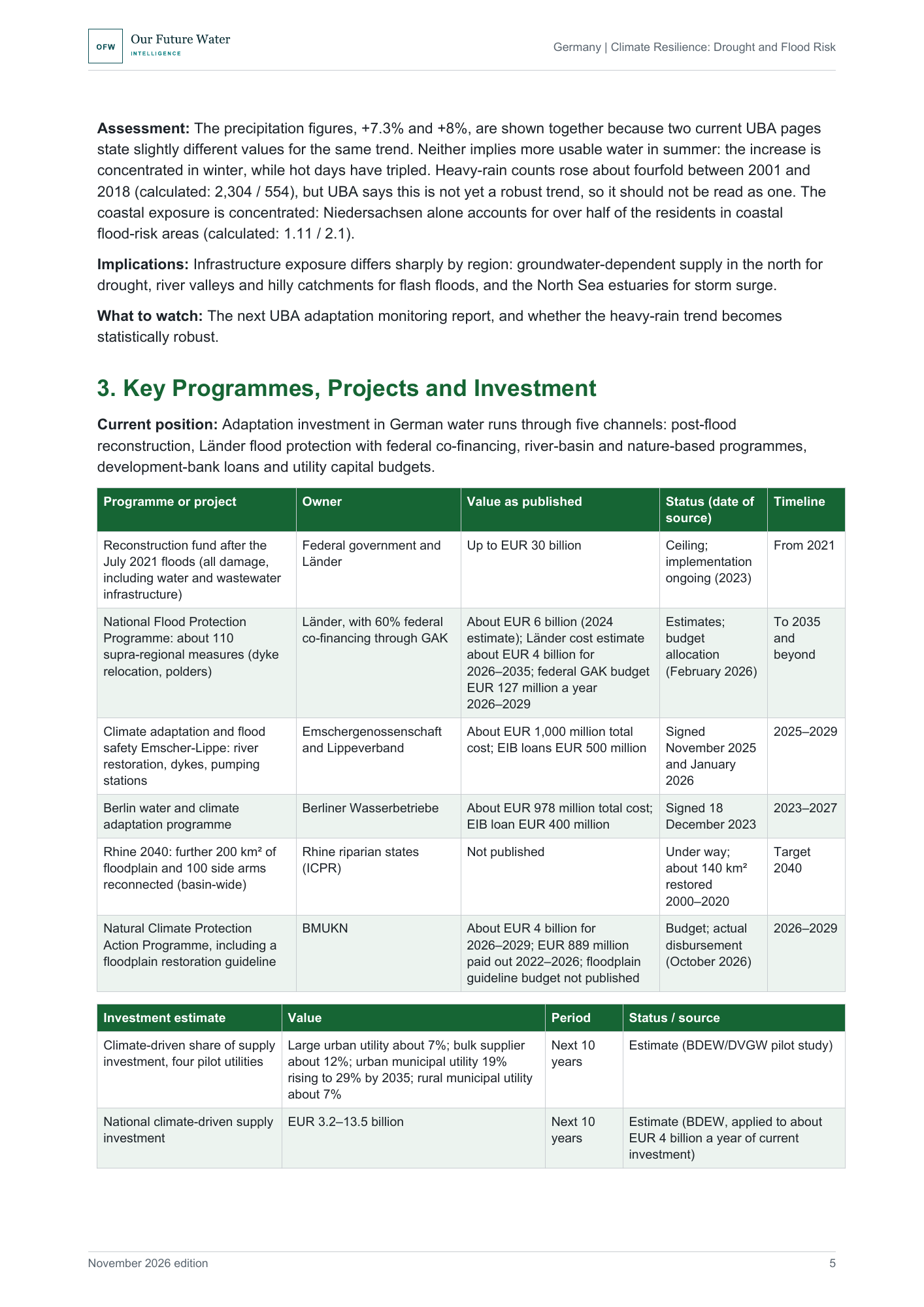
Adaptation programmes and investments with owner, value, status and timeline.
06
Included
What you receive
The complete PDF report: 11 pages, 9 sections, 9 tables and a register of 28 sources.
This edition
November 2026, First edition.
07
Evidence & method
Evidence and method
Climate and hydrological monitoring from UBA, DWD and BfG, federal government reports and parliamentary answers, federal adaptation and water law, river-basin commission programmes, EIB project records, and sector cost studies from BDEW, DVGW and VKU.
Sources
28 sources, listed in the report's source register. Evidence current to 1 November 2026. Principal data periods: temperature and precipitation trends 1881–2022 and 1881–2025; dry years 2018–2020, 2022 and 2026; July 2021 floods; coastal flood-risk reporting at 31 December 2015; adaptation investment estimates for 2025–2034 and 2025–2044. All currency is euros (EUR) unless stated..
Evidence boundaries
This report uses authoritative source material available at the stated research cutoff. It distinguishes published facts, calculated values and analytical interpretation. No independent modelling is performed. Forward-looking analysis reflects published plans, documented trends and stated uncertainties. It does not constitute legal, financial, investment or engineering advice.
08
Lead analyst
Robert C. Brears
Founder, Our Future Water Intelligence
Robert C. Brears is a water-security specialist and author whose work examines utility governance, infrastructure investment, climate resilience and long-term water-system change for executive and policy audiences.
- Decision-focused utility intelligence
- Published water-policy author
- Evidence-grounded system analysis
09
Buyer FAQs
Before you purchase
Who can use the report?
Licensed for internal use within one purchasing organization. The PDF and its contents may be shared with colleagues within that organization. External redistribution, resale and public publication are prohibited without permission.
How is the report delivered?
The PDF is available to download immediately after confirmed payment, through our secure delivery system.
Can my organization buy wider access?
Institutional purchasing: For invoice enquiries, multi-organization licensing or broader access requirements, contact Our Future Water Intelligence.
10
Climate Resilience: Drought and Flood Risk in Germany
- Format
- Length
- 11 pages
- Edition
- November 2026, First edition
- Price
- USD 249
11
Report details
Publication details
- Publisher
- Our Future Water Intelligence
- Report family
- Insight Brief
- Edition
- November 2026, First edition
- Format
- Length
- 11 pages
- Reference
- OFW_EXT_CLIMATE_RESILIENCE_DROUGHT_AND_FLOOD_RISK_IN_GERMANY_ad3b0a93ad41
- Evidence current to
- 1 November 2026
14
Explore this report family
More Climate Resilience: Drought and Flood Risk briefs
Explore the same report family covering other countries.
Climate Resilience: Drought and Flood Risk in Netherlands
- Geography
- Netherlands
- Edition
- November 2026, First edition
- Length
- 10 pages