01
Executive overview
Key findings
83.3 million: population at 30 June 2026; 99.5% of residents were connected to public water supply in 2022
10.1%: water exploitation index in 2022 (17.9 billion m³ abstracted against 176 billion m³ long-term availability)
5,599: public water supply undertakings; there is no national utility and no national economic regulator
About EUR 10 billion → about EUR 40 billion a year: current water and wastewater investment against the average annual requirement to 2044 projected in a study for the municipal utilities association VKU
02
Buyer relevance
Who the report is for
Firms entering the German water market
Identify the bodies that permit, regulate and buy, from the federal ministry to the 5,599 local undertakings.
Equipment and engineering suppliers
Size the asset base, including about 544,000 km of drinking water network and 8,891 municipal treatment plants, before targeting buyers.
Lenders and investors
Compare current investment of about EUR 10 billion a year with the EUR 800 billion projected need to 2044.
Policy and public-affairs teams
Track dated obligations such as phosphorus recovery from 2029 and the 2027 National Water Strategy status report.
03
Decision scope
Questions answered
Is Germany water-stressed?
Not on the national average: abstraction was 10.1% of long-term availability in 2022. But availability fell to 116 billion m³ in the 2020 dry year, and northern groundwater sat below the long-term mean of lowest levels for more than 8.5 months a year over 2019–2021.
Who supplies drinking water in Germany?
Municipalities and districts, through 5,599 public water supply undertakings; the largest include Berliner Wasserbetriebe (around 4 million people) and HAMBURG WASSER (around 2.3 million).
What does drinking water cost?
Volumetric rates at the providers sampled range from EUR 1.813 per m³ in Berlin to EUR 2.19 in Hamburg (2026), plus fixed and wastewater charges.
How large is the investment gap?
A study for VKU projects about EUR 40 billion a year of water and wastewater investment to 2044, against about EUR 10 billion a year now.
04
Inside the report
Inside the complete report
Executive Snapshot
1. Country Water Profile
2. Water Resources and Supply
3. Institutions and Utilities
4. Infrastructure and Major Projects
5. Tariffs and Finance
6. Climate and Resilience
7. Outlook and What to Watch
Source Register
05
Public preview
What to watch next
4. Infrastructure and Major Projects
Procurement for phosphorus-recovery capacity ahead of the 2029 deadline, and fourth-stage (micropollutant) treatment decisions under the recast EU Urban Wastewater Treatment Directive.
5. Tariffs and Finance
Annual tariff decisions by the large city utilities for 2027, the next Land cartel authority price surveys, and any change to the special fund's eligible investment areas.
6. Climate and Resilience
Groundwater recovery over winter 2026–27 after the dry summer, and implementation of the Water Action Programme's low-water information system (Action 2) and water-scarcity guideline (Action 6).
7. Outlook and What to Watch
The strategy status report due early 2027; the German draft transposing the recast Urban Wastewater Treatment Directive; tariff decisions at the large city utilities for 2027; and whether summer 2027 repeats the 2026 drought.
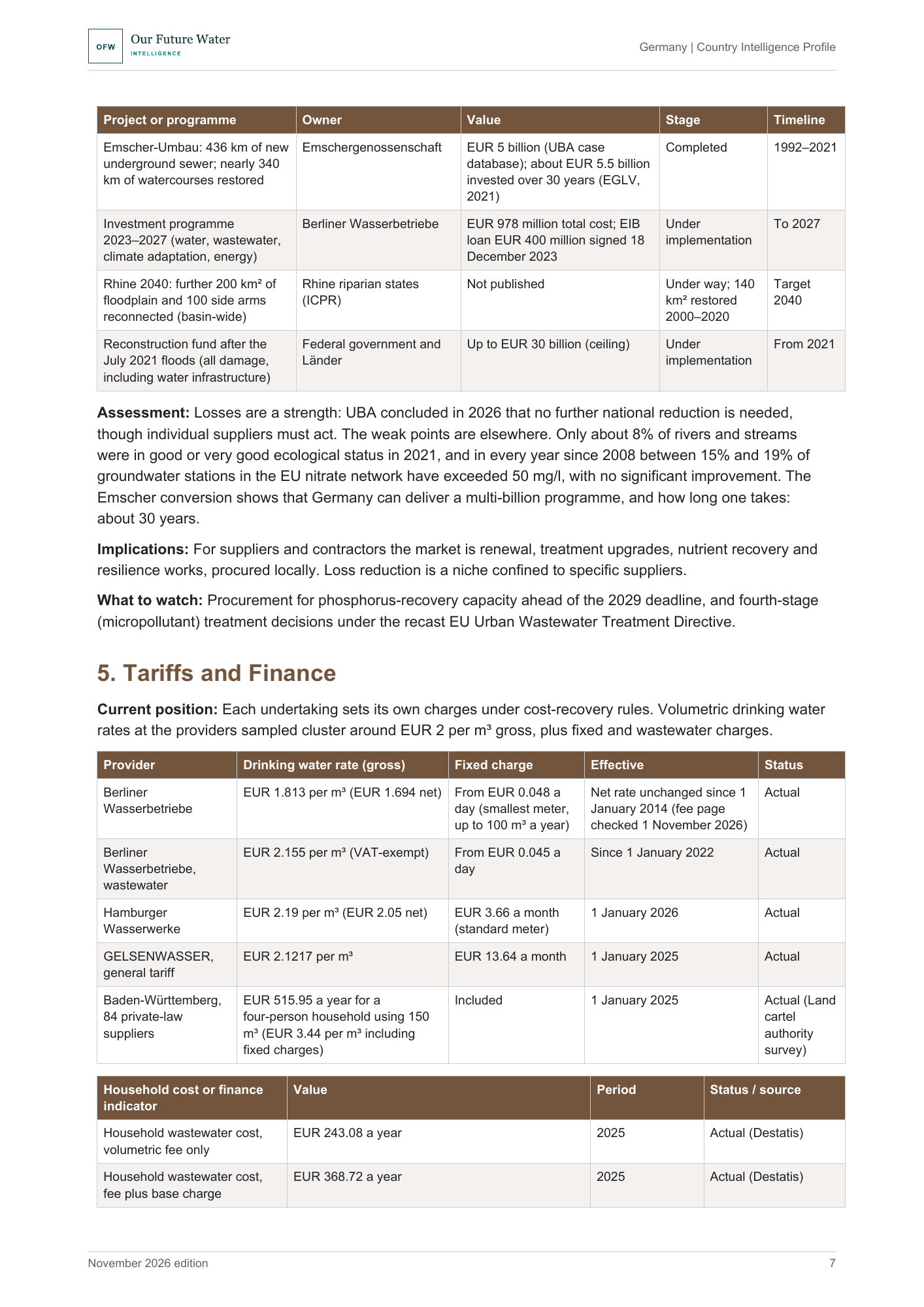
Major projects with owner, value, stage and timeline, and drinking water tariffs at four providers.
06
Included
What you receive
The complete PDF report: 13 pages, 9 sections, 10 tables and a register of 60 sources.
This edition
November 2026, First edition.
07
Evidence & method
Evidence and method
Official statistics from Destatis and the Umweltbundesamt, the National Water Strategy and federal law, utility annual reports and tariff schedules, Land cartel authority price surveys, and sector association data from BDEW, DVGW, DWA and VKU.
Sources
60 sources, listed in the report's source register. Evidence current to 1 November 2026. Principal data periods: 2022 statutory water statistics (latest triennial survey); 1991–2020 water-availability reference period; FY 2024 utility accounts; 2025–2026 tariffs; investment projections for 2025–2044. All currency is euros (EUR) unless stated..
Evidence boundaries
This report uses authoritative source material available at the stated research cutoff. It distinguishes published facts, calculated values and analytical interpretation. No independent modelling is performed. Forward-looking analysis reflects published plans, documented trends and stated uncertainties. It does not constitute legal, financial, investment or engineering advice.
08
Lead analyst
Robert C. Brears
Founder, Our Future Water Intelligence
Robert C. Brears is a water-security specialist and author whose work examines utility governance, infrastructure investment, climate resilience and long-term water-system change for executive and policy audiences.
- Decision-focused utility intelligence
- Published water-policy author
- Evidence-grounded system analysis
09
Buyer FAQs
Before you purchase
Who can use the report?
Licensed for internal use within one purchasing organization. The PDF and its contents may be shared with colleagues within that organization. External redistribution, resale and public publication are prohibited without permission.
How is the report delivered?
The PDF is available to download immediately after confirmed payment, through our secure delivery system.
Can my organization buy wider access?
Institutional purchasing: For invoice enquiries, multi-organization licensing or broader access requirements, contact Our Future Water Intelligence.
10
Germany Country Intelligence Profile
- Format
- Length
- 13 pages
- Edition
- November 2026, First edition
- Price
- USD 99
11
Report details
Publication details
- Publisher
- Our Future Water Intelligence
- Report family
- Country Intelligence Profile
- Edition
- November 2026, First edition
- Format
- Length
- 13 pages
- Reference
- OFW_EXT_GERMANY_COUNTRY_INTELLIGENCE_PROFILE_d47cfd67f23c
- Evidence current to
- 1 November 2026
14
Explore this report family
More Country Intelligence Profiles
Explore the same report family covering other countries.
National Water Research and Reference
Saudi Arabia Country Intelligence Profile
- Geography
- Saudi Arabia
- Edition
- October 2026 edition
- Length
- 13 pages
National Water Research and Reference
Morocco Country Intelligence Profile
- Geography
- Morocco
- Edition
- October 2026, New edition
- Length
- 14 pages
National Water Research and Reference
Qatar Country Intelligence Profile
- Geography
- Qatar
- Edition
- October 2026 edition
- Length
- 12 pages