01
Executive overview
Key findings
176 billion m³ a year: long-term potential availability (1991–2020), down from 188 billion m³ in 1961–1990
116 billion m³: renewable resources in the 2020 dry year, about two-thirds of the long-term mean
About 72%: summer 2026 rainfall as a share of normal (171 of 239 l/m²); the Rhine at Kaub fell below its pre-2026 record low
434 million litres: record daily delivery by the Landeswasserversorgung bulk supplier on 25 June 2026, while it cut its Danube intake
02
Buyer relevance
Who the report is for
Water utilities and bulk suppliers
Compare their dry-year margins with national evidence such as the 2020 low of 116 billion m³ and the 2026 summer at about 72% of normal rainfall.
Engineering firms and pipe, storage and well suppliers
Identify supply-security projects such as Hessenwasser's Ried main, at about EUR 200 million, and Hamburg's peak-capacity expansion to 500,000 m³ a day.
Land and municipal water authorities
Benchmark allocation tools, including Bavaria's new 10 cents per m³ groundwater charge and the pending national scarcity guideline.
Industrial and energy water users
Assess exposure to low river flows, given that energy supply abstracted 6.9 billion m³ in 2022, almost all for cooling.
03
Decision scope
Questions answered
Is Germany running short of water?
Not on the national average: abstraction was 10.1% of long-term availability in 2022. But availability fell to 116 billion m³ in the 2020 dry year, against a 176 billion m³ mean.
How did supply cope with the 2026 drought?
Summer rainfall was about 72% of normal; the Landeswasserversorgung delivered a record 434 million litres on 25 June 2026 and reported supply as secure, while the Rhine at Kaub fell below its pre-2026 record low.
Will desalination or water reuse add supply?
Not soon: the only seawater desalination plant supplies Helgoland, and EU reuse rules have applied since 26 June 2023 while national legal adjustments are pending.
Where is groundwater under most pressure?
In the north, where levels were below the long-term mean of lowest levels for more than 8.5 months a year over 2019–2021; 62 of 1,291 groundwater bodies fail good quantitative status.
04
Inside the report
Inside the complete report
Executive Snapshot
1. Why This Matters Now in Germany
2. Current Position
3. Key Programmes, Projects and Investment
4. Policy, Regulation and Institutions
5. Risks and Constraints
6. Strategic Implications
7. What to Watch
Source Register
05
Public preview
What to watch next
1. Why This Matters Now in Germany
Groundwater recovery over winter 2026–27, and how Länder and large suppliers use the UBA demand scenarios in their next supply concepts.
3. Key Programmes, Projects and Investment
Bodensee-Wasserversorgung's revised scope and cost for Zukunftsquelle, which was reported in November 2025 as having to be scaled back; Bavaria's long-distance supply plan (SüSWasser); and any federal funding decision on a Lusatia transfer.
4. Policy, Regulation and Institutions
The status report due early 2027, publication of the scarcity guideline under Action 6, and how Bavaria's new abstraction charge and Action 11 shape abstraction pricing elsewhere.
5. Risks and Constraints
Groundwater levels after the 2026 drought in northern, eastern and southern monitoring regions; nitrate indicator updates.
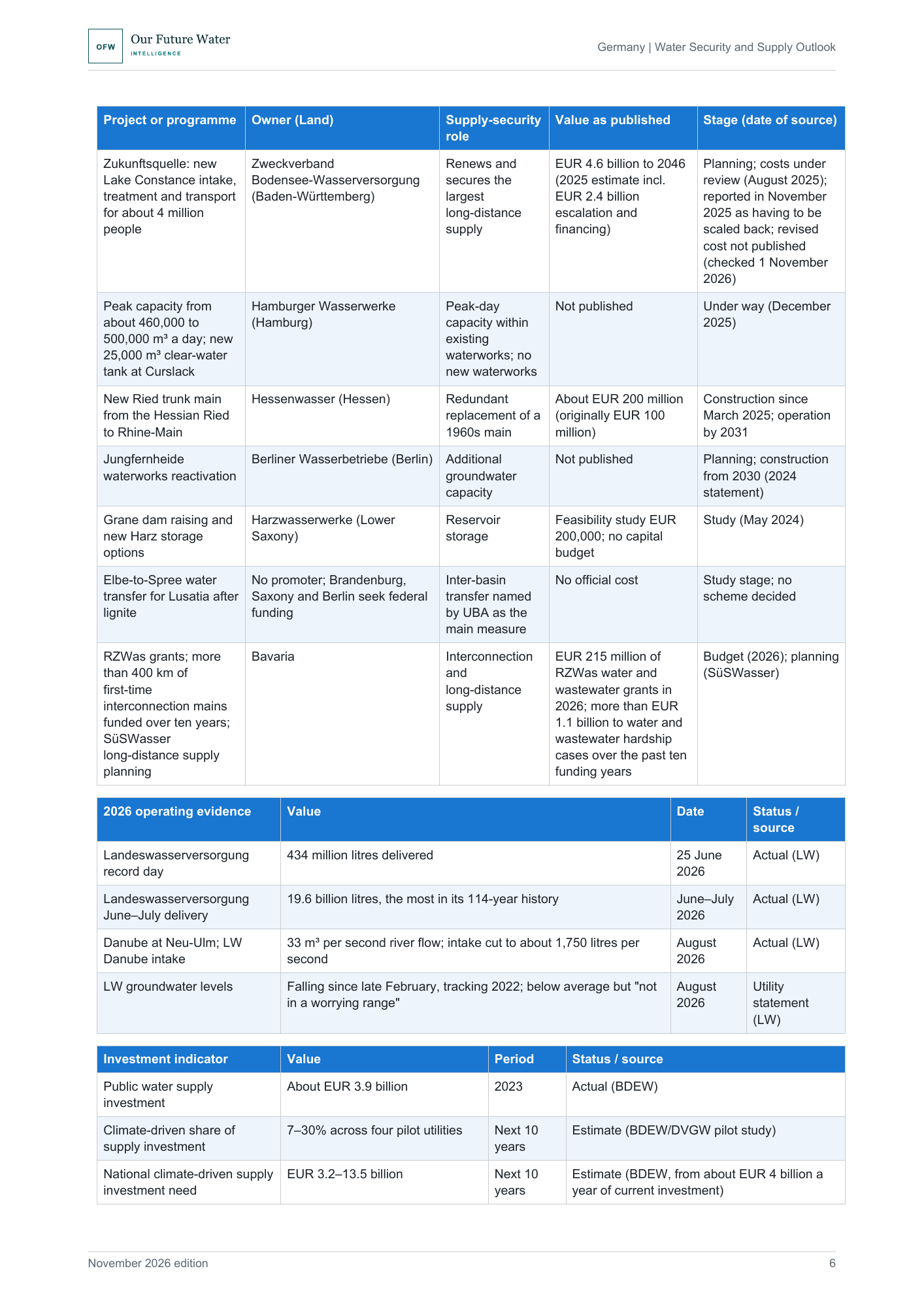
Supply-security projects with owner, role, value and stage, and 2026 drought operating evidence.
06
Included
What you receive
The complete PDF report: 12 pages, 9 sections, 10 tables and a register of 38 sources.
This edition
November 2026, First edition.
07
Evidence & method
Evidence and method
Official water balance and groundwater data from the Umweltbundesamt and Destatis, 2026 weather and low-water reports from DWD and BfG, Land and municipal orders, utility statements and project records, and the National Water Strategy and adaptation law.
Sources
38 sources, listed in the report's source register. Evidence current to 1 November 2026. Principal data periods: 2022 statutory water statistics; 1961–1990 and 1991–2020 water-availability reference periods; dry years 2018–2022 and 2026; 2023–2024 renewable-resource estimates; projections to 2050 and 2100. All currency is euros (EUR) unless stated..
Evidence boundaries
This report uses authoritative source material available at the stated research cutoff. It distinguishes published facts, calculated values and analytical interpretation. No independent modelling is performed. Forward-looking analysis reflects published plans, documented trends and stated uncertainties. It does not constitute legal, financial, investment or engineering advice.
08
Lead analyst
Robert C. Brears
Founder, Our Future Water Intelligence
Robert C. Brears is a water-security specialist and author whose work examines utility governance, infrastructure investment, climate resilience and long-term water-system change for executive and policy audiences.
- Decision-focused utility intelligence
- Published water-policy author
- Evidence-grounded system analysis
09
Buyer FAQs
Before you purchase
Who can use the report?
Licensed for internal use within one purchasing organization. The PDF and its contents may be shared with colleagues within that organization. External redistribution, resale and public publication are prohibited without permission.
How is the report delivered?
The PDF is available to download immediately after confirmed payment, through our secure delivery system.
Can my organization buy wider access?
Institutional purchasing: For invoice enquiries, multi-organization licensing or broader access requirements, contact Our Future Water Intelligence.
10
Water Security and Supply Outlook in Germany
- Format
- Length
- 12 pages
- Edition
- November 2026, First edition
- Price
- USD 249
11
Report details
Publication details
- Publisher
- Our Future Water Intelligence
- Report family
- Insight Brief
- Edition
- November 2026, First edition
- Format
- Length
- 12 pages
- Reference
- OFW_EXT_WATER_SECURITY_AND_SUPPLY_OUTLOOK_IN_GERMANY_0d8ddf2027d9
- Evidence current to
- 1 November 2026
14
Explore this report family
More Water Security and Supply Outlook briefs
Explore the same report family covering other countries.
Water Security and Supply Outlook in Netherlands
- Geography
- Netherlands
- Edition
- November 2026, First edition
- Length
- 11 pages