
01
Executive overview
Key findings
103 km: Hamburg's public flood protection line, being raised at EUR 20–30 million a year to a design water level that allows for sea-level rise to 2050
43 to 84 cm: median global sea-level rise by 2100 under a low- and a high-emission scenario, which the German Weather Service's Hamburg climate report assumes for the German Bight and the Elbe (projection)
+1.1 °C or +3.6 °C: projected warming in north-west Germany's lowlands by 2071–2100, depending on the emission scenario (projection)
3.1 → 6.6: hot days a year (30 °C or more) in Hamburg, 1961–1990 against 1991–2020 (observed)
02
Buyer relevance
Who the report is for
Coastal and flood-defence engineers
Compare the 2050 design level of the dike programme with projected sea-level rise of up to 110 cm by 2100 under high emissions.
Drainage and stormwater suppliers
Size the heavy-rain market after 49 of 131 overflow structures discharged in 2025 and sewer storage reached 215,200 m³.
Climate-risk and insurance analysts
Use the observed rise in hot days from 3.1 to 6.6 a year and the projected 10% fall in summer rain under high emissions.
Urban planners and developers
Apply RISA sponge-city measures such as the Louise-Schröder-Straße redesign, which unsealed 3,700 m² and planted 71 trees.
03
Decision scope
Questions answered
How well is Hamburg protected against storm surges?
Its 103 km public flood line has been raised by about 2.50 m on average since 1962 and is being raised further at EUR 20–30 million a year to 2050.
How much could sea level rise?
The 2021 Hamburg climate report cites median global rises of 43 cm (low emissions) and 84 cm (high emissions) by 2100, against 1986–2005.
How hot will Hamburg get?
Projected warming in north-west Germany's lowlands by 2071–2100 is +1.1 °C under low emissions and +3.6 °C under high emissions.
How exposed is the sewer system to heavy rain?
In 2025, 49 of 131 combined sewer overflow structures discharged about 559,739 m³; HAMBURG WASSER added 215,200 m³ of storage between 1990 and 2020.
Is drought a risk to supply?
Peak demand reached 90.8% of daily capacity on 1 July 2025; capacity is to rise to 500,000 m³ a day by 2030.
04
Inside the report
Inside the complete report
Executive Snapshot
1. Why This Matters Now in Hamburg
2. Current Position
3. Key Programmes, Projects and Investment
4. Policy, Regulation and Institutions
5. Risks and Constraints
6. Strategic Implications
7. What to Watch
Source Register
05
Public preview
What to watch next
2. Current Position
2025/26 groundwater levels; overflow data in the 2026 environmental statement.
3. Key Programmes, Projects and Investment
Any update of the design water level beyond 2050; RISA measures funded under the 2025 adaptation strategy; capacity works at Stellingen, Curslack and Langenhorn.
4. Policy, Regulation and Institutions
The German transposition of the wastewater directive and its overflow rules; implementation measures under the adaptation strategy; BUKEA's water and wastewater strategy.
5. Risks and Constraints
Delivery of RISA measures on private land; progress on dike stages; peak days in summer 2026.
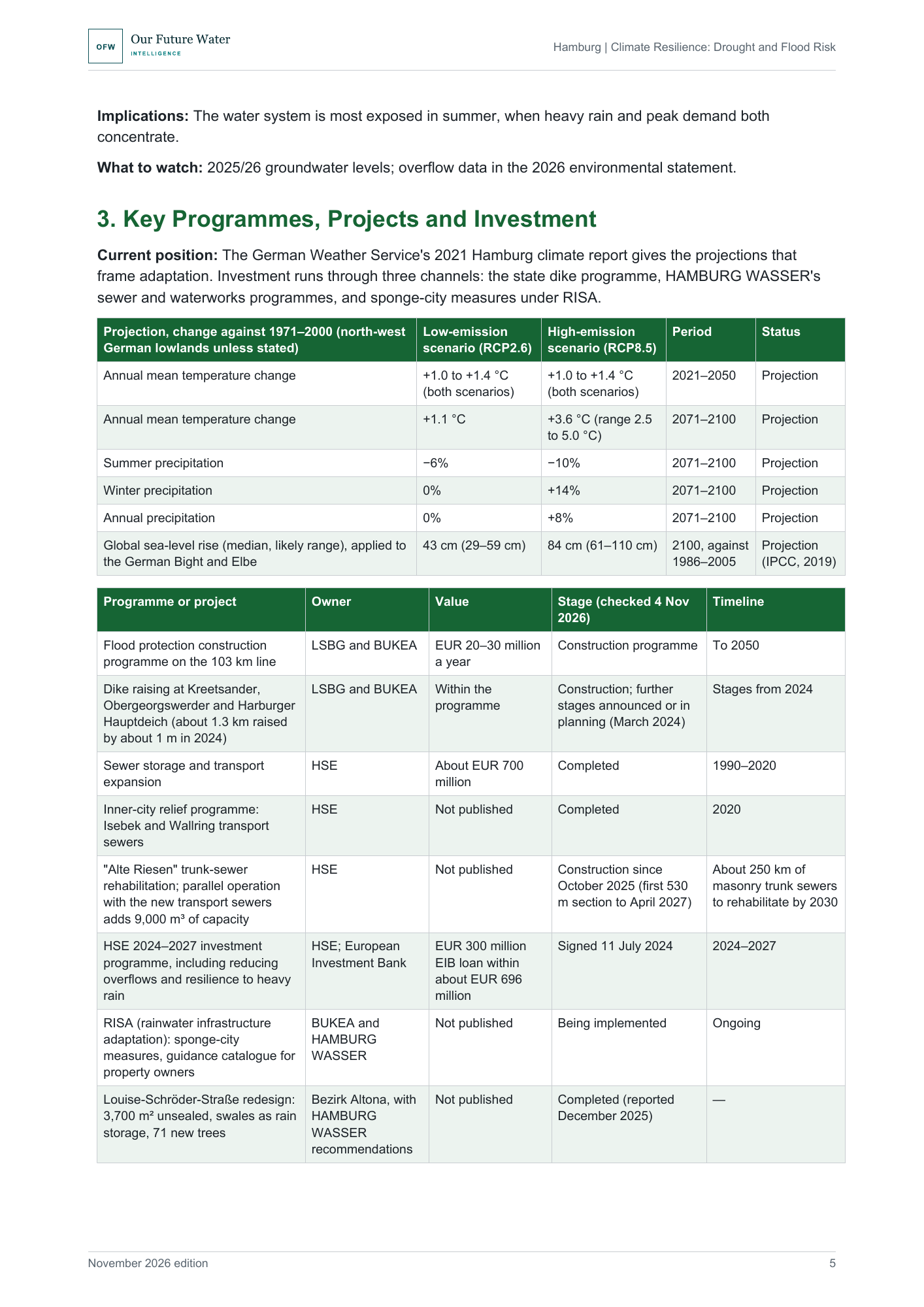
Climate projections by scenario and the adaptation programme table, from Section 3, Key Programmes, Projects and Investment.
06
Included
What you receive
The complete PDF report: 10 pages, 9 sections, 9 tables and a register of 18 sources.
This edition
November 2026, First edition.
07
Evidence & method
Evidence and method
The brief draws on the German Weather Service's 2021 climate report for Hamburg and BUKEA's climate information system, BUKEA's flood protection and heavy-rain material, and HAMBURG WASSER's environmental statement, Water Reports and position paper. It also uses the Senate's 2025 adaptation strategy and the European Investment Bank's project record.
Sources
18 sources, listed in the report's source register. Evidence current to 4 November 2026. Principal data periods: observed climate for the reference periods 1961–1990 and 1991–2020; climate projections for 2021–2050 and 2071–2100 (German Weather Service, 2021); hydrological year November 2024 to October 2025; HAMBURG WASSER operating data for 2025; programme and policy status re-checked on 4 November 2026. All currency is euros (EUR)..
Evidence boundaries
This report uses authoritative source material available at the stated research cutoff. It distinguishes published facts, calculated values and analytical interpretation. No independent modelling is performed. Forward-looking analysis reflects published plans, documented trends and stated uncertainties. It does not constitute legal, financial, investment or engineering advice.
08
Lead analyst
Robert C. Brears
Founder, Our Future Water Intelligence
Robert C. Brears is a water-security specialist and author whose work examines utility governance, infrastructure investment, climate resilience and long-term water-system change for executive and policy audiences.
- Decision-focused utility intelligence
- Published water-policy author
- Evidence-grounded system analysis
09
Buyer FAQs
Before you purchase
Who can use the report?
Licensed for internal use within one purchasing organization. The PDF and its contents may be shared with colleagues within that organization. External redistribution, resale and public publication are prohibited without permission.
How is the report delivered?
The PDF is available to download immediately after confirmed payment, through our secure delivery system.
Can my organization buy wider access?
Institutional purchasing: For invoice enquiries, multi-organization licensing or broader access requirements, contact Our Future Water Intelligence.
10
Climate Resilience: Drought and Flood Risk in Hamburg
- Format
- Length
- 10 pages
- Edition
- November 2026, First edition
- Price
- USD 249
11
Report details
Publication details
- Publisher
- Our Future Water Intelligence
- Report family
- Insight Brief
- Edition
- November 2026, First edition
- Format
- Length
- 10 pages
- Reference
- OFW_EXT_CLIMATE_RESILIENCE_DROUGHT_AND_FLOOD_RISK_IN_HAMBURG_8bbaa6ad82b6
- Evidence current to
- 4 November 2026
14
Explore this report family
More Climate Resilience: Drought and Flood Risk briefs
Explore the same report family covering other cities.
Climate Resilience: Drought and Flood Risk in Amsterdam
- Geography
- Netherlands
- Edition
- November 2026, First edition
- Length
- 11 pages
Climate Resilience: Drought and Flood Risk in Copenhagen
- Geography
- Denmark
- Edition
- November 2026, First edition
- Length
- 10 pages