
01
Executive overview
Key findings
125.3 against 129.9 million m³: groundwater abstracted in 2025 against the usable yield assessed for HAMBURG WASSER, leaving about 4.6 million m³ (3.5%) of headroom (calculated)
417,797 m³ against 460,000 m³: peak-day supply on 1 July 2025 against maximum daily supply capacity, or 90.8% (calculated)
16.1 against 18.4 million m³ a year: the average Nordheide abstraction permitted in 2019 against the volume applied for; HAMBURG WASSER's appeal has been pending since 1 December 2021
More than 2.4 million: people expected in HAMBURG WASSER's supply area by 2050, against about 2.2 million in 2025 (projection)
02
Buyer relevance
Who the report is for
Waterworks equipment and process suppliers
Follow the Stellingen, Curslack and Langenhorn works behind the 500,000 m³ a day capacity target for 2030.
Water-resource and hydrogeology consultants
Read the 4.6 million m³ headroom against the usable yield and the 2.2 million m³ rise in abstraction in 2025.
Regional and land-use planners
Weigh well-site protection and the call to enforce public supply's priority against growth to more than 2.4 million people by 2050.
Lenders and credit analysts
Assess legal risk to about 13% of demand from the Nordheide permit appeal, pending since 1 December 2021.
03
Decision scope
Questions answered
Where does Hamburg's water come from?
All of it is groundwater: 77.6 million m³ was abstracted in Hamburg in 2025, 31.7 million m³ in Schleswig-Holstein and 16.0 million m³ in Niedersachsen.
How much spare resource is there?
Abstraction of 125.3 million m³ in 2025 left about 4.6 million m³ against a usable yield of 129.9 million m³, down from 6.41 million m³ a year earlier.
Can supply meet peak demand?
The 2025 peak of 417,797 m³ used 90.8% of the 460,000 m³ daily capacity; HAMBURG WASSER targets 500,000 m³ a day by 2030.
What is at stake in the Nordheide case?
HAMBURG WASSER applied for 18.4 million m³ a year but was permitted an average of 16.1 million m³; the gap of 2.3 million m³ is about half the current headroom.
Is Hamburg heading into drought?
Groundwater levels are back to normal after wet winters, but the 2024/25 winter half-year was about 20% drier than average and hot days have risen from 3.1 to 6.6 a year.
04
Inside the report
Inside the complete report
Executive Snapshot
1. Why This Matters Now in Hamburg
2. Current Position
3. Key Programmes, Projects and Investment
4. Policy, Regulation and Institutions
5. Risks and Constraints
6. Strategic Implications
7. What to Watch
Source Register
05
Public preview
What to watch next
2. Current Position
The usable yield in the 2026 environmental statement; the 2026 peak day in the next Water Report.
3. Key Programmes, Projects and Investment
Procurement for Stellingen, Curslack and Langenhorn; whether backwash recycling moves from trials to installed plant; evaluation results from the GRE-Y trial.
4. Policy, Regulation and Institutions
The Nordheide appeal; whether BUKEA's strategy sets out how public supply's priority is enforced; well-site designations in new land-use plans.
5. Risks and Constraints
Recharge in the 2025/26 winter half-year; peak days in summer 2026; any demand-restriction appeals by HAMBURG WASSER.
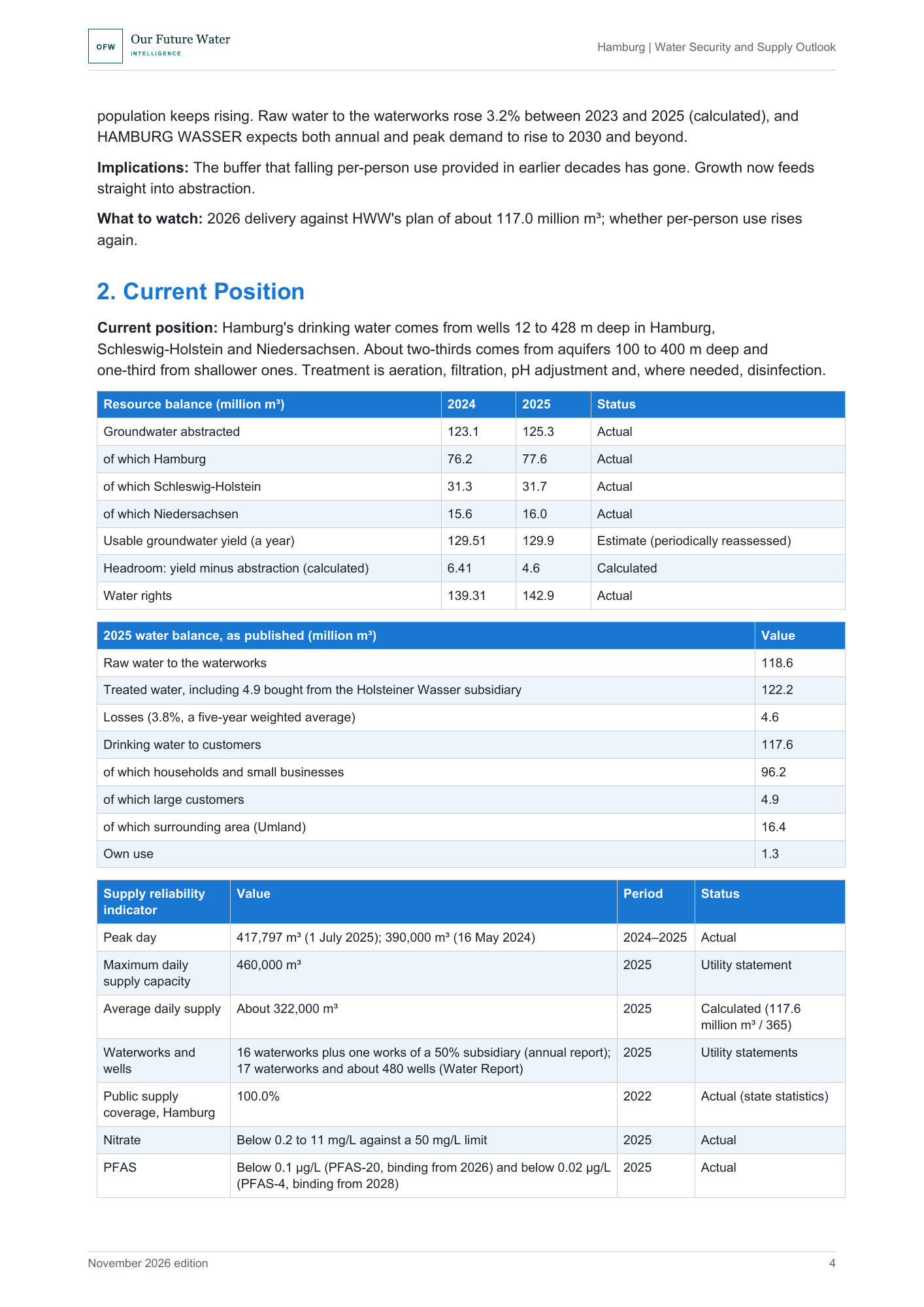
Groundwater abstraction against usable yield and water rights, the 2025 water balance and supply reliability indicators, from Section 2, Current Position.
06
Included
What you receive
The complete PDF report: 10 pages, 9 sections, 10 tables and a register of 17 sources.
This edition
November 2026, First edition.
07
Evidence & method
Evidence and method
The brief draws on HAMBURG WASSER's 2024 and 2025 annual reports, its environmental statements on yield, rights and abstraction, its Water Reports for 2024 and 2025, and its 2025 position paper. It also uses the Nordheide legal record, official population and supply statistics, and BUKEA climate data based on the German Weather Service.
Sources
17 sources, listed in the report's source register. Evidence current to 4 November 2026. Principal data periods: HAMBURG WASSER operating figures for 2023–2025 (calendar years); groundwater yield and water rights as assessed in the 2024 and 2025 environmental statements; hydrological years to October 2024 and October 2025; legal and project status re-checked on 4 November 2026. All currency is euros (EUR)..
Evidence boundaries
This report uses authoritative source material available at the stated research cutoff. It distinguishes published facts, calculated values and analytical interpretation. No independent modelling is performed. Forward-looking analysis reflects published plans, documented trends and stated uncertainties. It does not constitute legal, financial, investment or engineering advice.
08
Lead analyst
Robert C. Brears
Founder, Our Future Water Intelligence
Robert C. Brears is a water-security specialist and author whose work examines utility governance, infrastructure investment, climate resilience and long-term water-system change for executive and policy audiences.
- Decision-focused utility intelligence
- Published water-policy author
- Evidence-grounded system analysis
09
Buyer FAQs
Before you purchase
Who can use the report?
Licensed for internal use within one purchasing organization. The PDF and its contents may be shared with colleagues within that organization. External redistribution, resale and public publication are prohibited without permission.
How is the report delivered?
The PDF is available to download immediately after confirmed payment, through our secure delivery system.
Can my organization buy wider access?
Institutional purchasing: For invoice enquiries, multi-organization licensing or broader access requirements, contact Our Future Water Intelligence.
10
Water Security and Supply Outlook in Hamburg
- Format
- Length
- 10 pages
- Edition
- November 2026, First edition
- Price
- USD 249
11
Report details
Publication details
- Publisher
- Our Future Water Intelligence
- Report family
- Insight Brief
- Edition
- November 2026, First edition
- Format
- Length
- 10 pages
- Reference
- OFW_EXT_WATER_SECURITY_AND_SUPPLY_OUTLOOK_IN_HAMBURG_0b018f71e338
- Evidence current to
- 4 November 2026
14
Explore this report family
More Water Security and Supply Outlook briefs
Explore the same report family covering other cities.
Water Security and Supply Outlook in Amsterdam
- Geography
- Netherlands
- Edition
- November 2026, First edition
- Length
- 10 pages
Water Security and Supply Outlook in Copenhagen
- Geography
- Denmark
- Edition
- November 2026, First edition
- Length
- 10 pages