
01
Executive overview
Key findings
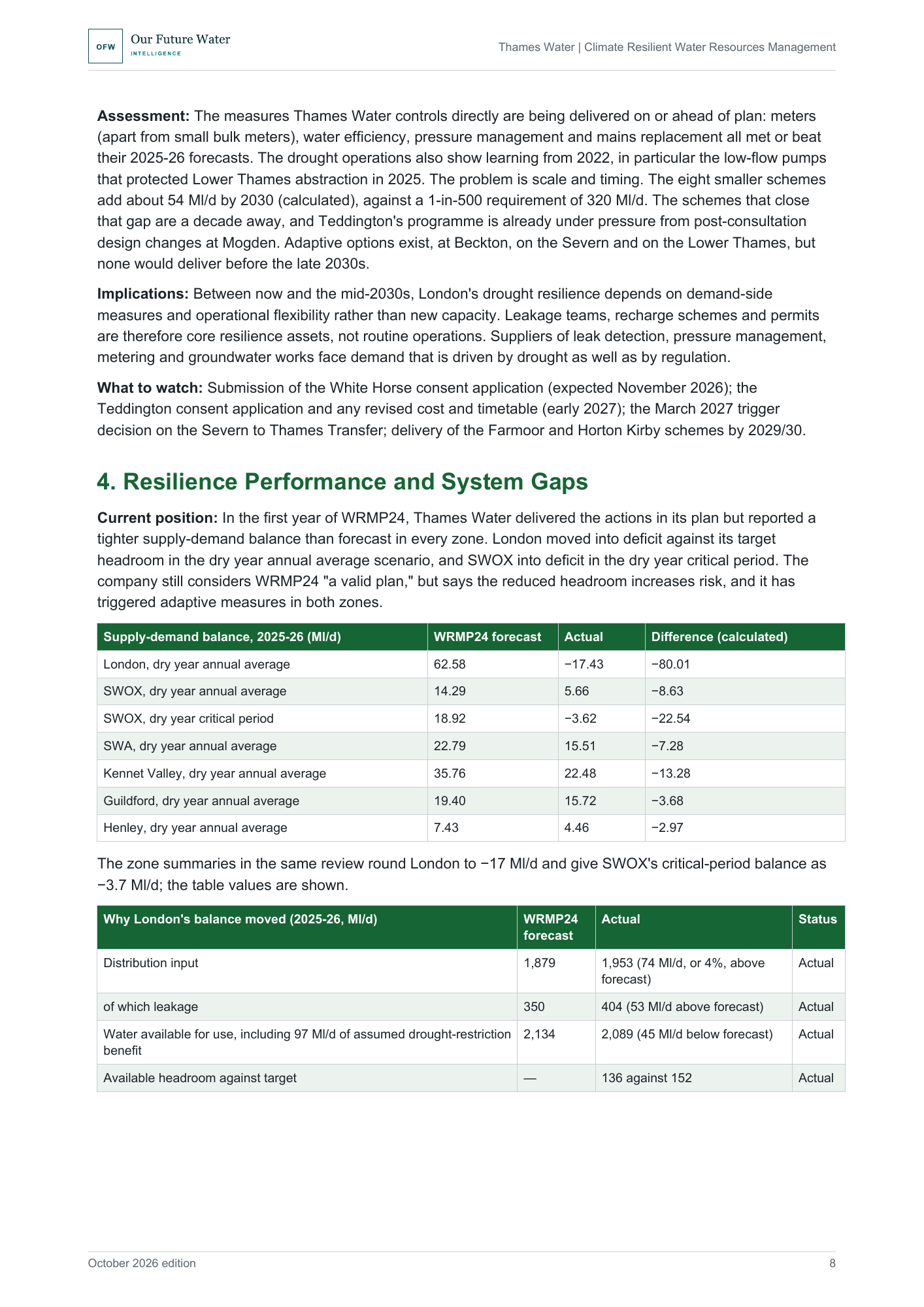
−17.43 Ml/d: London supply-demand balance in 2025-26 (dry year annual average), against a WRMP24 forecast surplus of 62.58 Ml/d (actual vs forecast)
592.7 Ml/d: company leakage in 2025-26 on a dry year basis, against a WRMP24 forecast of 498.3 Ml/d (actual vs forecast)
1 in 100 years: London's current level of service for emergency drought orders, against 1 in 200 in the 2030s and 1 in 500 by 2040 (current vs target)
July 23, 2026: company-wide Temporary Use Ban in force, still in place on October 12, 2026; the Thames area has been in drought since July 29, 2026 (status)
02
Buyer relevance
Who the report is for
Leakage, metering and pressure management suppliers
See why leakage of 592.7 Ml/d against a forecast of 498.3 Ml/d makes network work London's main drought-resilience lever to 2035.
Engineering and groundwater contractors
Track the eight supply schemes due by 2029/30 and the consent timetable for White Horse Reservoir and Teddington.
Local authorities and growth planners
Compare WRMP24's population forecasts with the pressures the company now reports from housing targets and data center demand.
Infrastructure investors and regulators
Judge how the 2026 drought, Gateway's outage and the financing timetable affect delivery of 1-in-500-year resilience by 2040.
03
Decision scope
Questions answered
Is London's water supply in deficit?
Yes, against its target headroom: the London zone's 2025-26 dry year balance was −17.43 Ml/d, against a WRMP24 forecast surplus of 62.58 Ml/d.
Why did London's balance worsen?
Distribution input was 74 Ml/d above forecast, 53 Ml/d of it leakage, and water available for use was 45 Ml/d below forecast after deployable output write-downs.
How resilient is London to severe drought today?
Its level of service for emergency drought orders is 1 in 100 years, against targets of 1 in 200 in the 2030s and 1 in 500 by 2040.
When will new strategic supply arrive?
Teddington is planned for the 2030s and White Horse Reservoir, up to 271 Ml/d, is planned to be operational by 2040.
What is the status of the 2026 drought?
A company-wide Temporary Use Ban took effect on July 23, 2026 and was still in place on October 12, 2026; the Thames area has been in drought since July 29, 2026.
04
Inside the report
Inside the complete report
Executive Snapshot
1. Introduction
2. Climate Risks to Urban Water Systems
3. Implemented and Emerging Resilience Measures
4. Resilience Performance and System Gaps
5. Stakeholder Roadmap
Future Outlook and Recommendations
Source Register
05
Public preview
What to watch next
4. Resilience Performance and System Gaps
Revised WRMP24 tables (October 2026) for London's target headroom and the leakage forecast; DWI approval of replacement membranes for Gateway; the Lower Thames deployable output study for WRMP29; the October 29, 2026 creditor vote and the stable platform extension before March 2027.
3. Implemented and Emerging Resilience Measures
Submission of the White Horse consent application (expected November 2026); the Teddington consent application and any revised cost and timetable (early 2027); the March 2027 trigger decision on the Severn to Thames Transfer; delivery of the Farmoor and Horton Kirby schemes by 2029/30.
2. Climate Risks to Urban Water Systems
Lifting of the 2026 Temporary Use Ban and whether the drought carries into winter 2026-27; reservoir and groundwater recovery in the Environment Agency's weekly reports; whether further drought permits follow Farmoor.
5. Stakeholder Roadmap
The Planning Inspectorate's acceptance of the White Horse application; Defra's timetable for water efficiency labelling; publication of the government's Transition Plan for Water, which the company says may change the regulatory and planning regime.
Section 4: supply-demand balance by water resource zone, WRMP24 forecast against 2025-26 actual.
06
Included
What you receive
The complete PDF report: 14 pages, 8 sections, 15 tables and a register of 13 sources.
This edition
October 2026 edition. Covers the first year of WRMP24 delivery (2025-26), with supply-demand balances for all six water resource zones. Includes the 2025 Swindon and Oxfordshire drought and the 2026 company-wide Temporary Use Ban, drought declaration and Farmoor drought permit. Includes the Gateway desalination outage, the Lower Thames deployable output study and the revised leakage outlook. Includes the White Horse Reservoir Gate 3 decision and the consent timetables for White Horse and Teddington. Time-sensitive facts checked to October 27, 2026. New edition, October 2026, with evidence current to 27 October 2026. Replaces the earlier edition for new buyers; buyers of an earlier edition keep access to the edition they bought.
07
Evidence & method
Evidence and method
The report draws on Thames Water's WRMP24 and its 2025-26 annual review, its 2024 climate change adaptation report, its FY 2025/26 sustainability report and leakage performance report, Environment Agency weekly drought reports for 2026, company drought announcements, and project and planning documents for White Horse Reservoir and Teddington.
Sources
13 sources, listed in the report's source register. Evidence current to 27 October 2026. Principal data periods: FY 2025/26 (year ended March 31, 2026) and the WRMP annual review for 2025-26; the 2025 and 2026 droughts, with drought status to October 22, 2026; the WRMP24 planning horizon, 2025–2075. All currency is pounds sterling (£)..
Evidence boundaries
This report uses authoritative source material available at the stated research cutoff. It distinguishes published facts, calculated values and analytical interpretation. No independent modelling is performed. Forward-looking analysis reflects published plans, documented trends and stated uncertainties. It does not constitute legal, financial, investment or engineering advice.
08
Lead analyst
Robert C. Brears
Lead Analyst, Our Future Water Intelligence
Robert C. Brears is a water-security specialist and author whose work examines utility transformation, infrastructure, governance, finance and climate resilience for executive and policy audiences.
- Evidence-led water intelligence
- Decision-focused system analysis
- Report-specific treatment of scope and terminology
09
Buyer FAQs
Before you purchase
Who can use the report?
Licensed for internal use within one purchasing organization. The PDF and its contents may be shared with colleagues within that organization. External redistribution, resale and public publication are prohibited without permission.
How is the report delivered?
The PDF is available to download immediately after confirmed payment, through our secure delivery system.
Can my organization buy wider access?
Institutional purchasing: For invoice enquiries, multi-organization licensing or broader access requirements, contact Our Future Water Intelligence.
10
Climate Resilient Water Resources Management: Thames Water
- Format
- Length
- 14 pages
- Edition
- October 2026 edition
- Price
- USD 499
11
Report details
Publication details
- Publisher
- Our Future Water Intelligence
- Report family
- Water Utility Intelligence Report
- Report type
- Climate Resilient Water Resources Management
- Edition
- October 2026 edition
- Format
- Length
- 14 pages
- Reference
- OFW-8783453421746_a45c552a734c
- Evidence current to
- 27 October 2026
14
Explore this report family
More Climate Resilient Water Resources Management reports
Explore the same report family covering other utilities.
Climate Resilient Water Resources Management
Climate Resilient Water Resources Management: Águas de Portugal
- Geography
- Portugal
- Edition
- 2026
- Length
- 17 pages
Climate Resilient Water Resources Management
Climate Resilient Water Resources Management: Department of Energy, Abu Dhabi Emirate
- Geography
- Abu Dhabi, United Arab Emirates
- Edition
- 2026
- Length
- 21 pages
Climate Resilient Water Resources Management
Climate Resilient Water Resources Management: Melbourne Water
- Geography
- Melbourne, Australia
- Edition
- 2026
- Length
- 20 pages