
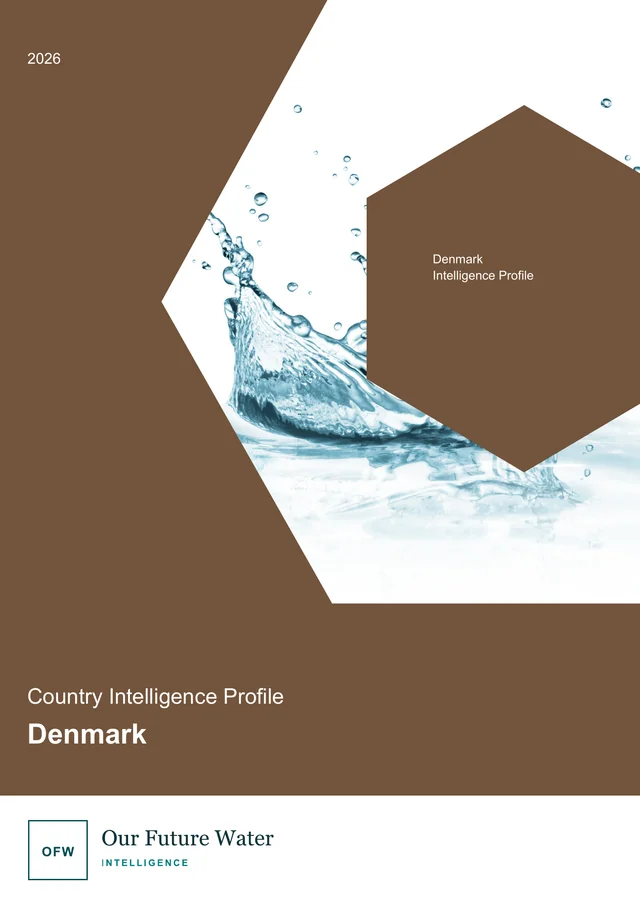
01
Executive overview
Key findings
26.63%: water stress (SDG 6.4.2) in 2023, just inside UN-Water's "low" band (25–50%)
815 million m³: total water abstraction in 2024, down 18% from 984 million m³ in 2023 as field irrigation fell in a wet year
Over 150%: groundwater abstraction on Zealand as a share of the estimated sustainable resource (GEUS, 2023 assessment)
DKK 40.1 billion: debt of 182 municipally owned water and wastewater companies in 2022
02
Buyer relevance
Who the report is for
Firms entering the Danish water market
Identify who permits, regulates, owns and buys, from the Danish Water Sector Regulator to the 98 municipalities and utilities such as HOFOR and Aarhus Vand.
Contractors and equipment suppliers
See the dated capital-region projects, including HOFOR's waterworks programme to 2032 and the DKK 4.1–4.6 billion Svanemøllen cloudburst tunnel.
Lenders and analysts
Compare 2022 sector investment of DKK 7.80 billion in wastewater and DKK 2.16 billion in drinking water with sector debt of DKK 40.1 billion.
Climate adaptation and coastal teams
Separate the agreed DKK 912.1 million coastal package for 2026–2029 from the DKK 14.9 billion national plan still awaiting a political deal.
03
Decision scope
Questions answered
Is Denmark short of water?
Not nationally: water stress was 26.63% in 2023. But groundwater abstraction on Zealand exceeds 150% of the estimated sustainable resource, and HOFOR projects a 12 million m³ shortfall in its capital-region area by 2040.
Where does Danish drinking water come from?
From groundwater: 0.75 km³ of the 0.98 km³ withdrawn in 2023 came from aquifers, and desalinated output was 0.00 km³.
What does water cost in Danish cities?
In 2026 the combined price for water and wastewater is DKK 65.98 per m³ in Odense and DKK 58.55 in Aarhus, against a provisional DKK 49.57 in Copenhagen.
How much water is lost from networks?
7.5% on average across 77 companies in 2024; 13 of them pay the penalty tax for losses above 10%.
04
Inside the report
Inside the complete report
Executive Snapshot
1. Country Water Profile
2. Water Resources and Supply
3. Institutions and Utilities
4. Infrastructure and Major Projects
5. Tariffs and Finance
6. Climate and Resilience
7. Outlook and What to Watch
Source Register
05
Public preview
What to watch next
3. Institutions and Utilities
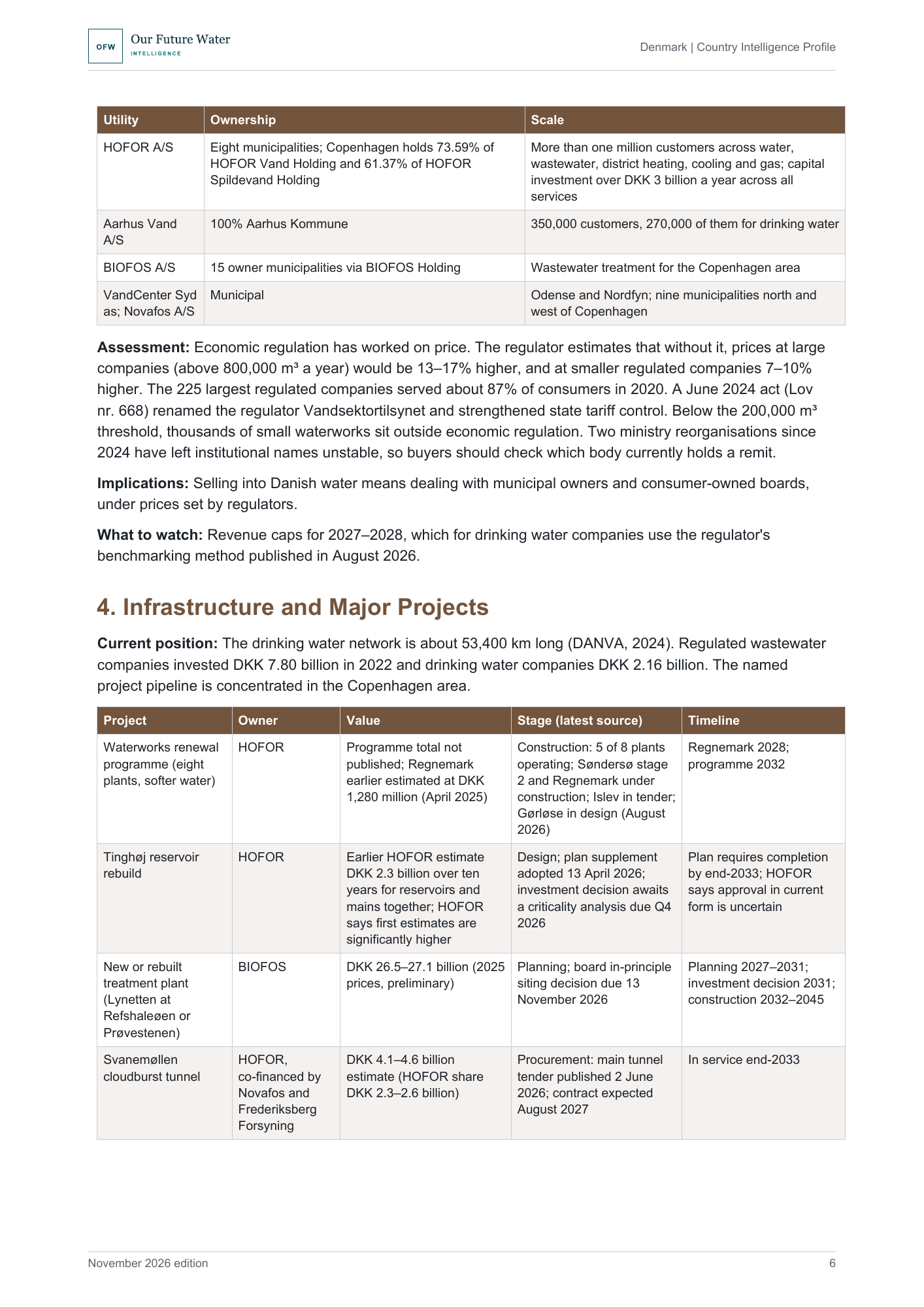
Revenue caps for 2027–2028, which for drinking water companies use the regulator's benchmarking method published in August 2026.
4. Infrastructure and Major Projects
Whether HOFOR's Q4 2026 criticality analysis confirms or rescopes Tinghøj, and the main tunnel contract award for Svanemøllen expected in August 2027.
5. Tariffs and Finance
2027 tariff decisions by the large utilities and municipal approvals over the winter.
6. Climate and Resilience
A cross-party agreement on the national coastal plan, and the outcome of the state's evaluation of the service-level rules.
Major capital-region projects with owner, value, stage and timeline, after the utility ownership table.
06
Included
What you receive
The complete PDF report: 12 pages, 9 sections, 10 tables and a register of 41 sources.
This edition
November 2026, First edition.
07
Evidence & method
Evidence and method
Official statistics from Statistics Denmark, the Danish EPA and GEUS; FAO and UN-Water indicators; national agreements, acts and river basin planning documents; DMI climate projections; and utility tariffs, plans and municipal committee papers, with DANVA sector benchmarking.
Sources
41 sources, listed in the report's source register. Evidence current to 3 November 2026. Principal data periods: 2023–2024 national water accounts; 2020–2022 drinking water supply statistics; 2022 sector finance; 2024 utility benchmarking; 2026 tariffs; climate projections for 2071–2100. All currency is Danish kroner (DKK) unless stated. Scope is metropolitan Denmark; Greenland and the Faroe Islands are excluded..
Evidence boundaries
This report uses authoritative source material available at the stated research cutoff. It distinguishes published facts, calculated values and analytical interpretation. No independent modelling is performed. Forward-looking analysis reflects published plans, documented trends and stated uncertainties. It does not constitute legal, financial, investment or engineering advice.
08
Lead analyst
Robert C. Brears
Founder, Our Future Water Intelligence
Robert C. Brears is a water-security specialist and author whose work examines utility governance, infrastructure investment, climate resilience and long-term water-system change for executive and policy audiences.
- Decision-focused utility intelligence
- Published water-policy author
- Evidence-grounded system analysis
09
Buyer FAQs
Before you purchase
Who can use the report?
Licensed for internal use within one purchasing organization. The PDF and its contents may be shared with colleagues within that organization. External redistribution, resale and public publication are prohibited without permission.
How is the report delivered?
The PDF is available to download immediately after confirmed payment, through our secure delivery system.
Can my organization buy wider access?
Institutional purchasing: For invoice enquiries, multi-organization licensing or broader access requirements, contact Our Future Water Intelligence.
10
Denmark Country Intelligence Profile
- Format
- Length
- 12 pages
- Edition
- November 2026, First edition
- Price
- USD 99
11
Report details
Publication details
- Publisher
- Our Future Water Intelligence
- Report family
- Country Intelligence Profile
- Edition
- November 2026, First edition
- Format
- Length
- 12 pages
- Reference
- OFW_EXT_DENMARK_COUNTRY_INTELLIGENCE_PROFILE_fa2a1cacbbcc
- Evidence current to
- 3 November 2026
14
Explore this report family
More Country Intelligence Profiles
Explore the same report family covering other countries.
National Water Research and Reference
Saudi Arabia Country Intelligence Profile
- Geography
- Saudi Arabia
- Edition
- October 2026 edition
- Length
- 13 pages
National Water Research and Reference
Morocco Country Intelligence Profile
- Geography
- Morocco
- Edition
- October 2026, New edition
- Length
- 14 pages
National Water Research and Reference
Qatar Country Intelligence Profile
- Geography
- Qatar
- Edition
- October 2026 edition
- Length
- 12 pages