
01
Executive overview
Key findings
+90% (range 30–160%): projected increase in cloudburst intensity by 2071–2100 under a high-emissions scenario (DMI Klimaatlas v2020b)
37.0°C: temperature measured on 27 June 2026, the highest maximum temperature for any time of year since national records began in 1874 (DMI)
DKK 912.1 million: coastal protection acceleration package agreed for 2026–2029
DKK 14.9 billion: state funding proposed for national coastal protection in 2029–2040; no cross-party agreement found by 3 November 2026
02
Buyer relevance
Who the report is for
Coastal engineering and consultancy firms
Separate funded work (DKK 912.1 million for 2026–2029, 14 preliminary investigations and screenings) from the unfunded DKK 14.9 billion national plan.
Utilities and municipal planners
Set design loads against DMI's two atlas editions, including a 10-year daily rainfall rise of +19% (v2025a) against +23% (v2020b).
Insurers and risk analysts
Track exposure to cloudbursts, storm surge and heat, including the DKK 12–13 billion capital storm-surge scheme still without a financing model.
Policy and public-affairs teams
Follow the state's evaluation of the cloudburst service level, now limited to a 10-year event for tariff-financed projects started after 1 January 2027.
03
Decision scope
Questions answered
How much heavier will Danish cloudbursts get?
DMI's Klimaatlas v2020b projects cloudburst intensity up 90% (range 30–160%) by 2071–2100 under a high-emissions scenario.
What happened in 2026?
Spring rainfall was 22% below normal, and on 27 June Denmark recorded 37.0°C, its highest temperature since national records began in 1874.
How much coastal protection money is committed?
DKK 912.1 million for 2026–2029 under the October 2025 package, plus about DKK 1.3 billion for West Coast sand nourishment; the DKK 14.9 billion national plan is a proposal.
Who pays for urban flood protection?
Mainly wastewater tariffs: Copenhagen's DKK 14.9 billion cloudburst estimate includes DKK 11.9 billion from tariffs and DKK 3.0 billion from property owners.
04
Inside the report
Inside the complete report
Executive Snapshot
1. Why This Matters Now in Denmark
2. Current Position
3. Key Programmes, Projects and Investment
4. Policy, Regulation and Institutions
5. Risks and Constraints
6. Strategic Implications
7. What to Watch
Source Register
05
Public preview
What to watch next
1. Why This Matters Now in Denmark
DMI's full summer 2026 summary, and HOFOR's 2026 consumption data.
2. Current Position
Whether design guidance and service-level rules are updated to the v2025a projections.
Drought and supply resilience
The first preliminary-investigation results in early 2027 and a political agreement on the national plan.
4. Policy, Regulation and Institutions
The outcome of the state's evaluation of the cloudburst service-level rules.
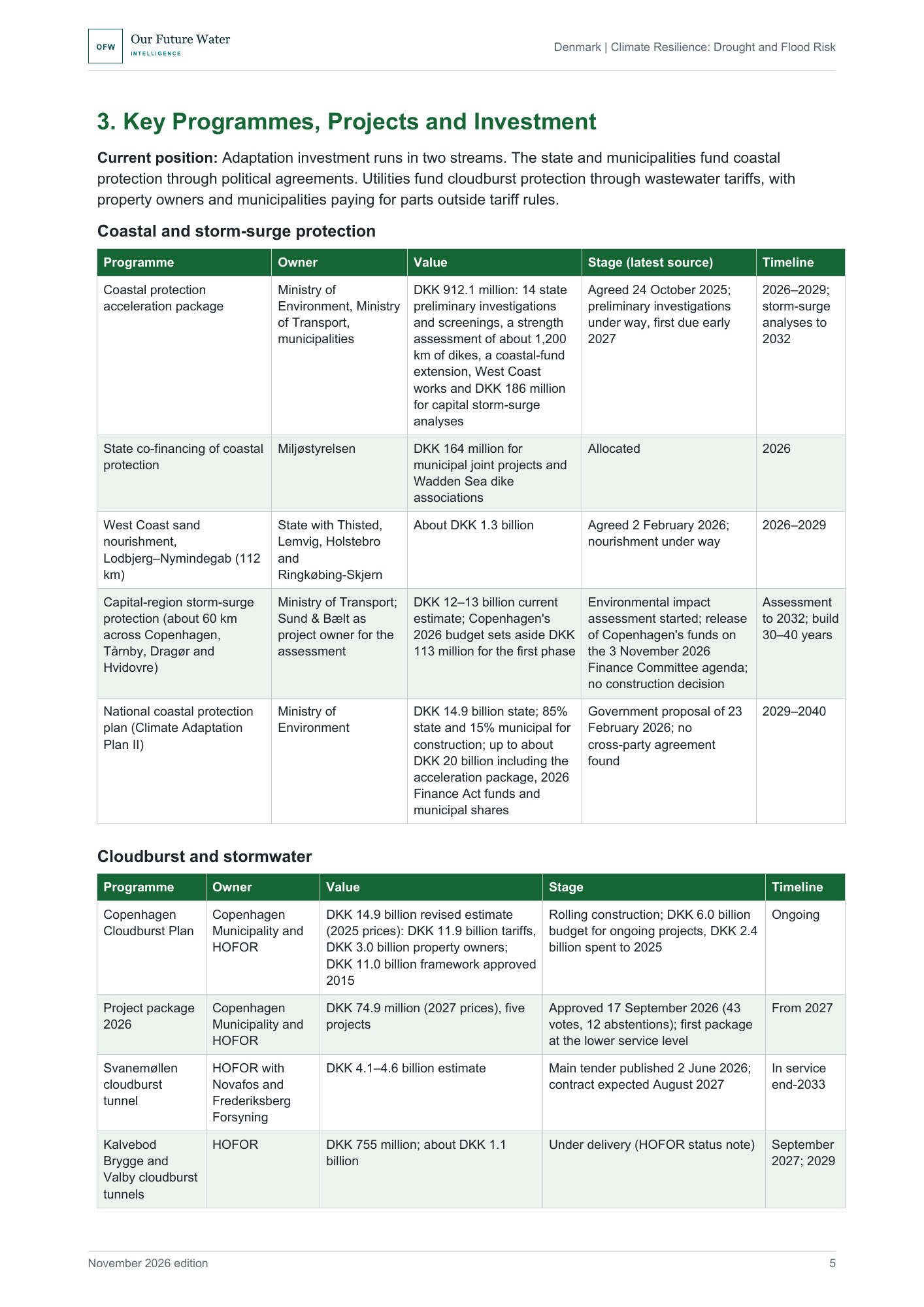
Coastal, storm-surge and cloudburst programmes with owner, value, stage and timeline.
06
Included
What you receive
The complete PDF report: 10 pages, 9 sections, 9 tables and a register of 18 sources.
This edition
November 2026, First edition.
07
Evidence & method
Evidence and method
DMI climate atlases and monthly and seasonal weather summaries, national coastal protection agreements and government announcements, Miljøstyrelsen programme pages, Copenhagen Municipality and HOFOR adaptation papers, and GEUS and NIRAS water-resource assessments.
Sources
18 sources, listed in the report's source register. Evidence current to 3 November 2026. Principal data periods: DMI climate projections for 2071–2100 against 1981–2010 (Klimaatlas v2020b and v2025a); observed weather to June 2026; coastal and cloudburst programmes for 2026–2040. Statuses were re-checked on 3 November 2026. All currency is Danish kroner (DKK) unless stated..
Evidence boundaries
This report uses authoritative source material available at the stated research cutoff. It distinguishes published facts, calculated values and analytical interpretation. No independent modelling is performed. Forward-looking analysis reflects published plans, documented trends and stated uncertainties. It does not constitute legal, financial, investment or engineering advice.
08
Lead analyst
Robert C. Brears
Founder, Our Future Water Intelligence
Robert C. Brears is a water-security specialist and author whose work examines utility governance, infrastructure investment, climate resilience and long-term water-system change for executive and policy audiences.
- Decision-focused utility intelligence
- Published water-policy author
- Evidence-grounded system analysis
09
Buyer FAQs
Before you purchase
Who can use the report?
Licensed for internal use within one purchasing organization. The PDF and its contents may be shared with colleagues within that organization. External redistribution, resale and public publication are prohibited without permission.
How is the report delivered?
The PDF is available to download immediately after confirmed payment, through our secure delivery system.
Can my organization buy wider access?
Institutional purchasing: For invoice enquiries, multi-organization licensing or broader access requirements, contact Our Future Water Intelligence.
10
Climate Resilience: Drought and Flood Risk in Denmark
- Format
- Length
- 10 pages
- Edition
- November 2026, First edition
- Price
- USD 249
11
Report details
Publication details
- Publisher
- Our Future Water Intelligence
- Report family
- Insight Brief
- Edition
- November 2026, First edition
- Format
- Length
- 10 pages
- Reference
- OFW_EXT_CLIMATE_RESILIENCE_DROUGHT_AND_FLOOD_RISK_IN_DENMARK_10869ce58716
- Evidence current to
- 3 November 2026
14
Explore this report family
More Climate Resilience: Drought and Flood Risk briefs
Explore the same report family covering other countries.
Climate Resilience: Drought and Flood Risk in Germany
- Geography
- Germany
- Edition
- November 2026, First edition
- Length
- 11 pages
Climate Resilience: Drought and Flood Risk in Netherlands
- Geography
- Netherlands
- Edition
- November 2026, First edition
- Length
- 10 pages