01
Executive overview
Key findings
Over 150%: groundwater abstraction on Zealand as a share of the estimated sustainable resource (GEUS, 2023 assessment, excluding climate change)
12 million m³ a year: HOFOR's projected 2040 shortfall in the capital region, with demand of 73 million m³ against 2024 capacity of 61 million m³; 16 million m³ if the past 15 years' capacity decline continues
3.6 million m³ a year: HOFOR capacity lost to PFAS and pesticide contamination in 2024
50.9%: share of 2,272 tested drinking-water supply boreholes with a pesticide detection in 2023; 12.2% exceeded the single-substance limit
02
Buyer relevance
Who the report is for
Capital-region utilities and municipal planners
Benchmark the 12–16 million m³ 2040 gap against the projects and protection measures now under way.
Treatment and monitoring suppliers
Size demand for pesticide and PFAS treatment where 50.9% of tested supply boreholes showed a pesticide detection in 2023.
Industrial and Power-to-X developers
Plan for groundwater as a last resort on Zealand, where Power-to-X demand of 20–25 million m³ is estimated for 2040.
Policy and public-affairs teams
Prepare for the 2027 decision on protecting vulnerable groundwater-forming areas and the reuse review due by 2029.
03
Decision scope
Questions answered
Is Denmark running out of water?
Not nationally: water stress was 26.63% in 2023. But Zealand abstracts over 150% of its estimated sustainable groundwater resource, and HOFOR projects demand of 73 million m³ against 61 million m³ of capacity by 2040.
What is reducing supply capacity?
Contamination: HOFOR lost 3.6 million m³ a year of capacity to PFAS and pesticides in 2024, at 8 of about 50 well fields.
Can Denmark turn to desalination or reuse?
Desalinated output was 0.00 km³ in 2023 and new plants are permitted only by exception; a January 2026 decision excludes treated wastewater for farm irrigation until a review due by 2029.
How did 2026 test the system?
Spring rainfall was 103.4 mm, 22% below normal, and HOFOR reported 2026 on course for the highest capital-region consumption in more than 20 years.
04
Inside the report
Inside the complete report
Executive Snapshot
1. Why This Matters Now in Denmark
2. Current Position
3. Key Programmes, Projects and Investment
4. Policy, Regulation and Institutions
5. Risks and Constraints
6. Strategic Implications
7. What to Watch
Source Register
05
Public preview
What to watch next
1. Why This Matters Now in Denmark
HOFOR's 2026 consumption totals once published, and DMI's full summer 2026 summary.
Resource quality
GEUS's next groundwater monitoring report, with 2024 pesticide and nitrate results.
3. Key Programmes, Projects and Investment
The 2027 decision on groundwater-forming areas and whether it adopts groundwater parks; HOFOR's Tinghøj investment decision.
4. Policy, Regulation and Institutions
Any government response to DI's call for a national water plan; the reuse review due by 2029.
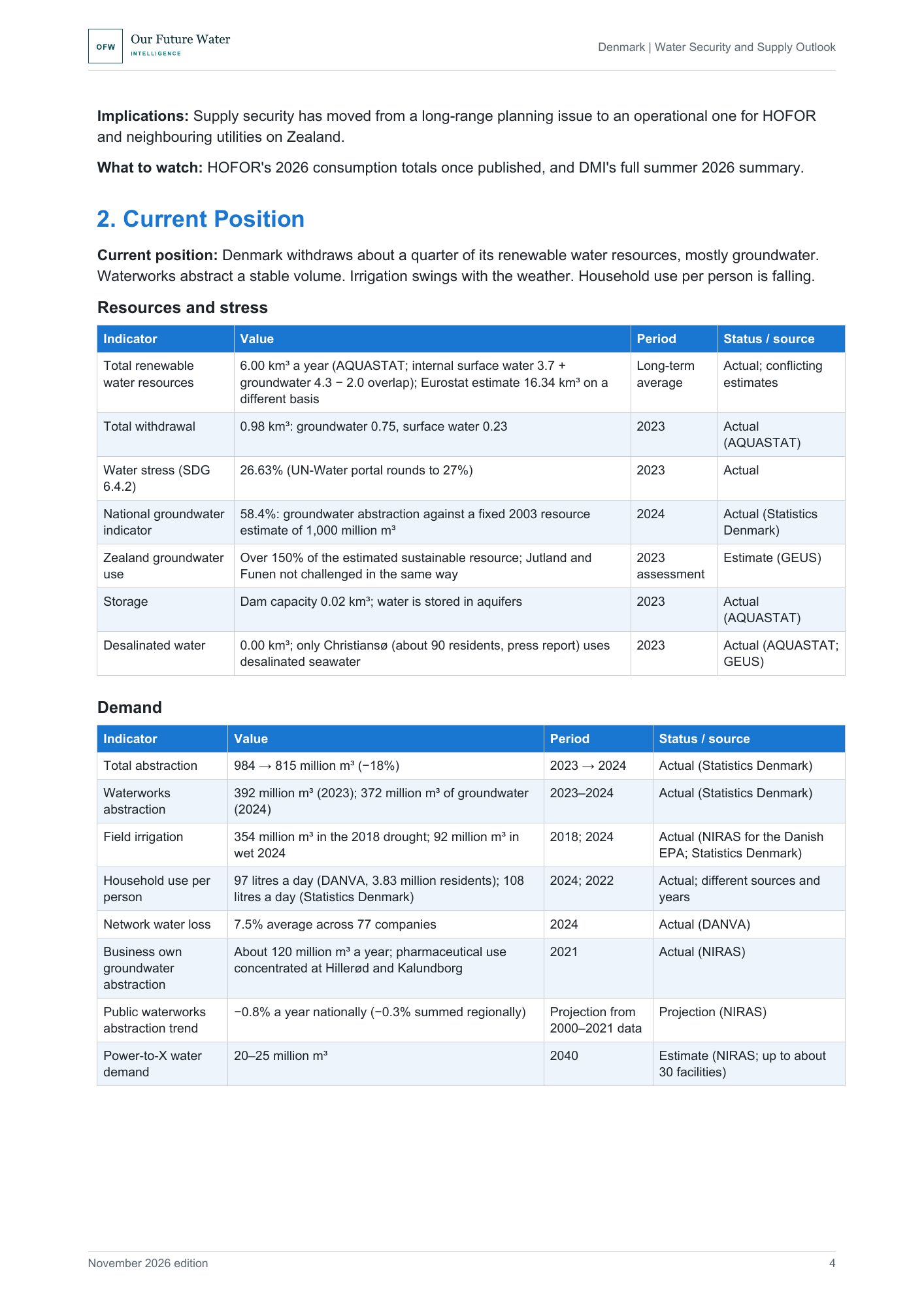
Resource, stress and demand indicators with periods and status.
06
Included
What you receive
The complete PDF report: 10 pages, 9 sections, 9 tables and a register of 27 sources.
This edition
November 2026, First edition.
07
Evidence & method
Evidence and method
National water accounts and SDG indicators from Statistics Denmark, FAO and UN-Water; GEUS groundwater monitoring and resource assessments; DMI observations and climate projections; ministry decisions and orders; and HOFOR planning documents and statements.
Sources
27 sources, listed in the report's source register. Evidence current to 3 November 2026. Principal data periods: 2023 resource and water-stress indicators; 2023–2024 national water accounts; 2023 groundwater monitoring; 2024 capital-region capacity; projections to 2040 and 2071–2100; spring 2026 weather. Statuses were re-checked on 3 November 2026. All currency is Danish kroner (DKK) unless stated..
Evidence boundaries
This report uses authoritative source material available at the stated research cutoff. It distinguishes published facts, calculated values and analytical interpretation. No independent modelling is performed. Forward-looking analysis reflects published plans, documented trends and stated uncertainties. It does not constitute legal, financial, investment or engineering advice.
08
Lead analyst
Robert C. Brears
Founder, Our Future Water Intelligence
Robert C. Brears is a water-security specialist and author whose work examines utility governance, infrastructure investment, climate resilience and long-term water-system change for executive and policy audiences.
- Decision-focused utility intelligence
- Published water-policy author
- Evidence-grounded system analysis
09
Buyer FAQs
Before you purchase
Who can use the report?
Licensed for internal use within one purchasing organization. The PDF and its contents may be shared with colleagues within that organization. External redistribution, resale and public publication are prohibited without permission.
How is the report delivered?
The PDF is available to download immediately after confirmed payment, through our secure delivery system.
Can my organization buy wider access?
Institutional purchasing: For invoice enquiries, multi-organization licensing or broader access requirements, contact Our Future Water Intelligence.
10
Water Security and Supply Outlook in Denmark
- Format
- Length
- 10 pages
- Edition
- November 2026, First edition
- Price
- USD 249
11
Report details
Publication details
- Publisher
- Our Future Water Intelligence
- Report family
- Insight Brief
- Edition
- November 2026, First edition
- Format
- Length
- 10 pages
- Reference
- OFW_EXT_WATER_SECURITY_AND_SUPPLY_OUTLOOK_IN_DENMARK_df44156af23f
- Evidence current to
- 3 November 2026
14
Explore this report family
More Water Security and Supply Outlook briefs
Explore the same report family covering other countries.
Water Security and Supply Outlook in Germany
- Geography
- Germany
- Edition
- November 2026, First edition
- Length
- 12 pages
Water Security and Supply Outlook in Netherlands
- Geography
- Netherlands
- Edition
- November 2026, First edition
- Length
- 11 pages