01
Executive overview
Key findings
1,375,577: population of Doha Municipality (2025 estimate, National Planning Council); 1,186,023 at Census 2020, 41.7% of Qatar
538 MIGD: national potable desalination capacity (2024), against national water demand of 420 MIGD (2024)
648 MIGD: national production capacity expected after the Facility E plant at Ras Abu Fontas is commissioned in 2028 (projection)
9,707 km: national sewer network assets in 2025, up from 2,836 km in 2013 (Ashghal)
02
Buyer relevance
Who the report is for
Water and wastewater suppliers entering Qatar
Identify the two national clients, KAHRAMAA and Ashghal, and the eleven named projects with owner, value and last confirmed stage.
Consultants preparing a Doha market entry or bid
Use the City Water Profile table to separate Doha's own figures (1,375,577 people, 100.0% coverage) from national ones.
Investors and lenders following Gulf desalination
Track Facility E's conflicting value and schedule figures, from QAR 13.5bn and USD 2.97bn of co-financing to full operations in 2029.
Analysts of tariffs and affordability
See the bill structure, including Ashghal's 20% wastewater charge and the two conflicting residential rate reports.
03
Decision scope
Questions answered
Who runs water in Doha?
KAHRAMAA operates the single national water network and sets tariffs; Ashghal runs the national drainage network, which had 9,707 km of sewer network assets in 2025.
Does Qatar have enough desalination capacity?
National potable desalination capacity was 538 MIGD in 2024 against water demand of 420 MIGD, and capacity is expected to reach 648 MIGD after Facility E in 2028.
How large is Doha's strategic water reserve?
Five measures are reported and are not comparable: 5.2 days of demand (2024), about 5.5 days of supply (2026), about four months of consumption, a 35% capacity margin and a level averaging 93%.
What does wastewater add to a water bill in Doha?
Ashghal's wastewater disposal charge is 20% of the monthly KAHRAMAA water bill, so a QAR 300 bill adds QAR 60.
04
Inside the report
Inside the complete report
Executive Snapshot
1. City Water Profile
2. Water Resources and Supply
3. Institutions and Utilities
4. Infrastructure and Major Projects
5. Tariffs and Finance
6. Climate and Resilience
7. Outlook and What to Watch
Source Register
05
Public preview
What to watch next
2. Water Resources and Supply
KAHRAMAA's next demand forecast (its latest is for 2025, 428 MIGD), and any reuse rate reported against the 2030 target.
3. Institutions and Utilities
Enforcement of Law No. 23 of 2025 after the compliance extension from 19 June 2026.
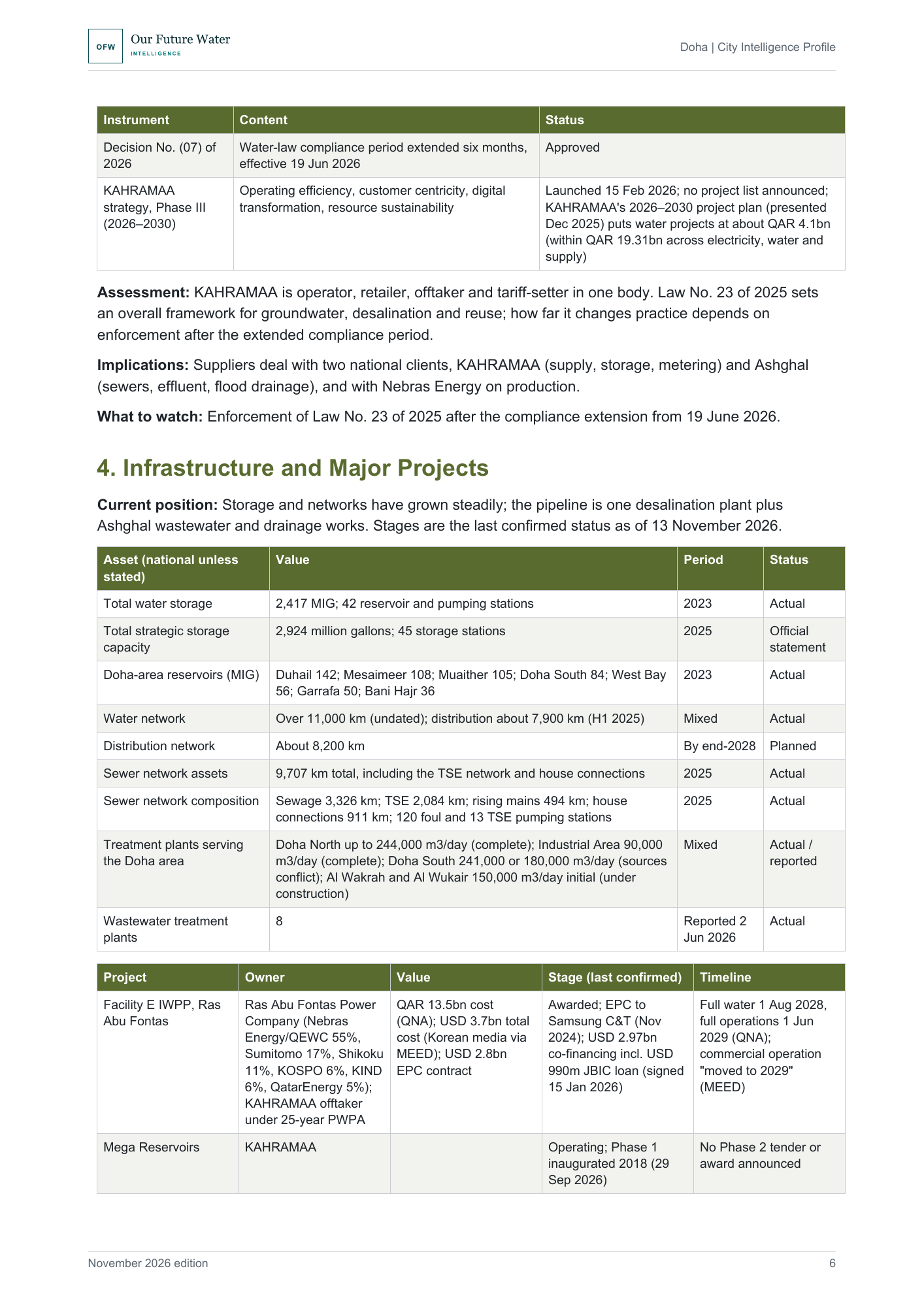
4. Infrastructure and Major Projects
Facility E construction progress and a confirmed schedule; completion notices for the D-Line and Al Wakrah works; tender launch for the two strategic tunnels.
5. Tariffs and Finance
An official KAHRAMAA tariff decision or rate publication; any water and wastewater share of Ashghal's QAR 81bn plan.
Section 4: Doha's major water and drainage projects, with owner, value, last confirmed stage and timeline.
06
Included
What you receive
The complete PDF report: 13 pages, 9 sections, 15 tables and a register of 40 sources.
This edition
November 2026, First edition.
07
Evidence & method
Evidence and method
The profile draws on KAHRAMAA's annual statistics, sustainability report and open datasets, National Planning Council census and population data, Ashghal releases and fee schedules, national strategies and laws, and dated news reports on project status re-checked in November 2026.
Sources
40 sources, listed in the report's source register. Evidence current to 13 November 2026. Principal data periods: water production and capacity 2019–2025; Census 2020 and 2025 population estimates; project status as of 13 November 2026. Currency is Qatari riyals (QAR; some sources write QR), with US dollar (USD) figures where sources give them..
Evidence boundaries
This report uses authoritative source material available at the stated research cutoff. It distinguishes published facts, calculated values and analytical interpretation. No independent modelling is performed. Forward-looking analysis reflects published plans, documented trends and stated uncertainties. It does not constitute legal, financial, investment or engineering advice.
08
Lead analyst
Robert C. Brears
Founder, Our Future Water Intelligence
Robert C. Brears is a water-security specialist and author whose work examines utility governance, infrastructure investment, climate resilience and long-term water-system change for executive and policy audiences.
- Decision-focused utility intelligence
- Published water-policy author
- Evidence-grounded system analysis
09
Buyer FAQs
Before you purchase
Who can use the report?
Licensed for internal use within one purchasing organization. The PDF and its contents may be shared with colleagues within that organization. External redistribution, resale and public publication are prohibited without permission.
How is the report delivered?
The PDF is available to download immediately after confirmed payment, through our secure delivery system.
Can my organization buy wider access?
Institutional purchasing: For invoice enquiries, multi-organization licensing or broader access requirements, contact Our Future Water Intelligence.
10
Doha City Intelligence Profile
- Format
- Length
- 13 pages
- Edition
- November 2026, First edition
- Price
- USD 99
11
Report details
Publication details
- Publisher
- Our Future Water Intelligence
- Report family
- City Intelligence Profile
- Edition
- November 2026, First edition
- Format
- Length
- 13 pages
- Reference
- OFW_EXT_DOHA_CITY_INTELLIGENCE_PROFILE_ffc52af49d51
- Evidence current to
- 13 November 2026
14
Explore this report family
More City Intelligence Profiles
Explore the same report family covering other cities.
Muscat City Intelligence Profile
- Geography
- Oman
- Edition
- November 2026, First edition
- Length
- 13 pages
Jeddah City Intelligence Profile
- Geography
- Saudi Arabia
- Edition
- November 2026, First edition
- Length
- 13 pages
Urban Water Research and Reference
Riyadh City Intelligence Profile
- Geography
- Riyadh, Saudi Arabia
- Edition
- November 2026
- Length
- 12 pages