
01
Executive overview
Key findings
202.2 million m³: water produced for Muscat in 2025, against 233.3 million m³ in 2024 (NCSI, data from APSR; actual)
300,000 m³ a day: Ghubrah III desalination plant, 93% built in November 2026, with operations expected in Q2 2027
RO 11.1 billion: Nama Water Services' Integrated Master Plan capital expenditure to 2050 for its licensed area (Oman excluding Dhofar), presented in December 2025
About RO 900 million (NWS) / €2 billion (SUEZ): 15-year performance-based operations contract for water and wastewater in Muscat and North and South Al Sharqiyah, awarded in July 2026
02
Buyer relevance
Who the report is for
Desalination, pumping and transmission suppliers
See Muscat Zone capacity plant by plant, from Ghubrah II's 191,000 m³ a day to Ghubrah III's 300,000, and the Al Ghubrah hub upgrade from about 190 to about 490 million litres a day.
Wastewater contractors and PPP developers
Track the Al Ansab and Al Amerat expansion, from 125,000 to about 207,000 and 18,000 to 54,000 m³ a day, with bids due on 5 January 2027, alongside the Seeb and Bawshar programmes.
Lenders and investors assessing Omani utility counterparties
Read Nama Water Services' 2024 position: a subsidy of RO 173.651 million within RO 428.663 million of operating revenue and current liabilities RO 338 million above current assets.
Consultants and analysts briefing on the Omani capital
Use one table of city figures with their geography, from 1,569,604 registered residents to 341,355 water connections, kept apart from licensed-area and national data.
03
Decision scope
Questions answered
Where does Muscat's water come from?
From Ghubrah II (191,000 m³ a day) and Qurayyat (200,000 m³ a day) desalination plants, about 40,000 m³ a day from two NWS-operated plants, and transfers from the Barka Zone of about 242,000 m³ a day available capacity.
Who runs water in Muscat?
Nama Water Services distributes water and runs wastewater, Nama PWP buys bulk desalinated water and APSR regulates; a SUEZ-led consortium was awarded a 15-year operations contract valued at about RO 900 million by NWS and €2 billion by SUEZ.
What do households pay?
NWS lists OMR 0.66 for citizen households with two accounts or fewer and OMR 0.770 for non-citizen households, plus a monthly sewage fee of OMR 2.100; the page does not state the unit.
Which new supply is coming?
Ghubrah III (300,000 m³ a day), expected to operate from Q2 2027, and the Wadi Dayqah dam plant (35,000 m³ a day potable), 57% complete in October 2026 and due in May 2027 (Nama PWP plans for 2028).
How exposed is Muscat to floods?
Nearly 45% of the capital's areas were reported vulnerable to wadi floods and about 20% to coastal floods; the Wadi Adai dam in Mutrah was 53.7% complete in June 2026.
04
Inside the report
Inside the complete report
Executive Snapshot
1. City Water Profile
2. Water Resources and Supply
3. Institutions and Utilities
4. Infrastructure and Major Projects
5. Tariffs and Finance
6. Climate and Resilience
7. Outlook and What to Watch
Source Register
05
Public preview
What to watch next
3. Institutions and Utilities
The Cluster 1 handover date, and whether NWS or APSR publishes a single loss baseline.
4. Infrastructure and Major Projects
Al Ansab/Al Amerat bid opening after 5 January 2027; Seeb–Barka bid submissions on 16 November 2026; PS4 commissioning.
5. Tariffs and Finance
The 2027 bulk supply tariff; any new retail schedule with stated units and effective date; NWS's 2025 audited statements.
6. Climate and Resilience
The AK01 and Al-Khoud drainage awards; publication of the updated Muscat flood-risk maps; Wadi Adai progress reports.
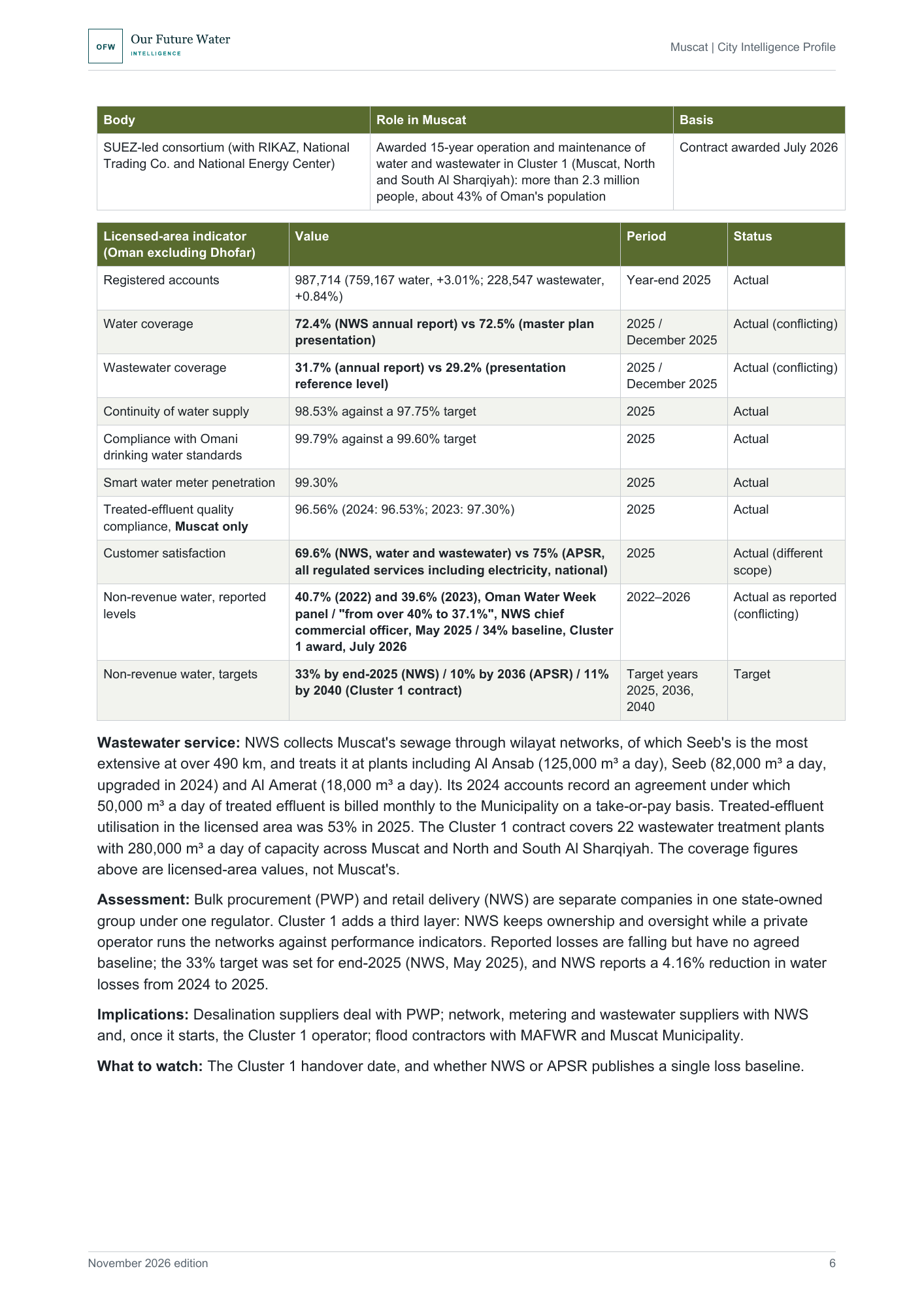
Section 3 and 4: licensed-area indicators with conflicting figures side by side, and the start of the Muscat project table with owner, value, stage and timeline.
06
Included
What you receive
The complete PDF report: 13 pages, 9 sections, 12 tables and a register of 36 sources.
This edition
November 2026, First edition.
07
Evidence & method
Evidence and method
The profile draws on NCSI population and water statistics compiled from APSR data, Nama PWP's 2026–2032 7-Year Statement and bulk tariff, Nama Water Services' 2025 annual report, 2024 audited accounts and tariff page, Oman's NDC 3.0, and project and procurement reports checked to 14 November 2026.
Sources
36 sources, listed in the report's source register. Evidence current to 14 November 2026. Principal data periods: 2025 water and population statistics (NCSI, data from APSR); Nama Water Services 2025 annual report and 2024 audited accounts; Nama PWP 7-Year Statement 2026–2032; project, procurement and tariff status as of 14 November 2026. Currency: Omani rial (RO, written OMR in some sources); US dollars (US$) and euros (€) where sources report them..
Evidence boundaries
This report uses authoritative source material available at the stated research cutoff. It distinguishes published facts, calculated values and analytical interpretation. No independent modelling is performed. Forward-looking analysis reflects published plans, documented trends and stated uncertainties. It does not constitute legal, financial, investment or engineering advice.
08
Lead analyst
Robert C. Brears
Founder, Our Future Water Intelligence
Robert C. Brears is a water-security specialist and author whose work examines utility governance, infrastructure investment, climate resilience and long-term water-system change for executive and policy audiences.
- Decision-focused utility intelligence
- Published water-policy author
- Evidence-grounded system analysis
09
Buyer FAQs
Before you purchase
Who can use the report?
Licensed for internal use within one purchasing organization. The PDF and its contents may be shared with colleagues within that organization. External redistribution, resale and public publication are prohibited without permission.
How is the report delivered?
The PDF is available to download immediately after confirmed payment, through our secure delivery system.
Can my organization buy wider access?
Institutional purchasing: For invoice enquiries, multi-organization licensing or broader access requirements, contact Our Future Water Intelligence.
10
Muscat City Intelligence Profile
- Format
- Length
- 13 pages
- Edition
- November 2026, First edition
- Price
- USD 99
11
Report details
Publication details
- Publisher
- Our Future Water Intelligence
- Report family
- City Intelligence Profile
- Edition
- November 2026, First edition
- Format
- Length
- 13 pages
- Reference
- OFW_EXT_MUSCAT_CITY_INTELLIGENCE_PROFILE_ee6e5dacb3ca
- Evidence current to
- 14 November 2026
14
Explore this report family
More City Intelligence Profiles
Explore the same report family covering other cities.
Jeddah City Intelligence Profile
- Geography
- Saudi Arabia
- Edition
- November 2026, First edition
- Length
- 13 pages
Doha City Intelligence Profile
- Geography
- Qatar
- Edition
- November 2026, First edition
- Length
- 13 pages
Urban Water Research and Reference
Riyadh City Intelligence Profile
- Geography
- Riyadh, Saudi Arabia
- Edition
- November 2026
- Length
- 12 pages