
01
Executive overview
Key findings
95 → 107 million m³ a year: Waternet's regular production capacity in 2024 against the capacity required by 2030 (projection)
122 million m³ a year: capacity required by 2050 in the 2023 forecast; the 2024 update adds about 4 million m³ a year after 2030
70 → 75 million m³ a year: dune abstraction ceiling, raised on 13 August 2025 after demand growth and extra deliveries to neighbouring utilities threatened to exceed it
141 litres: water use per person per day in the Waternet supply area in 2021, against a national target of 100 litres by 2035
02
Buyer relevance
Who the report is for
Large water users and data-centre developers
Gauge supply risk before relying on drinking water, given permits such as about 1.1 billion litres a year for two planned Equinix data centres.
Water sector consultants and engineers
Follow the post-2030 options, including about 6 million m³ a year of brackish seepage from the Horstermeerpolder that needs membrane treatment.
Provincial, city and national policy teams
See which intake, permit and demand decisions set the supply balance after 2030 and the national 100-litre target.
Investors and analysts covering Dutch utilities
Assess how a 5% operational reserve and a 2030 shortfall of 10 against 14 million m³ a year affect Waternet's risk.
03
Decision scope
Questions answered
Does Amsterdam have enough drinking water capacity today?
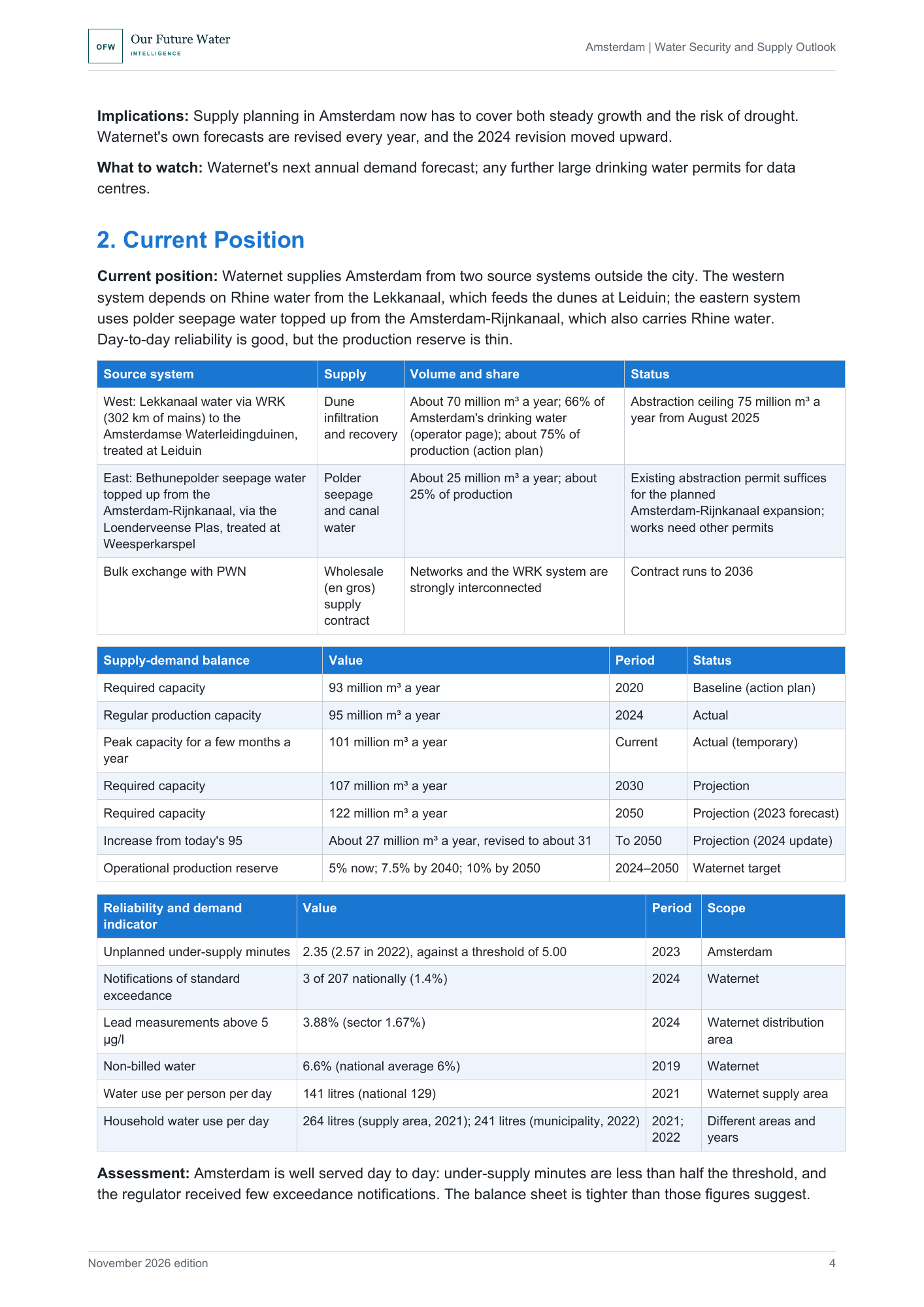
Regular capacity is 95 million m³ a year with a 5% reserve; the required capacity rises to 107 million m³ a year by 2030.
Where will new supply come from before 2030?
From +5 million m³ a year at the Leiduin dunes and +5 through a new bulk supply from PWN, 10 million in total; a further +6 at Weesperkarspel is expected in use in 2031.
Is there enough new supply after 2030?
The named options add about 30 million m³ a year if all deliver in full, against a forecast post-2030 need of about 15 to 19 million.
How much water do residents use?
141 litres per person per day in the Waternet supply area in 2021, against a national target of 100 litres by 2035.
04
Inside the report
Inside the complete report
Executive Snapshot
1. Why This Matters Now in Amsterdam
2. Current Position
3. Key Programmes, Projects and Investment
4. Policy, Regulation and Institutions
5. Risks and Constraints
6. Strategic Implications
7. What to Watch
Source Register
05
Public preview
What to watch next
1. Why This Matters Now in Amsterdam
Waternet's next annual demand forecast; any further large drinking water permits for data centres.
2. Current Position
Under-supply minutes and any intake stops reported in the next City of Amsterdam annual account; the next ILT quality report, especially lead.
3. Key Programmes, Projects and Investment
Award of the Weesperkarspel contracts; a final Natura 2000 decision for Leiduin; a preferred option for WAAG; the joint Waternet and City of Amsterdam saving plan.
4. Policy, Regulation and Institutions
Intake designations in the next National Water Programme; the government's response to the Rli; publication of the freshwater approach.
Section 2: the source systems, the supply-demand balance to 2050 and reliability indicators, set out in three tables.
06
Included
What you receive
The complete PDF report: 10 pages, 9 sections, 10 tables and a register of 18 sources.
This edition
November 2026, First edition.
07
Evidence & method
Evidence and method
The report draws on Waternet's regional action plan with the provinces of North Holland and Utrecht, provincial abstraction and nature permit decisions, ILT drinking water quality reporting, CBS water use surveys, national demand and freshwater policy, and the city's annual account and growth forecasts.
Sources
18 sources, listed in the report's source register. Evidence current to 1 November 2026. Principal data periods: drinking water capacity plan and forecasts published in 2024; production and service data for 2023–2024; household water use survey for 2021; abstraction permit of August 2025; national demand policy to 2035. All currency is euros (EUR)..
Evidence boundaries
This report uses authoritative source material available at the stated research cutoff. It distinguishes published facts, calculated values and analytical interpretation. No independent modelling is performed. Forward-looking analysis reflects published plans, documented trends and stated uncertainties. It does not constitute legal, financial, investment or engineering advice.
08
Lead analyst
Robert C. Brears
Founder, Our Future Water Intelligence
Robert C. Brears is a water-security specialist and author whose work examines utility governance, infrastructure investment, climate resilience and long-term water-system change for executive and policy audiences.
- Decision-focused utility intelligence
- Published water-policy author
- Evidence-grounded system analysis
09
Buyer FAQs
Before you purchase
Who can use the report?
Licensed for internal use within one purchasing organization. The PDF and its contents may be shared with colleagues within that organization. External redistribution, resale and public publication are prohibited without permission.
How is the report delivered?
The PDF is available to download immediately after confirmed payment, through our secure delivery system.
Can my organization buy wider access?
Institutional purchasing: For invoice enquiries, multi-organization licensing or broader access requirements, contact Our Future Water Intelligence.
10
Water Security and Supply Outlook in Amsterdam
- Format
- Length
- 10 pages
- Edition
- November 2026, First edition
- Price
- USD 249
11
Report details
Publication details
- Publisher
- Our Future Water Intelligence
- Report family
- Insight Brief
- Edition
- November 2026, First edition
- Format
- Length
- 10 pages
- Reference
- OFW_EXT_WATER_SECURITY_AND_SUPPLY_OUTLOOK_IN_AMSTERDAM_4dc1f4fdbf38
- Evidence current to
- 1 November 2026