
01
Executive overview
Key findings
540 MGD of 910 MGD: Yamuna and Bhakra Beas Management Board share of raw water allocated (DJB Action Plan 2018-19), about 59% (calculated)
About 1,000 MGD against nearly 1,250 MGD: water received against the city's requirement, as stated by officials (March 2026), for a population of around 2.5 crore
About 80-100 MGD: production lost when the Yamuna fell at Wazirabad in summer 2026 (Water Minister, May 2026)
About 45%: share of Delhi not covered by the sewerage system (2018-19 baseline); 1,799 unauthorized colonies to be connected by December 2028
02
Buyer relevance
Who the report is for
Water resource and river basin planners
See how 540 MGD of 910 MGD of allocated raw water depends on the Yamuna and Bhakra Beas system, and what the 2023 flood and 2026 low flows did to output.
Consultants and contractors entering the Delhi market
Map which institution controls each part of the system, from the Board's Rs 50 crore sanction powers to interstate allocation and Tribunal oversight.
Sewage treatment and network suppliers
Compare 814 MGD of treatment capacity in 2026 with 45% of the city outside the sewer network in the baseline and 1,799 unauthorized colonies due to be connected by December 2028.
Development lenders and investors
Set Rs 31,386 crore of programs approved in one Board meeting against a 2026-27 water supply and sanitation budget line of Rs 2,415 crore.
03
Decision scope
Questions answered
Where does Delhi's water come from?
The 2018-19 allocation gives 540 MGD from the Yamuna and Bhakra Beas system, 240 MGD from the Ganga, 81 MGD from wells and 49 MGD of recycled water, of 910 MGD in total.
How short of water is the city?
Officials put supply at about 1,000 MGD against a requirement of nearly 1,250 MGD in March 2026, and summer output on June 1, 2026 was 912 MGD.
How much of Delhi is sewered?
About 45% of the city was outside the sewerage system in the 2018-19 baseline; 1,799 unauthorized colonies are to be connected by December 2028.
Are Delhi's sewage plants meeting standards?
Most, but not all: 28 of 36 operational plants met the Pollution Control Committee's standard in April 2026, up from 10 of 35 in 2023, and two Yamuna Vihar plants were reported non-compliant in July-August 2026.
04
Inside the report
Inside the complete report
Executive Overview
1. Water Resource Profile
2. Governance and Institutional Framework
3. Infrastructure and Service Delivery
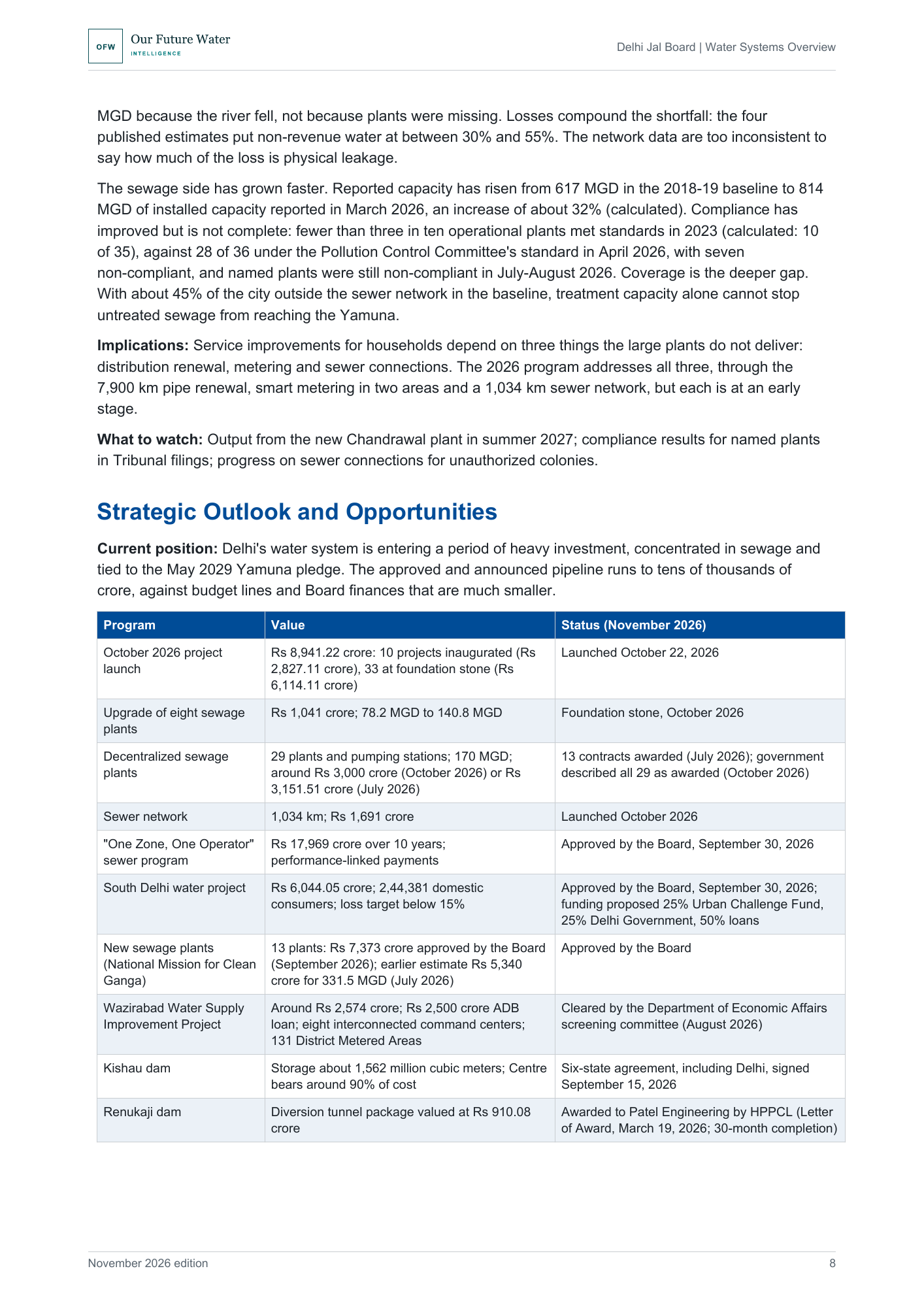
Strategic Outlook and Opportunities
Source Register
05
Public preview
What to watch next
Strategic Outlook and Opportunities
Tender issue for zone operators and command centers; ADB loan signature for the Wazirabad project; government approval of the reclaimed water policy; installed treatment capacity against the 1,500 MGD target in 2027.
1. Water Resource Profile
Summer 2027 river levels and Haryana's deliveries through the Munak canal; any new interstate allocation decision; government approval of the reclaimed water policy.
2. Governance and Institutional Framework
Interstate decisions on Yamuna releases; Tribunal directions in OA 274/2022; the zone count and operator terms in the sewer program tenders.
3. Infrastructure and Service Delivery
Output from the new Chandrawal plant in summer 2027; compliance results for named plants in Tribunal filings; progress on sewer connections for unauthorized colonies.
Planned investment from the October 2026 project launch to upstream dams, with funding context and the Board's debt.
06
Included
What you receive
The complete PDF report: 12 pages, 6 sections, 13 tables and a register of 24 sources.
This edition
November 2026, First edition.
07
Evidence & method
Evidence and method
The report draws on the Master Plan for Delhi 2041 infrastructure and environment baselines, JICA loan and project releases, AMRUT 2.0 listings, NITI Aayog's Composite Water Management Index and National Green Tribunal material. It adds PRS Legislative Research budget analysis, Delhi Jal Board decisions and court affidavits, and press reporting on supply, projects and institutions checked in November 2026.
Sources
24 sources, listed in the report's source register. Evidence current to 8 November 2026. Principal data periods: Master Plan for Delhi 2041 infrastructure and environment baselines (2018-19 data; water bodies as of June 2019); summer 2026 supply figures; Delhi budget 2026-27; project, court and Board decisions to November 2026. Project, legal and regulatory status checked on November 8, 2026. All currency is Indian rupees (Rs; 1 lakh = 100,000; 1 crore = 10 million) unless stated..
Evidence boundaries
This report uses authoritative source material available at the stated research cutoff. It distinguishes published facts, calculated values and analytical interpretation. No independent modelling is performed. Forward-looking analysis reflects published plans, documented trends and stated uncertainties. It does not constitute legal, financial, investment or engineering advice.
08
Lead analyst
Robert C. Brears
Founder, Our Future Water Intelligence
Robert C. Brears is a water-security specialist and author whose work examines utility governance, infrastructure investment, climate resilience and long-term water-system change for executive and policy audiences.
- Decision-focused utility intelligence
- Published water-policy author
- Evidence-grounded system analysis
09
Buyer FAQs
Before you purchase
Who can use the report?
Licensed for internal use within one purchasing organization. The PDF and its contents may be shared with colleagues within that organization. External redistribution, resale and public publication are prohibited without permission.
How is the report delivered?
The PDF is available to download immediately after confirmed payment, through our secure delivery system.
Can my organization buy wider access?
Institutional purchasing: For invoice enquiries, multi-organization licensing or broader access requirements, contact Our Future Water Intelligence.
10
Water Systems Overview: Delhi Jal Board
- Format
- Length
- 12 pages
- Edition
- November 2026, First edition
- Price
- USD 499
11
Report details
Publication details
- Publisher
- Our Future Water Intelligence
- Report family
- Water Utility Intelligence Report
- Edition
- November 2026, First edition
- Format
- Length
- 12 pages
- Reference
- OFW_EXT_WATER_SYSTEMS_OVERVIEW_DELHI_JAL_BOARD_92a376e7966f
- Evidence current to
- 8 November 2026
14
Explore this report family
More Water Systems Overview reports
Explore the same report family covering other utilities.
Water Systems Overview: Aguas Andinas
- Geography
- Greater Santiago, Metropolitan Region, Chile
- Edition
- November 2026, corrected edition
- Length
- 11 pages
Water Systems Overview: Berliner Wasserbetriebe
- Geography
- Berliner Wasserbetriebe
- Edition
- October 2026, First edition
- Length
- 11 pages
Water Systems Overview: Department of Energy, Abu Dhabi Emirate
- Geography
- Department of Energy, Abu Dhabi Emirate
- Edition
- October 2026, First edition
- Length
- 14 pages