
01
Executive overview
Key findings
213.22 MIGD: installed water production capacity (2024, actual); 91.5% of it privately owned in 2022 (calculated)
100.0%: desalinated share of production in 2020, 2021 and 2022 (actual; up from 99.8% in 2017–2019)
722 million imperial gallons: storage in 171 tanks (2024, actual), about 4.3 days of average 2024 production (calculated)
23%: water loss target for 2032 in EWA's updated plan (target, reported March 2026)
02
Buyer relevance
Who the report is for
Desalination developers and their contractors
Size the Hidd (up to 60 MIGD) and Sitra (30 MIGD) projects against 213.22 MIGD of installed capacity and see who already produces Bahrain's water, plant by plant.
Network, metering and leak-detection suppliers
Gauge the renewal and metering task behind EWA's 23% loss target, from about 704 km of aged mains and a flow-meter replacement program starting in 2026.
Development lenders and infrastructure investors
Follow the US$407 million Al Dur 2 water transmission and storage program and the institutional risk in the draft law that would move EWA's assets to a national company.
Government and policy advisers
Compare the first citizen water band of 25 fils/m³ with EWA's stated cost of 750 fils/m³ alongside the parliamentary dispute over tariff control.
03
Decision scope
Questions answered
How dependent is Bahrain on desalination?
Desalinated water was 100.0% of the water produced in 2020, 2021 and 2022, up from 99.8% in 2017–2019; groundwater is kept as a strategic reserve.
Who produces Bahrain's water?
Private plants held 195 MIGD, or 91.5%, of the 213.22 MIGD installed in 2022 and made 96.2% of that year's water; Hidd Power Company alone made 42.9%.
Where do the Hidd and Sitra projects stand?
As of 7 November 2026 neither had been awarded; Acwa was the only remaining Hidd bidder at BD0.276 per m³ and the lowest Sitra bidder, with a Sitra award expected by end-2026.
How much spare desalination capacity does the system have?
Average daily output of 168.89 MIGD in 2024 used about 79.2% of installed capacity, and storage of 722 million imperial gallons equalled about 4.3 days of average output.
What would the draft sector law change?
It would dissolve EWA, move its assets and staff to a National Electricity and Water Company and create an independent regulator; committee debate was deferred in June 2026.
04
Inside the report
Inside the complete report
Executive Overview
1. Water Resource Profile
2. Governance and Institutional Framework
3. Infrastructure and Service Delivery
Strategic Outlook and Opportunities
Source Register
05
Public preview
What to watch next
1. Water Resource Profile
Peak-day production against installed capacity in the next Statistical Book; continued storage additions; the 2023 and 2024 sector consumption series on a consistent basis.
2. Governance and Institutional Framework
The bill's progress in the next parliamentary session, and in particular the final position on tariff control; whether the Speaker accepts the MPs' inquiry request; any change to the subsidy framework.
3. Infrastructure and Service Delivery
A published baseline loss rate and annual progress against the 23% target; the flow-meter replacement program from 2026; the aged-mains share in the 2025 Statistical Book; the next satisfaction index release.
Strategic Outlook and Opportunities
Award of the Hidd Independent Water Project and a confirmed commercial operation date; award of the Sitra Independent Water and Power Project, expected by end-2026, and its final generation capacity; award of the Hawar intake and outfall package after the October 2026 bid opening; a progress report on Al Dur 2 water transmission and storage; the first published baseline and annual figure against the 23% water loss target; the sector regulation law in the next parliamentary session, especially tariff control; any change to citizens' first-band water tariff or the subsidy framework.
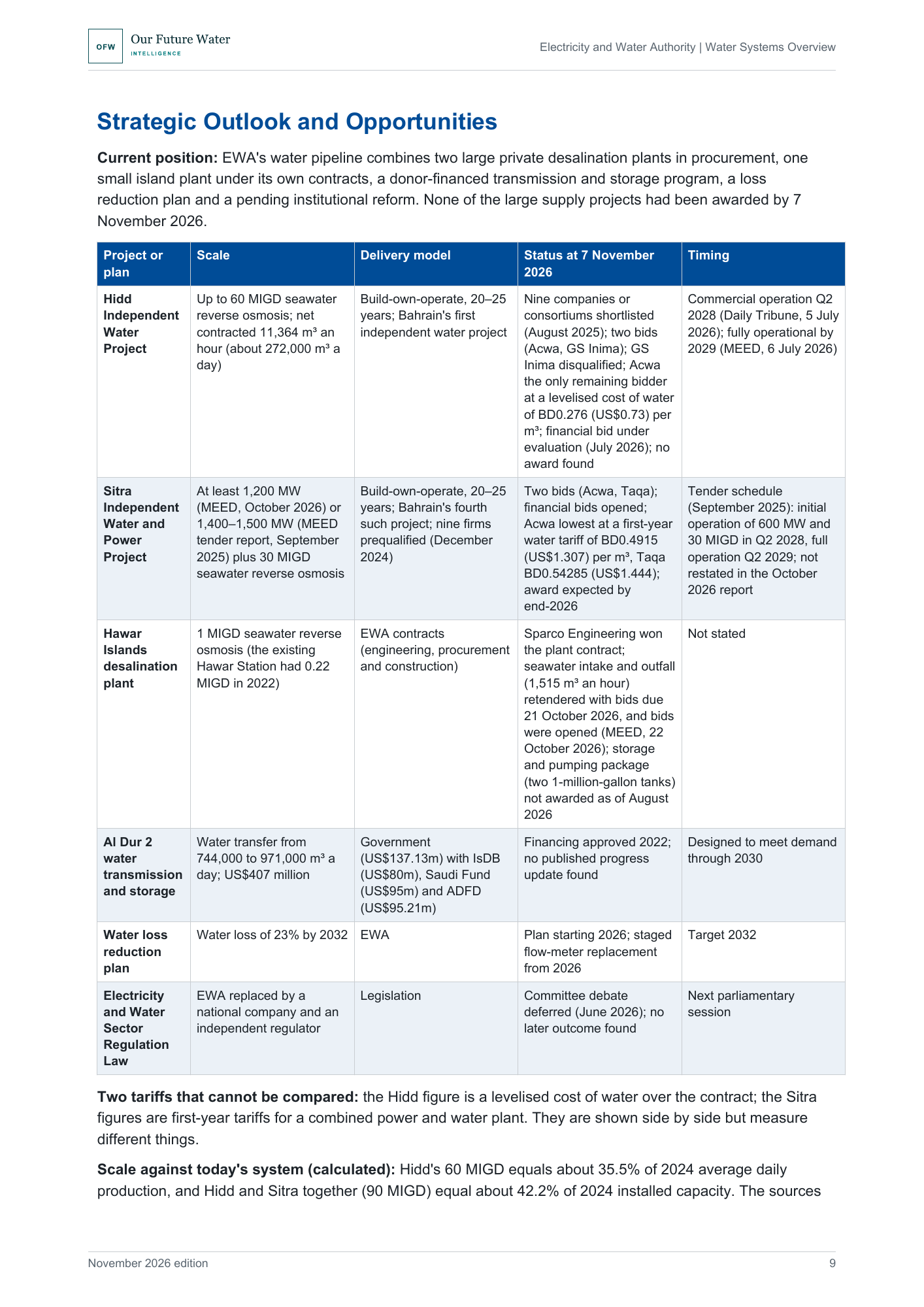
The Strategic Outlook table: scale, delivery model, status and timing for Hidd, Sitra, Hawar, Al Dur 2 transmission, the loss plan and the sector law.
06
Included
What you receive
The complete PDF report: 12 pages, 6 sections, 15 tables and a register of 22 sources.
This edition
November 2026, First edition.
07
Evidence & method
Evidence and method
The report draws on EWA's Statistical Books for 2016 to 2024, including plant-level capacity and output tables, and EWA's January–September 2025 satisfaction index. Procurement, tariff and legislative status comes from trade and Bahraini press reports checked on 7 November 2026.
Sources
22 sources, listed in the report's source register. Evidence current to 7 November 2026. Principal data periods: EWA Statistical Books for calendar years 2015–2024 (primary year 2024); customer satisfaction January–September 2025; project, procurement, tariff and legislative status checked against public sources on 7 November 2026. Currency is the Bahraini dinar (BD), with tariffs quoted in fils (thousandths of a dinar) and US dollar equivalents (US$) as the sources report them..
Evidence boundaries
This report uses authoritative source material available at the stated research cutoff. It distinguishes published facts, calculated values and analytical interpretation. No independent modelling is performed. Forward-looking analysis reflects published plans, documented trends and stated uncertainties. It does not constitute legal, financial, investment or engineering advice.
08
Lead analyst
Robert C. Brears
Founder, Our Future Water Intelligence
Robert C. Brears is a water-security specialist and author whose work examines utility governance, infrastructure investment, climate resilience and long-term water-system change for executive and policy audiences.
- Decision-focused utility intelligence
- Published water-policy author
- Evidence-grounded system analysis
09
Buyer FAQs
Before you purchase
Who can use the report?
Licensed for internal use within one purchasing organization. The PDF and its contents may be shared with colleagues within that organization. External redistribution, resale and public publication are prohibited without permission.
How is the report delivered?
The PDF is available to download immediately after confirmed payment, through our secure delivery system.
Can my organization buy wider access?
Institutional purchasing: For invoice enquiries, multi-organization licensing or broader access requirements, contact Our Future Water Intelligence.
10
Water Systems Overview: Electricity and Water Authority
- Format
- Length
- 12 pages
- Edition
- November 2026, First edition
- Price
- USD 499
11
Report details
Publication details
- Publisher
- Our Future Water Intelligence
- Report family
- Water Utility Intelligence Report
- Edition
- November 2026, First edition
- Format
- Length
- 12 pages
- Reference
- OFW_EXT_WATER_SYSTEMS_OVERVIEW_ELECTRICITY_AND_WATER_AUTHORITY_36d8161195ad
- Evidence current to
- 7 November 2026
14
Explore this report family
More Water Systems Overview reports
Explore the same report family covering other utilities.
Water Systems Overview: Aguas Andinas
- Geography
- Greater Santiago, Metropolitan Region, Chile
- Edition
- November 2026, corrected edition
- Length
- 11 pages
Water Systems Overview: Berliner Wasserbetriebe
- Geography
- Berliner Wasserbetriebe
- Edition
- October 2026, First edition
- Length
- 11 pages
Water Systems Overview: Department of Energy, Abu Dhabi Emirate
- Geography
- Department of Energy, Abu Dhabi Emirate
- Edition
- October 2026, First edition
- Length
- 14 pages