
01
Executive overview
Key findings
509 billion liters: water supplied by Melbourne Water in 2024-25, the highest of the nine years from 2016-17
69.3%: storage level on 1 September 2026, after a low of 63.4% on 1 June 2026
150 GL: desalinated water ordered for 2026-27, the plant's maximum ordering level
A$7,307.7 million: capital expenditure benchmark for 2026–2031 set by the Essential Services Commission
02
Buyer relevance
Who the report is for
Water sector advisers and consultants
Use the institutional map to see which decisions sit with Melbourne Water, the retailers, the Essential Services Commission and the state.
Infrastructure contractors and suppliers
Read the major project table, from the Hobsons Bay Main Sewer to Cardinia Dam, with costs and status for each.
Investors and lenders
Set the A$7,307.7 million 2026–2031 benchmark against inflows, storage levels and the pending supply decision.
Urban planners and developers
Understand flood exposure for more than 200,000 properties and the drainage audit findings that affect growth areas.
03
Decision scope
Questions answered
How far have inflows to Melbourne's storages fallen?
Average inflows were 615 GL a year from 1913 to 1996 and 427 GL a year from 1997 to 2020.
How important is desalination now?
The 150 GL order for 2026-27 is about 29% of the 509 billion liters supplied in 2024-25.
Where is Melbourne's sewage treated?
In 2023-24 the Western Treatment Plant received 210,110 ML and the Eastern Treatment Plant 155,757 ML, about 57% and 43%.
Who decides on the next water source?
The state; its Water Security Taskforce is due to report in March 2027.
04
Inside the report
Inside the complete report
Executive Overview
1. Water Resource Profile
2. Governance and Institutional Framework
3. Infrastructure and Service Delivery
Strategic Outlook and Opportunities
Source Register
05
Public preview
What to watch next
1. Water Resource Profile
Storage levels through summer 2026/27; the following year's desalination order; residential use against the 150-liter target.
2. Governance and Institutional Framework
The taskforce report in March 2027 and the government's response; Melbourne Water's public reporting of growth-area drainage performance; any further statement on future ownership.
3. Infrastructure and Service Delivery
Completion of the Hobsons Bay Main Sewer in late 2026; Western Treatment Plant licence compliance in 2025-26; publication of the 2026–2031 Waterways and Drainage Investment Plan.
Strategic Outlook and Opportunities
The taskforce's recommendation and the government's response; storage levels and any restrictions over summer 2026/27; the following year's desalination order; Melbourne Water's FY2026 results.
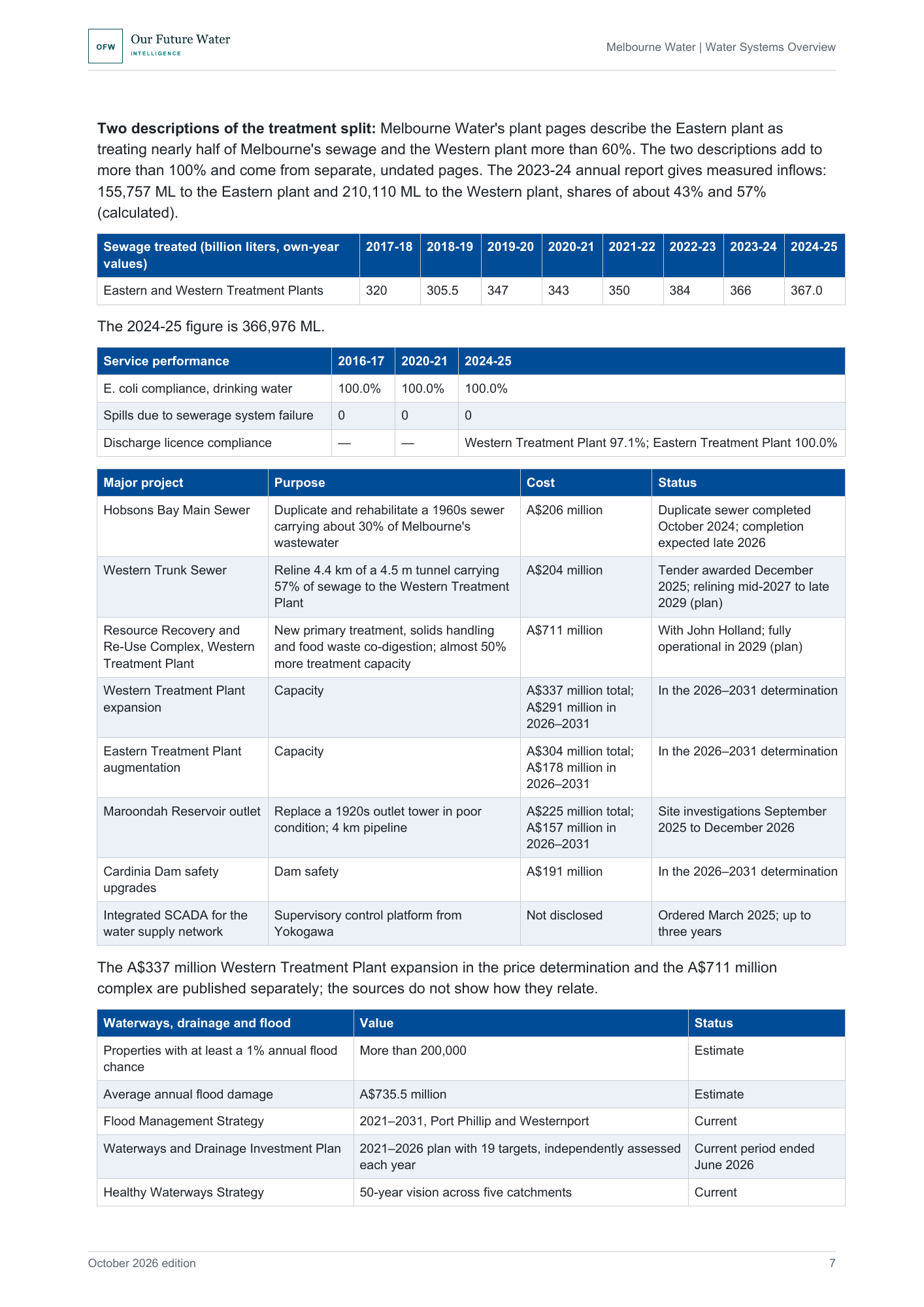
Section 3 lists sewage treated by year, service performance and the major projects with cost and status.
06
Included
What you receive
The complete PDF report: 11 pages, 6 sections, 12 tables and a register of 23 sources.
This edition
October 2026 edition.
07
Evidence & method
Evidence and method
The report draws on Melbourne Water annual reports from 2016-17 to 2024-25, Essential Services Commission price decisions, state water accounts and strategy documents, and Melbourne Water's supply, treatment, project and flood publications. Current status is checked against the 2026 Water Outlook, state government releases, an Auditor-General's audit and parliamentary proceedings.
Sources
23 sources, listed in the report's source register. Evidence current to 29 October 2026. Principal data periods: Operating data 2016-17 to 2024-25 and FY2025 audited results (years ending 30 June); storage levels to 1 September 2026; 2026–2031 regulatory period. Status checked against public sources on 29 October 2026. All currency is Australian dollars (A$)..
Evidence boundaries
This report uses authoritative source material available at the stated research cutoff. It distinguishes published facts, calculated values and analytical interpretation. No independent modelling is performed. Forward-looking analysis reflects published plans, documented trends and stated uncertainties. It does not constitute legal, financial, investment or engineering advice.
08
Lead analyst
Robert C. Brears
Founder, Our Future Water Intelligence
Robert C. Brears is a water-security specialist and author whose work examines utility governance, infrastructure investment, climate resilience and long-term water-system change for executive and policy audiences.
- Decision-focused utility intelligence
- Published water-policy author
- Evidence-grounded system analysis
09
Buyer FAQs
Before you purchase
Who can use the report?
Licensed for internal use within one purchasing organization. The PDF and its contents may be shared with colleagues within that organization. External redistribution, resale and public publication are prohibited without permission.
How is the report delivered?
The PDF is available to download immediately after confirmed payment, through our secure delivery system.
Can my organization buy wider access?
Institutional purchasing: For invoice enquiries, multi-organization licensing or broader access requirements, contact Our Future Water Intelligence.
10
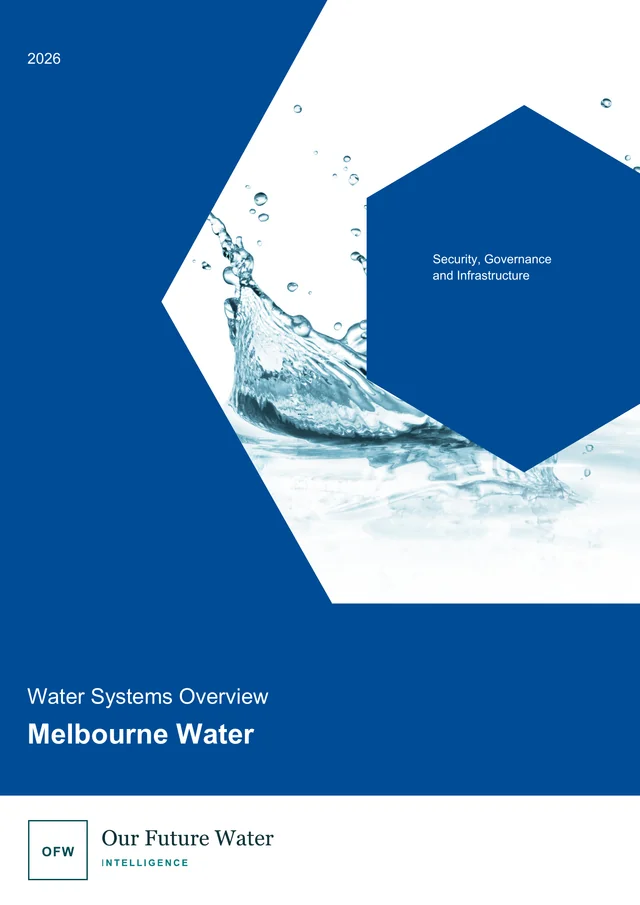
Water Systems Overview: Melbourne Water
- Format
- Length
- 11 pages
- Edition
- October 2026 edition
- Price
- USD 499
11
Report details
Publication details
- Publisher
- Our Future Water Intelligence
- Report family
- Water Utility Intelligence Report
- Edition
- October 2026 edition
- Format
- Length
- 11 pages
- Reference
- OFW_EXT_WATER_SYSTEMS_OVERVIEW_MELBOURNE_WATER_58a3a96629c0
- Evidence current to
- 29 October 2026
14
Explore this report family
More Water Systems Overview reports
Explore the same report family covering other utilities.
Water Systems Overview: Berliner Wasserbetriebe
- Geography
- Berliner Wasserbetriebe
- Edition
- October 2026, First edition
- Length
- 11 pages
Water Systems Overview: Department of Energy, Abu Dhabi Emirate
- Geography
- Department of Energy, Abu Dhabi Emirate
- Edition
- October 2026, First edition
- Length
- 14 pages
Water Systems Overview: Sydney Water
- Geography
- Sydney Water
- Edition
- October 2026, First edition
- Length
- 13 pages