01
Executive overview
Key findings
3.8%: desalination's share of drinking water produced in FY 2024-25: 21,412 of 556,551 ML (calculated)
8.6%: network leakage as a share of drinking water supplied in FY 2024-25 (130 ML a day), against a target of 8% or less (actual)
A$32 billion: investment planned over the next 10 years to renew assets and build new ones (plan)
A$26.4 billion → A$39.5 billion: Regulated Asset Base, June 2024 to FY 2027-28 (actual to forecast)
02
Buyer relevance
Who the report is for
Water and wastewater contractors and consultants in New South Wales
See which treatment, network and recycling projects are under way at Sydney Water, who is delivering them and when each is due between 2026 and 2030.
Infrastructure investors and lenders
Follow capital investment from A$1,170m in FY 2021-22 to a A$3,547m budget for FY 2026-27, alongside the forecast rise in net debt and the Regulated Asset Base.
Policy and regulatory teams
Map the division of responsibility for Greater Sydney's water among Sydney Water, WaterNSW, IPART, the EPA, NSW Health and private owners, with the Operating Licence standards for 2024–2028.
Technology and metering suppliers
Assess the service indicators, such as 178-minute average unplanned interruptions and 8.6% leakage, that Sydney Water's network and smart meter programs will be measured against.
03
Decision scope
Questions answered
How much of Sydney's drinking water comes from desalination?
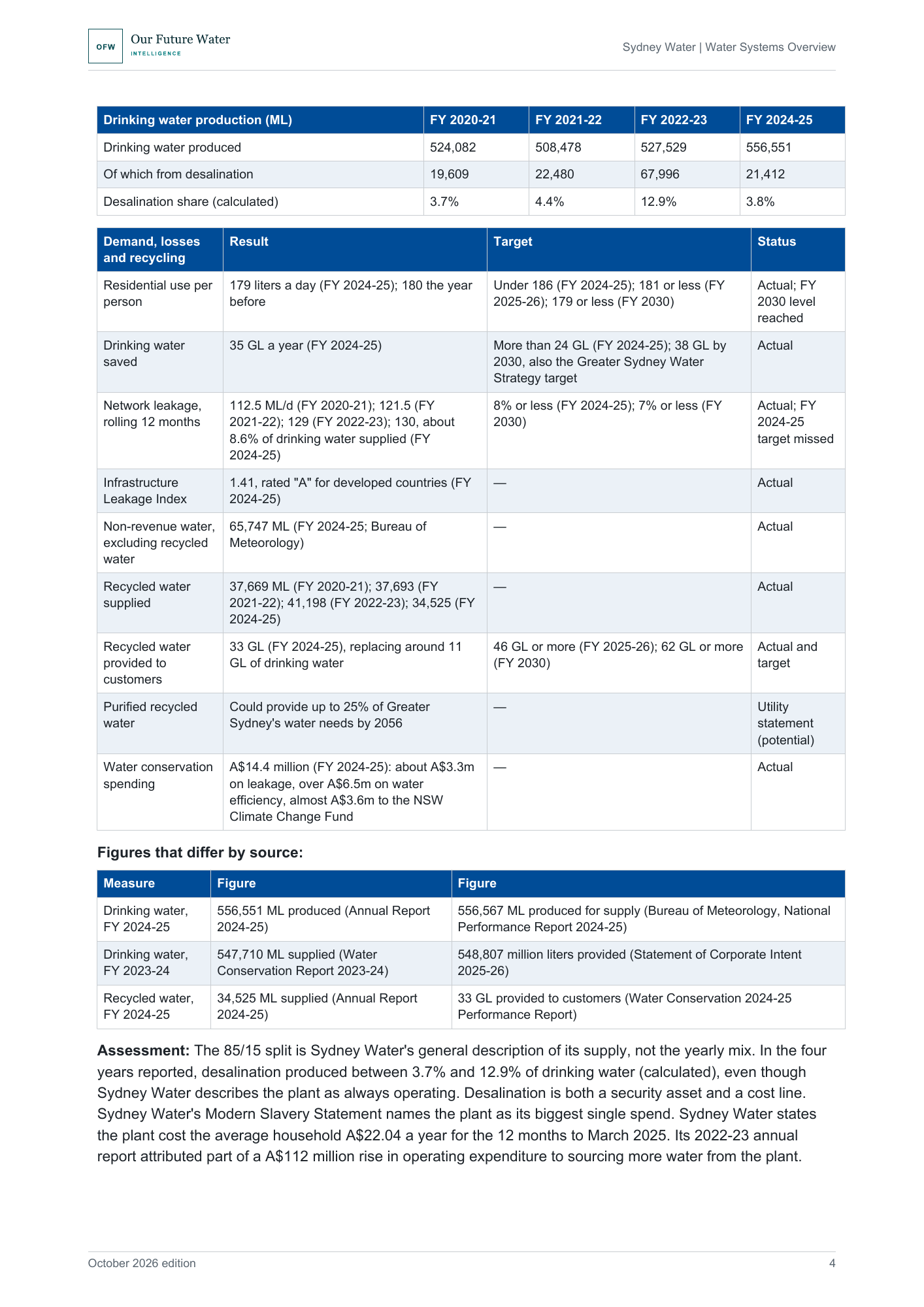
Sydney Water describes a 15% role, but the plant produced 21,412 of 556,551 ML in FY 2024-25 (3.8%), against 12.9% in FY 2022-23.
Is Sydney Water meeting its leakage target?
No. Leakage was 130 ML a day in FY 2024-25, about 8.6% of drinking water supplied, against a target of 8% or less.
How fast is the capital program growing?
Capital investment was A$2,466m in FY 2024-25 against a A$2,940m target, and the FY 2026-27 budget is A$3,547m.
Who regulates Sydney Water?
IPART sets prices and oversees the Operating Licence, the EPA licenses its 23 wastewater systems, and NSW Health sets drinking water requirements; the 2024–2028 licence requires at least 98.00% of properties to be unaffected by unplanned interruptions of more than 5 hours.
Is recycled water growing?
Not recently: supply fell from 41,198 ML in FY 2022-23 to 34,525 ML in FY 2024-25, against an FY 2025-26 target of 46 GL.
04
Inside the report
Inside the complete report
Executive Overview at a Glance
1. Water Resource Profile
2. Governance and Institutional Framework
3. Infrastructure and Service Delivery
Strategic Outlook and Opportunities
Source Register
05
Public preview
What to watch next
1. Water Resource Profile
Recycled water supplied in FY 2025-26 against 46 GL; leakage against the 8% level; desalination's share in the FY 2025-26 annual report; Greater Sydney dam levels against the 60% price trigger.
2. Governance and Institutional Framework
Published variations to the Environment Protection Licences and their treatment requirements; Sydney Water's reported performance against clauses 14 to 16; arrangements for the license term ending June 30, 2028.
3. Infrastructure and Service Delivery
Interruption duration and dry weather overflows in the FY 2025-26 results; satisfaction with tap water quality; the smart meter installed count, which Sydney Water has not yet published.
Strategic Outlook and Opportunities
The FY 2025-26 annual report, with capital delivered against A$3,279m and the desalination share; commissioning of the Upper South Creek Advanced Water Recycling Centre; how Quakers Hill flows are managed between 2028 and 2030; a decision on Quakers Hill to Prospect; the next Statement of Corporate Intent and any re-phasing of the A$10.2 billion three-year budget.
Drinking water produced, desalination share, demand, leakage and recycled water against targets
06
Included
What you receive
The complete PDF report: 13 pages, 6 sections, 16 tables and a register of 27 sources.
This edition
October 2026, First edition.
07
Evidence & method
Evidence and method
Sydney Water's annual reports from FY 2020-21 to FY 2024-25, its Statement of Corporate Intent 2025-26, water conservation performance reports and the Bureau of Meteorology's national performance data. Regulatory instruments, including the Operating Licence and Customer Contract 2024–2028, NSW Environment Protection Authority and Audit Office publications, and project, pricing and contractor pages checked on October 26, 2026.
Sources
27 sources, listed in the report's source register. Evidence current to 26 October 2026. Principal data periods: FY 2020-21 to FY 2024-25 results (years ended June 30); FY 2025-26 to FY 2027-28 budgets and forecasts; 2026-27 prices; regulatory instruments in force for 2024–2028; project status checked against public sources on October 26, 2026. All currency is Australian dollars (A$). Figures marked "calculated" are derived in this report from the values shown..
Evidence boundaries
This report uses authoritative source material available at the stated research cutoff. It distinguishes published facts, calculated values and analytical interpretation. No independent modelling is performed. Forward-looking analysis reflects published plans, documented trends and stated uncertainties. It does not constitute legal, financial, investment or engineering advice.
08
Lead analyst
Robert C. Brears
Founder, Our Future Water Intelligence
Robert C. Brears is a water-security specialist and author whose work examines utility governance, infrastructure investment, climate resilience and long-term water-system change for executive and policy audiences.
- Decision-focused utility intelligence
- Published water-policy author
- Evidence-grounded system analysis
09
Buyer FAQs
Before you purchase
Who can use the report?
Licensed for internal use within one purchasing organization. The PDF and its contents may be shared with colleagues within that organization. External redistribution, resale and public publication are prohibited without permission.
How is the report delivered?
The PDF is available to download immediately after confirmed payment, through our secure delivery system.
Can my organization buy wider access?
Institutional purchasing: For invoice enquiries, multi-organization licensing or broader access requirements, contact Our Future Water Intelligence.
10
Water Systems Overview: Sydney Water
- Format
- Length
- 13 pages
- Edition
- October 2026, First edition
- Price
- USD 499
11
Report details
Publication details
- Publisher
- Our Future Water Intelligence
- Report family
- Water Utility Intelligence Report
- Edition
- October 2026, First edition
- Format
- Length
- 13 pages
- Reference
- OFW_WATER_SYSTEMS_OVERVIEW_SYDNEY_WATER_39c3d4831d49
- Evidence current to
- 26 October 2026
14
Explore this report family
More Water Systems Overview reports
Explore the same report family covering other utilities.
Water Systems Overview: Berliner Wasserbetriebe
- Geography
- Berliner Wasserbetriebe
- Edition
- October 2026, First edition
- Length
- 11 pages
Water Systems Overview: Department of Energy, Abu Dhabi Emirate
- Geography
- Department of Energy, Abu Dhabi Emirate
- Edition
- October 2026, First edition
- Length
- 14 pages
Water Systems Overview
Water Systems Overview: PUB, Singapore's National Water Agency | Our Future Water Intelligence
- Geography
- Singapore, Asia
- Edition
- 2026
- Length
- 17 pages