
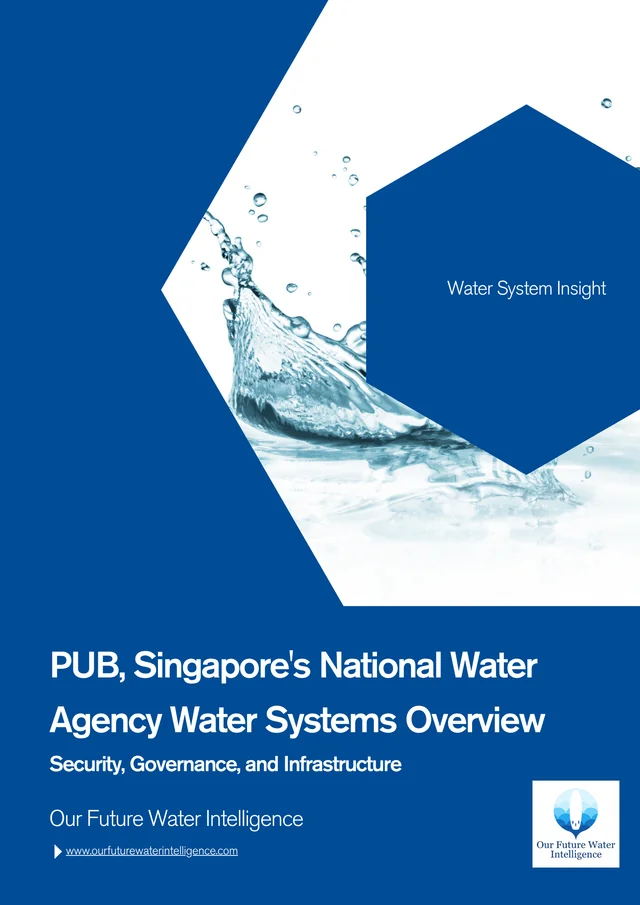
01
Executive overview
Why this report matters
Summary Insight: PUB operates as a unified statutory authority responsible for the full urban water cycle. Transformation is being delivered through a diversified supply portfolio, major reclamation infrastructure, smart metering, digital control, industrial recycling, and coastal adaptation. This integrated governance model connects supply independence, operating efficiency, climate resilience, and long-term capital planning.
This Our Future Water Intelligence report provides an independent assessment of PUB’s system architecture, capital programme, governance model, digital capability, climate resilience, demand management, and long-term supply-security strategy.
The Deep Tunnel Sewerage System Phase 2 is the largest water infrastructure project in Singapore's history, supporting long-term reuse, land recovery, and system resilience through a 98 km underground network.
02
Buyer relevance
Who the report is for
- Utility Executives & System Operators: Understand how deep-tunnel conveyance and reclamation infrastructure strengthen network resilience and water reuse.
- Regulators & Policymakers: Examine how the national supply portfolio supports long-term water independence and climate adaptation.
- Infrastructure Investors & Financiers: Assess how public funding, green finance, and utility reserves support strategic infrastructure delivery.
03
Decision scope
Questions answered
How does PUB fund its capital programme?
PUB combines tariff revenue, utility reserves, green financing, and dedicated government climate funds. This approach supports long-term investment while linking eligible projects to water security, resource efficiency, and adaptation outcomes.
What is driving Singapore’s water-infrastructure transformation?
The transformation is driven by demand growth, climate risk, limited land and natural resources, and the need for greater supply independence. Reclamation, desalination, reuse, demand management, and coastal protection are therefore planned as connected systems.
How advanced is PUB’s digital water infrastructure?
PUB combines smart metering, centralised operational control, predictive maintenance, pressure monitoring, water-quality analytics, and automated network oversight. These capabilities support early intervention and more efficient asset management.
What is PUB’s approach to decarbonising the water system?
PUB integrates decarbonisation into infrastructure design and operational efficiency. Key mechanisms include reclaimed water, resource recovery, biogas utilisation, renewable energy, efficient pumping, and green financing.
04
Inside the report
Analytical coverage
Architectures: Supply Self-Sufficiency
Singapore’s national supply strategy combines local catchments, imported water, NEWater, and desalination to reduce dependence on any single source and strengthen long-term flexibility.
Enablement: Capital Programme Delivery
Deep-tunnel conveyance, reclamation plants, Tuas Nexus, coastal infrastructure, and green finance support the expansion of treatment, reuse, and climate-resilience capacity.
Resolution: Coastal and Climate Resilience
Dedicated coastal funding, flood management, land reclamation, barrages, drainage upgrades, and extreme-sea-level planning strengthen national adaptation.
Alignment: Digital Operations
Centralised operational control, smart metering, predictive maintenance, automated water-quality monitoring, and network analytics improve system visibility and reliability.
Capability Building: Demand and Industrial Water Management
Industrial recycling obligations, efficiency funding, appliance standards, tariff signals, and customer engagement reduce demand for newly produced water.
05
Included
What you receive
Complete digital report
The full analysis in a professionally formatted PDF.
Decision-focused analysis
Evidence interpreted around the report’s central strategic and operational questions.
Supporting evidence
Relevant data, documented developments and source material used throughout the assessment.
Analytical frameworks
Structured interpretation of the financial, operational, governance, resilience or resource issues relevant to the report.
Forward priorities
Key developments, risks and issues to monitor following publication.
06
Evidence & method
Built for defensible decisions
The report is grounded in documented public, institutional, regulatory, utility and sector evidence appropriate to its stated scope. Source periods, definitions and reported claims are retained within the complete analysis.
07
Lead analyst
Robert C. Brears
Lead Analyst, Our Future Water Intelligence
Robert C. Brears is a water-security specialist and author whose work examines utility transformation, infrastructure, governance, finance and climate resilience for executive and policy audiences.
- Evidence-led water intelligence
- Decision-focused system analysis
- Report-specific treatment of scope and terminology
08
Water Systems Overview: PUB, Singapore's National Water Agency | Our Future Water Intelligence
- Format
- Digital report · PDF
- Length
- 17 pages
- Edition
- 2026
- Price
- USD 499
09
Report details
Publication details
- Publisher
- Our Future Water Intelligence
- Report family
- Water Utility Intelligence Report
- Report type
- Water Systems Overview
- Edition
- 2026
- Format
- Digital report · PDF
- Length
- 17 pages
- Reference
- WATER-SYSTEMS-OVERVIEW-PUB-SINGAPORE
12
Explore this report family
More Water Systems Overview reports
Explore the same report family covering other utilities.
Water Systems Overview: Watercare Services
- Geography
- Auckland (Tāmaki Makaurau), New Zealand
- Edition
- November 2026, First edition
- Length
- 12 pages
Water Systems Overview: Acea
- Geography
- Rome and ATO 2 Lazio Centrale, Italy
- Edition
- November 2026, First edition
- Length
- 10 pages
Water Systems Overview: Johannesburg Water
- Geography
- City of Johannesburg, Gauteng, South Africa
- Edition
- November 2026, First edition
- Length
- 11 pages