
01
Executive overview
Key findings
About 80%: share of the Bureau's water sources held in the Tone and Arakawa river systems (Management Plan 2026)
6,844,500 m³ a day: total purification capacity (March 2024); the peak day in FY2023 used about 65% of it (calculated)
14% → 76%: share of purification capacity seismically reinforced, FY2024 actual against the FY2035 target
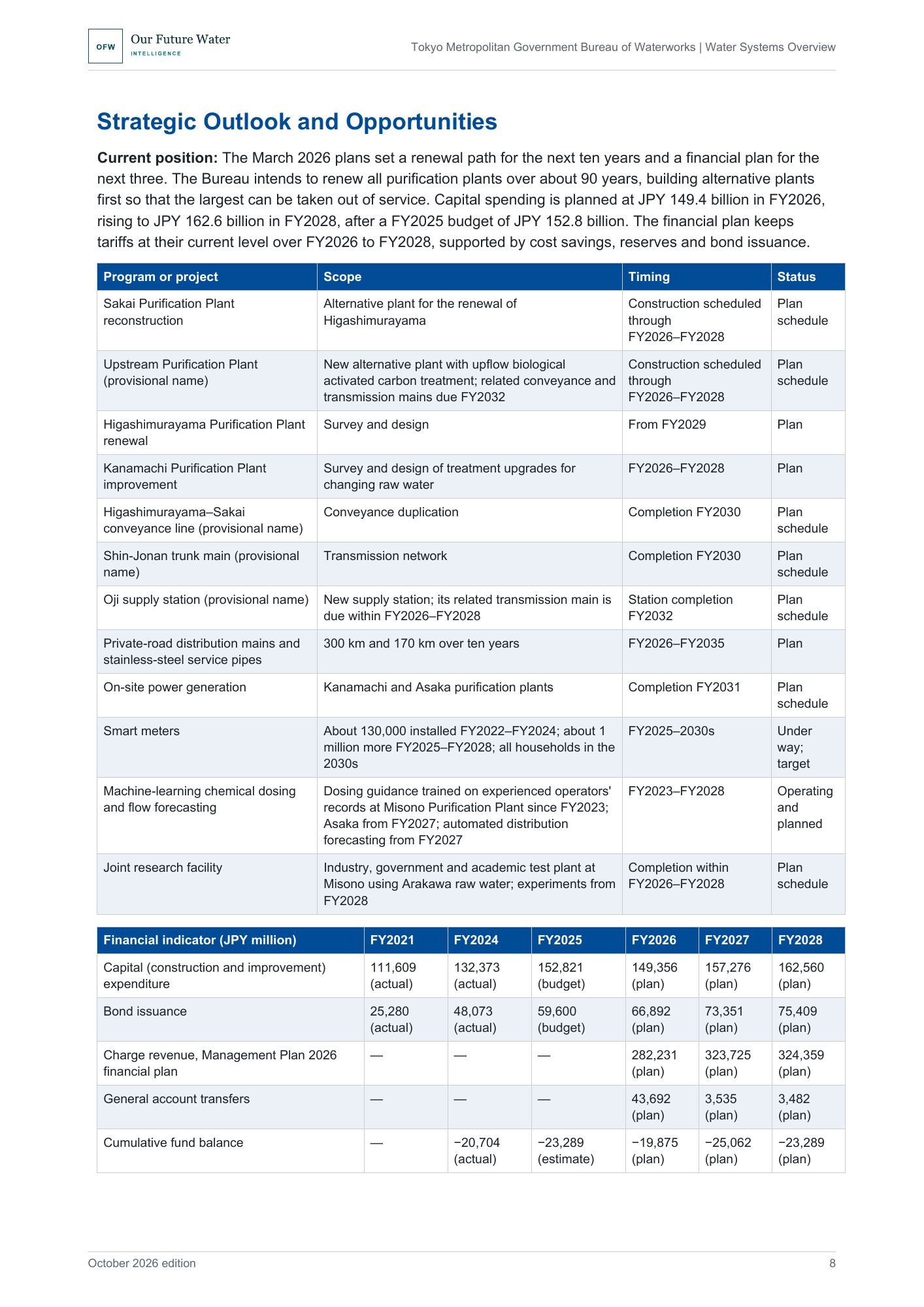
JPY 469.2 billion: capital (construction and improvement) expenditure planned for FY2026 to FY2028, against JPY 132.4 billion actual in FY2024
02
Buyer relevance
Who the report is for
Engineering and construction firms
Read the project table, from the Sakai and Upstream purification plants to the Shin-Jonan trunk main, with timing and status for each.
Water sector advisers and consultants
Use the institutional map to see which decisions sit with the Bureau, Tokyo Water Co., Ltd., the national ministries and the Japan Water Agency.
Investors and analysts following Japanese public utilities
Set the JPY 469.2 billion capital plan for FY2026 to FY2028 against the FY2024 operating loss and the planned cumulative fund balance.
Resilience and risk specialists
Compare the twelve seismic, power and backup indicators the Bureau tracks, with FY2024 actuals and FY2035 targets.
03
Decision scope
Questions answered
How dependent is Tokyo on one river basin?
About 80% of the Bureau's water sources are in the Tone and Arakawa systems, and those plants provide 5,480,000 of 6,844,500 m³ a day of purification capacity.
How earthquake-ready are Tokyo's water plants?
Only 14% of purification capacity was seismically reinforced at the end of FY2024; the target is 76% by FY2035.
How much is Tokyo planning to invest?
Capital expenditure is planned at JPY 469.2 billion over FY2026 to FY2028, against JPY 132.4 billion actual in FY2024.
Will tariffs rise?
The Management Plan 2026 keeps tariffs at their current level over FY2026 to FY2028, supported by JPY 10 billion of savings and extra revenue, bonds and reserves.
How much water does the network lose?
The leakage rate was 3.9% in FY2025, and 95.6% of distributed water was billed as revenue water.
04
Inside the report
Inside the complete report
Executive Overview
1. Water Resource Profile
2. Governance and Institutional Framework
3. Infrastructure and Service Delivery
Strategic Outlook and Opportunities
Source Register
05
Public preview
What to watch next
1. Water Resource Profile
Completion of the Kasumigaura Water Conveyance in FY2030; any drought-related intake restrictions on the Tone; decisions to renew, merge or close Tama wells, including those affected by PFAS; and the Ogouchi Reservoir preventive maintenance program.
2. Governance and Institutional Framework
The scope of further work transferred to Tokyo Water Co., Ltd. by FY2028; results of the first performance-based bundled contracts; national water quality standard revisions; and annual evaluations of Management Plan 2026 targets.
3. Infrastructure and Service Delivery
Annual results for purification-plant seismic reinforcement and seismic-joint coverage; whether the renewal rate recovers above 1%; the leakage rate after the FY2025 rise to 3.9%; and construction-related complaints as works increase.
Strategic Outlook and Opportunities
FY2026 settlement results against the plan's first-year figures; whether the summer basic-charge waiver is repeated in 2027; annual progress on the Sakai and Upstream plants; delivery of the planned 1 million smart meters by FY2028; and any review of the tariff level after FY2028.
The Strategic Outlook lists the renewal projects with timing and status, and the capital, bond and revenue figures from FY2021 to FY2028.
06
Included
What you receive
The complete PDF report: 11 pages, 6 sections, 9 tables and a register of 17 sources.
This edition
October 2026 edition.
07
Evidence & method
Evidence and method
The report draws on the Bureau of Waterworks' Business Outlines, the Management Plan 2026 and revised Facility Development Master Plan, the Water Supply Business Account financial statements and plan tracking tables, and the Bureau's customer surveys. Current status is checked against Tokyo Metropolitan Government and national ministry releases on the basic-charge waivers, water quality standards and the transfer of water supply administration.
Sources
17 sources, listed in the report's source register. Evidence current to 29 October 2026. Principal data periods: Operating statistics FY2016 to FY2025 (Japanese fiscal years, April to March; FY2025 ended 31 March 2026); Water Supply Business Account statements FY2015 to FY2024; Management Plan 2026 (FY2026 to FY2028) and the revised Facility Development Master Plan (FY2026 to FY2035). Status checked against public sources on 29 October 2026. All currency is Japanese yen (JPY)..
Evidence boundaries
This report uses authoritative source material available at the stated research cutoff. It distinguishes published facts, calculated values and analytical interpretation. No independent modelling is performed. Forward-looking analysis reflects published plans, documented trends and stated uncertainties. It does not constitute legal, financial, investment or engineering advice.
08
Lead analyst
Robert C. Brears
Founder, Our Future Water Intelligence
Robert C. Brears is a water-security specialist and author whose work examines utility governance, infrastructure investment, climate resilience and long-term water-system change for executive and policy audiences.
- Decision-focused utility intelligence
- Published water-policy author
- Evidence-grounded system analysis
09
Buyer FAQs
Before you purchase
Who can use the report?
Licensed for internal use within one purchasing organization. The PDF and its contents may be shared with colleagues within that organization. External redistribution, resale and public publication are prohibited without permission.
How is the report delivered?
The PDF is available to download immediately after confirmed payment, through our secure delivery system.
Can my organization buy wider access?
Institutional purchasing: For invoice enquiries, multi-organization licensing or broader access requirements, contact Our Future Water Intelligence.
10
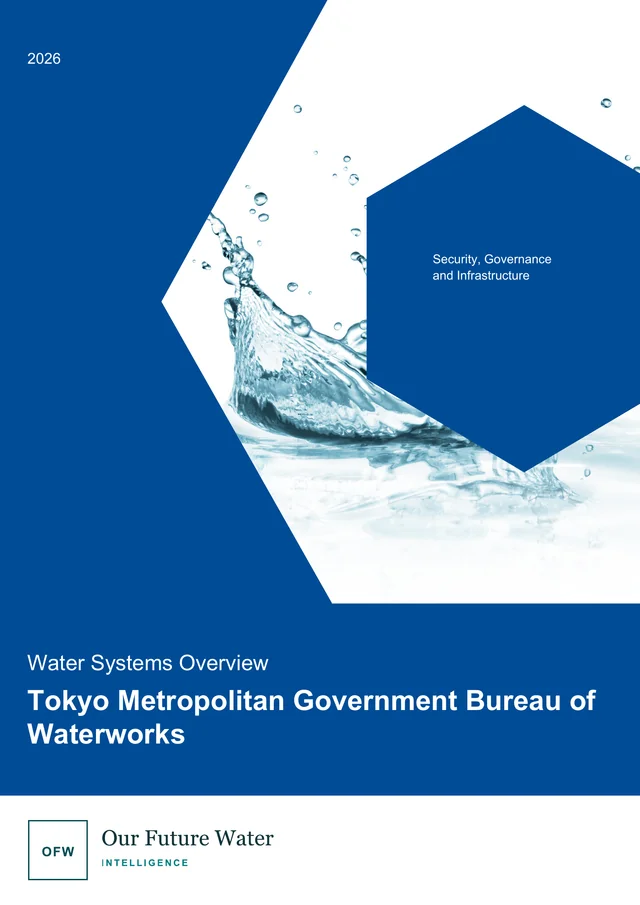
Water Systems Overview: Tokyo Metropolitan Government Bureau of Waterworks
- Format
- Length
- 11 pages
- Edition
- October 2026 edition
- Price
- USD 499
11
Report details
Publication details
- Publisher
- Our Future Water Intelligence
- Report family
- Water Utility Intelligence Report
- Edition
- October 2026 edition
- Format
- Length
- 11 pages
- Reference
- OFW_EXT_WATER_SYSTEMS_OVERVIEW_TOKYO_METROPOLITAN_GOVERNMENT_BUREAU_OF_WATERWORKS_c68cc8e8f14b
- Evidence current to
- 29 October 2026
14
Explore this report family
More Water Systems Overview reports
Explore the same report family covering other utilities.
Water Systems Overview: EYATH S.A.
- Geography
- Thessaloniki, Greece
- Edition
- November 2026 edition
- Length
- 12 pages
Water Systems Overview: Seattle Public Utilities
- Geography
- Seattle, Washington, United States
- Edition
- November 2026, First edition
- Length
- 13 pages
Water Systems Overview: De Watergroep
- Geography
- West Flanders, East Flanders, Flemish Brabant and Limburg, Flanders, Belgium
- Edition
- November 2026, First edition
- Length
- 12 pages