
01
Executive overview
Key findings
95 million m3: drinking water produced in 2025, with 70 million m3 a year treated at the Amsterdam Water Supply Dunes (Leiduin)
3,355 km: drinking water network at December 31, 2025, serving 543 thousand connections
About 3,900 km: Amsterdam sewers, with about 65 km needing replacement each year
2030: the year until which Waternet says its current sources can produce enough drinking water
02
Buyer relevance
Who the report is for
Engineering and contracting firms entering the Amsterdam market
See where the system's assets sit, from the Leiduin dunes and Weesperkarspel to 1,165 sewage pumping stations, and who now commissions each.
Public bodies in the Amsterdam region
Follow which tasks moved to the water board on January 1, 2026, which services Waternet still provides on a temporary basis and what returns to the city.
Water sector analysts comparing Dutch utilities
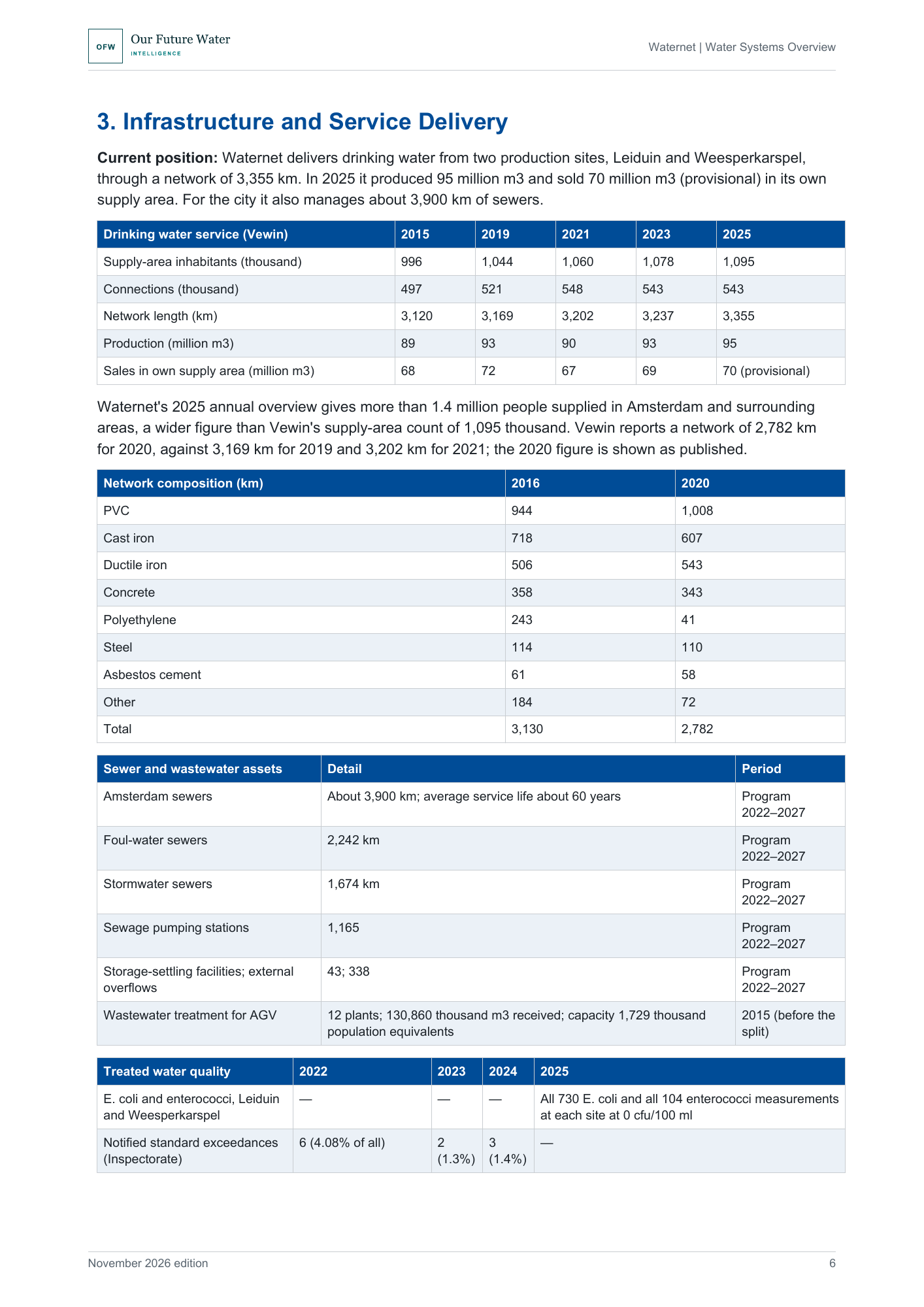
Use the Vewin series for 2015–2025 and the 2016 and 2020 network composition to place Waternet against peers.
03
Decision scope
Questions answered
Where does Amsterdam's drinking water come from?
From the Lek at Nieuwegein and Bethunepolder seepage; Leiduin in the dunes treats 70 million m3 a year, out of 95 million m3 produced in 2025.
How long will current sources last?
Waternet says they can produce enough drinking water until 2030; its two published expansions add about 11 million m3 a year.
How large is the sewer renewal task?
About 3,900 km of sewers need about 65 km of replacement a year, and the program notes that of 40 km planned in a year fewer than 30 km may be replaced.
Who runs wastewater treatment now?
The water board AGV's own organization; Waternet operated 12 treatment plants for AGV in 2015 but that task left it with the split.
04
Inside the report
Inside the complete report
Executive Overview
1. Water Resource Profile
2. Governance and Institutional Framework
3. Infrastructure and Service Delivery
Strategic Outlook and Opportunities
Source Register
05
Public preview
What to watch next
1. Water Resource Profile
Works start for the Leiduin expansion; the Weesperkarspel permit and construction start in 2027; any decision on new sources, water saving or other water qualities for business customers; PFAS policy at EU level.
2. Governance and Institutional Framework
The governance study for the stand-alone drinking water company; the date for returning sewer and water-management tasks to the city; the end date of temporary services to AGV.
3. Infrastructure and Service Delivery
Vewin's next network figures; the successor to the 2022–2027 sewer program; the cause of the Zuiderzeeweg failure; lead results in the Inspectorate's 2025 report.
Strategic Outlook and Opportunities
The 2027 tariff decision; a long-term supply plan naming new sources after 2035; the phase 2 decision and its date; the successor sewer program.
Section 3 sets out the drinking water service, network composition and sewer assets.
06
Included
What you receive
The complete PDF report: 10 pages, 6 sections, 11 tables and a register of 20 sources.
This edition
November 2026, First edition.
07
Evidence & method
Evidence and method
The report draws on Vewin company data for 2015–2025 and network composition for 2016 and 2020, Amsterdam's sewer program for 2022–2027, Waternet's 2025 drinking water quality reports and project pages, the foundation's statutes as at January 1, 2026, and Inspectorate and ACM publications.
Sources
20 sources, listed in the report's source register. Evidence current to 4 November 2026. Principal data periods: Vewin company data for calendar 2015–2025; network composition for 2016 and 2020; Amsterdam sewer program 2022–2027; calendar 2025 treated water quality; institutional arrangements as at January 1, 2026, with status to November 2026. All currency is euros (€)..
Evidence boundaries
This report uses authoritative source material available at the stated research cutoff. It distinguishes published facts, calculated values and analytical interpretation. No independent modelling is performed. Forward-looking analysis reflects published plans, documented trends and stated uncertainties. It does not constitute legal, financial, investment or engineering advice.
08
Lead analyst
Robert C. Brears
Founder, Our Future Water Intelligence
Robert C. Brears is a water-security specialist and author whose work examines utility governance, infrastructure investment, climate resilience and long-term water-system change for executive and policy audiences.
- Decision-focused utility intelligence
- Published water-policy author
- Evidence-grounded system analysis
09
Buyer FAQs
Before you purchase
Who can use the report?
Licensed for internal use within one purchasing organization. The PDF and its contents may be shared with colleagues within that organization. External redistribution, resale and public publication are prohibited without permission.
How is the report delivered?
The PDF is available to download immediately after confirmed payment, through our secure delivery system.
Can my organization buy wider access?
Institutional purchasing: For invoice enquiries, multi-organization licensing or broader access requirements, contact Our Future Water Intelligence.
10
Water Systems Overview: Waternet
- Format
- Length
- 10 pages
- Edition
- November 2026, First edition
- Price
- USD 499
11
Report details
Publication details
- Publisher
- Our Future Water Intelligence
- Report family
- Water Utility Intelligence Report
- Edition
- November 2026, First edition
- Format
- Length
- 10 pages
- Reference
- OFW_EXT_WATER_SYSTEMS_OVERVIEW_WATERNET_2364783fe3fa
- Evidence current to
- 4 November 2026
14
Explore this report family
More Water Systems Overview reports
Explore the same report family covering other utilities.
Water Systems Overview: Aguas Andinas
- Geography
- Greater Santiago, Metropolitan Region, Chile
- Edition
- November 2026, corrected edition
- Length
- 11 pages
Water Systems Overview: Berliner Wasserbetriebe
- Geography
- Berliner Wasserbetriebe
- Edition
- October 2026, First edition
- Length
- 11 pages
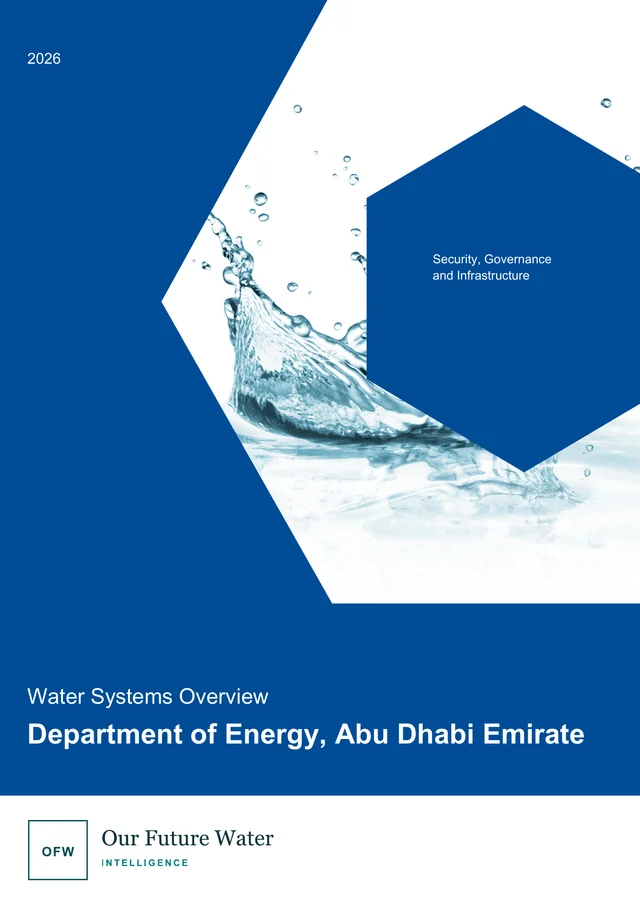
Water Systems Overview: Department of Energy, Abu Dhabi Emirate
- Geography
- Department of Energy, Abu Dhabi Emirate
- Edition
- October 2026, First edition
- Length
- 14 pages