
01
Executive overview
Key findings
4,574 ML/d vs 5,161 ML/d: average potable supply against peak day demand, FY 2025
1,803 million m³ a year: Rand Water's abstraction allocation from the Integrated Vaal River System, temporarily raised to 2,003 million m³ for February to June 2026
R41.1 billion: five-year capital plan for 2026–2030, against R1.98 billion of actual capital spending in FY 2025
July 2027: expected start of impounding at Polihali Dam (LHWP Phase II), with R24 billion spent of R53 billion allocated (September 2026)
02
Buyer relevance
Who the report is for
Lenders and bond investors
Set Rand Water's R41.1 billion 2026–2030 plan against FY 2025 delivery, debtor days of 125 and S&P's November 2025 rating action.
Engineering and construction firms
See which programs lead the plan, from augmentation and renewals to the R12,759 million Strategic Goal Delivery Unit.
Energy developers and power suppliers
Understand why electricity is Rand Water's top-ranked risk and how its energy self-reliance pillar is framed.
Municipal and provincial officials in Gauteng
Compare municipal use against allocations, such as Johannesburg's 1,801 ML/d against 1,356 ML/d, and the 2028 supply timetable.
03
Decision scope
Questions answered
How close is Gauteng's demand to Rand Water's supply ceiling?
Peak day demand was 5,161 ML/d in FY 2025, above the roughly 4,940 ML/d daily average that a 1,803 million m³ annual allocation allows.
How large is Rand Water's capital plan?
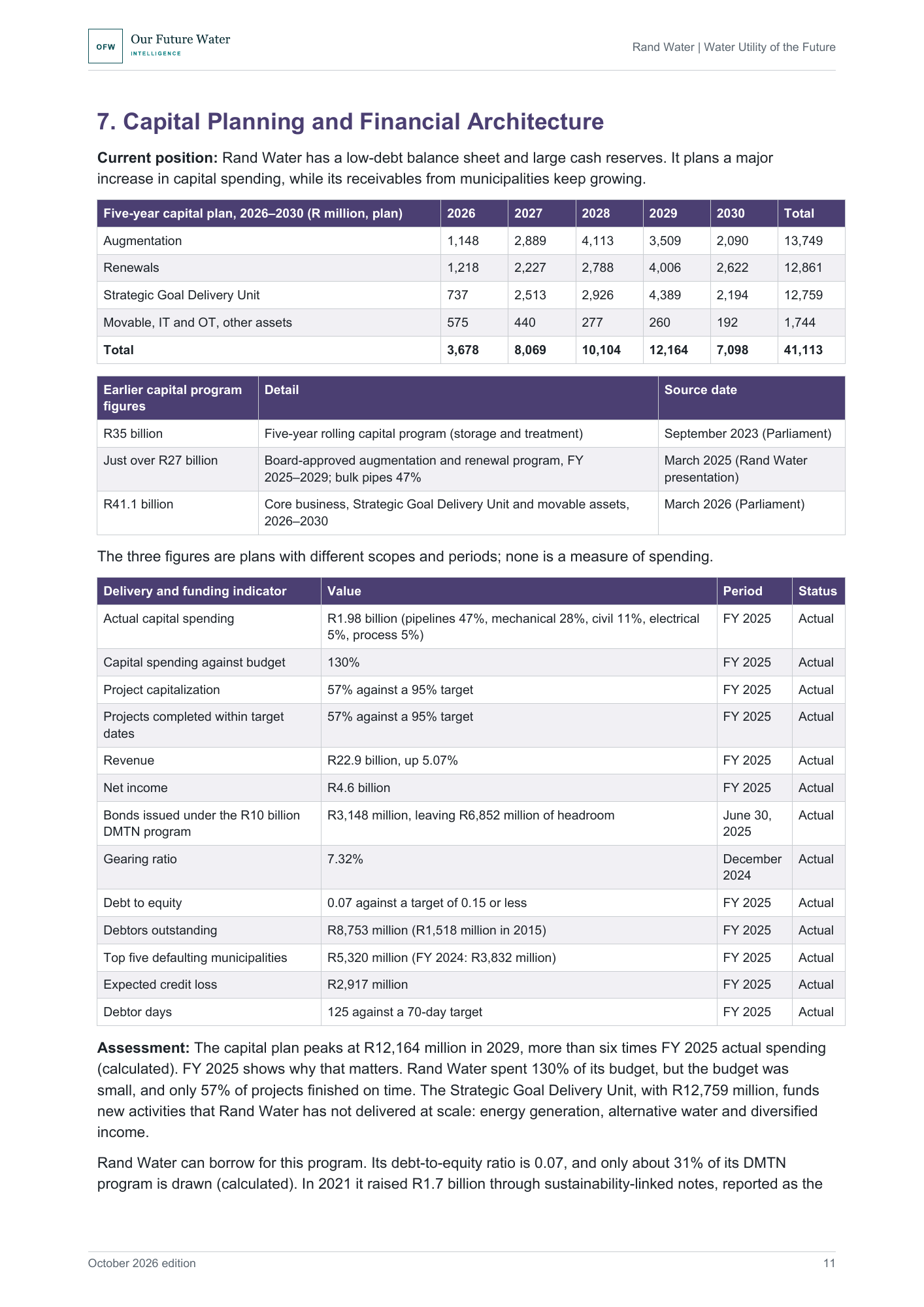
R41,113 million over 2026–2030, peaking at R12,164 million in 2029, against R1.98 billion of actual capital spending in FY 2025.
When does new water from Lesotho arrive?
Polihali Dam is expected to begin impounding in July 2027, with Phase II completion targeted for October 2028; R24 billion of R53 billion had been spent by September 2026.
What has happened to Rand Water's energy costs?
The cost of energy rose from 120.2 to 211.7 cents per kWh between 2020 and 2025, while energy use per megaliter stayed between 1.36 and 1.42 MWh.
04
Inside the report
Inside the complete report
Executive Snapshot
1. From Service Provider to System Operator
2. System Intelligence and Digital Control
3. Energy, Carbon, and Resource Decoupling
4. Infrastructure Strategy for a Non-Stationary Climate
5. Customers, Demand, and the Water Prosumer
6. Governance, Regulation, and Institutional Reform
7. Capital Planning and Financial Architecture
8. Workforce, Capability, and Organisational Change
9. Strategic System Roadmap
Conclusion
Source Register
05
Public preview
What to watch next
4. Infrastructure Strategy for a Non-Stationary Climate
Polihali impounding in 2027 and the transfer tunnel's recovery plan; confirmation that Station 5A is producing its full 600 ML/d; start of construction on the further Zuikerbosch upgrade.
5. Customers, Demand, and the Water Prosumer
The scope and duration of supply restrictions on over-consuming municipalities; confirmation of the 2026/27 bulk tariff in Rand Water's FY 2026 report; whether Johannesburg and Tshwane reduce use toward their licensed allocations.
7. Capital Planning and Financial Architecture
FY 2026 actual capital spending against the R3,678 million planned for 2026; any new DMTN issuance; the debtor book and expected credit loss in the FY 2026 statements; S&P's next action.
9. Strategic System Roadmap
LHWP Phase II progress reports; the FY 2026 integrated annual report and the next corporate plan; the first committed alternative water or self-generation project.
Section 7: Rand Water's 2026–2030 capital plan by year and line, set against earlier plan figures and FY 2025 delivery and funding indicators.
06
Included
What you receive
The complete PDF report: 16 pages, 12 sections, 21 tables and a register of 22 sources.
This edition
October 2026, First edition.
07
Evidence & method
Evidence and method
The report draws on Rand Water's FY 2025 integrated annual report and its March 2026 presentation to Parliament, Department of Water and Sanitation statements and dam level data, parliamentary committee records and written replies, Lesotho Highlands project updates, and Rand Water's October 2026 statement on municipal allocations.
Sources
22 sources, listed in the report's source register. Evidence current to 30 October 2026. Principal data periods: FY 2025 integrated annual report (year ended June 30, 2025) and Rand Water's March 17, 2026 presentation to Parliament; abstraction, supply, project and institutional developments to October 2026. All currency is South African rand (R)..
Evidence boundaries
This report uses authoritative source material available at the stated research cutoff. It distinguishes published facts, calculated values and analytical interpretation. No independent modelling is performed. Forward-looking analysis reflects published plans, documented trends and stated uncertainties. It does not constitute legal, financial, investment or engineering advice.
08
Lead analyst
Robert C. Brears
Founder, Our Future Water Intelligence
Robert C. Brears is a water-security specialist and author whose work examines utility governance, infrastructure investment, climate resilience and long-term water-system change for executive and policy audiences.
- Decision-focused utility intelligence
- Published water-policy author
- Evidence-grounded system analysis
09
Buyer FAQs
Before you purchase
Who can use the report?
Licensed for internal use within one purchasing organization. The PDF and its contents may be shared with colleagues within that organization. External redistribution, resale and public publication are prohibited without permission.
How is the report delivered?
The PDF is available to download immediately after confirmed payment, through our secure delivery system.
Can my organization buy wider access?
Institutional purchasing: For invoice enquiries, multi-organization licensing or broader access requirements, contact Our Future Water Intelligence.
10
Water Utility of the Future: Rand Water
- Format
- Length
- 16 pages
- Edition
- October 2026, First edition
- Price
- USD 499
11
Report details
Publication details
- Publisher
- Our Future Water Intelligence
- Report family
- Water Utility Intelligence Report
- Edition
- October 2026, First edition
- Format
- Length
- 16 pages
- Reference
- OFW_EXT_WATER_UTILITY_OF_THE_FUTURE_RAND_WATER_e51256ce6ecf
- Evidence current to
- 30 October 2026
14
Explore this report family
More Water Utility of the Future reports
Explore the same report family covering other utilities.
Water Utility of the Future
Water Utility of the Future: Thames Water
- Geography
- United Kingdom, Europe
- Edition
- October 2026 edition
- Length
- 15 pages
water utility of the future
Water Utility of the Future: Denver Water
- Geography
- Denver, United States
- Edition
- October 2026, Second edition
- Length
- 13 pages
Water Utility of the Future
Water Utility of the Future: Berliner Wasserbetriebe
- Geography
- Berlin, Germany
- Edition
- 2026 · v3
- Length
- 19 pages