
01
Executive overview
Why this report matters
Summary Insight: The Southern Nevada Water Authority is adapting a predominantly Colorado River-dependent regional system to sustained drought, declining Lake Mead elevations, interstate shortage requirements, and continued population growth. The authority combines Intake No. 3 and the Low Lake Level Pumping Station with water banking, return-flow credits, regional governance, nonfunctional turf removal, conservation incentives, and long-term resource planning to protect reliable municipal supply.
This Our Future Water Intelligence report provides an independent assessment of the Southern Nevada Water Authority’s regional governance, Colorado River strategy, low-lake infrastructure, conservation framework, financial resilience, and long-term climate-risk response.
The Intake No. 3 programme delivered a deep-water intake shaft, a three-mile tunnel beneath Lake Mead, and supporting systems designed to preserve water access and protect water quality under declining reservoir conditions.
02
Buyer relevance
Who the report is for
- Utility Executives & System Operators: Evaluate Lake Mead intakes, pumping infrastructure, treatment capacity, regional transmission, member-agency coordination, and drought operations.
- Regulators & Policymakers: Assess Colorado River shortage requirements, water banking, return-flow credits, nonfunctional turf mandates, conservation policy, and regional resource planning.
- Infrastructure Investors & Financiers: Evaluate revenue bonds, regional charges, connection fees, capital sequencing, debt obligations, and long-term infrastructure risk.
03
Decision scope
Questions answered
How does the Southern Nevada Water Authority finance regional infrastructure?
The report evaluates revenue bonds, regional infrastructure charges, commodity charges, connection fees, and other dedicated revenues as mechanisms for financing major water facilities and recovering long-term capital costs.
How does demand management strengthen Southern Nevada’s water security?
Turf conversion, restrictions on nonfunctional grass, development standards, pool-size limits, pricing, and conservation incentives reduce consumptive water use. The report assesses how these measures lower demand and reduce exposure to Colorado River shortages.
What role does water banking play in the regional supply strategy?
Water banking allows the Southern Nevada Water Authority to store water through arrangements in Nevada, Arizona, California, and Lake Mead. The report evaluates how these reserves provide flexibility during shortages, infrastructure disruptions, and other supply pressures.
Why are Intake No. 3 and the Low Lake Level Pumping Station critical?
The assets work together to maintain access to Lake Mead water at extremely low reservoir elevations. The report examines how the deep-water intake and pumping station reduce hydraulic and water-quality risks affecting the region’s primary municipal supply.
04
Inside the report
Analytical coverage
Architectures: Regional governance and Colorado River security
Examines how the Southern Nevada Water Authority coordinates member agencies, Colorado River entitlements, return-flow credits, local groundwater, stored reserves, and regional resource planning.
Enablement: Resource accounting and water banking
Evaluates how the Southern Nevada Water Authority uses water accounting, interstate banking, storage agreements, recharge, conservation data, and demand monitoring to strengthen long-term supply flexibility.
Resolution: Intake No. 3 and low-lake pumping
Assesses how Intake No. 3 and the Low Lake Level Pumping Station preserve access to Lake Mead supplies under low reservoir conditions while supporting treatment reliability and regional delivery.
Alignment: Capital finance and infrastructure resilience
Reviews how the Southern Nevada Water Authority aligns infrastructure charges, connection fees, revenue bonds, project controls, and long-term capital planning with drought resilience and system reliability.
Capability Building: Conservation and demand transformation
Explains how the Southern Nevada Water Authority uses turf replacement incentives, nonfunctional grass requirements, development standards, water budgets, pricing, and public engagement to reduce consumptive demand.
05
Included
What you receive
Complete digital report
The full analysis in a professionally formatted PDF.
Decision-focused analysis
Evidence interpreted around the report’s central strategic and operational questions.
Supporting evidence
Relevant data, documented developments and source material used throughout the assessment.
Analytical frameworks
Structured interpretation of the financial, operational, governance, resilience or resource issues relevant to the report.
Forward priorities
Key developments, risks and issues to monitor following publication.
06
Evidence & method
Built for defensible decisions
The report is grounded in documented public, institutional, regulatory, utility and sector evidence appropriate to its stated scope. Source periods, definitions and reported claims are retained within the complete analysis.
07
Lead analyst
Robert C. Brears
Lead Analyst, Our Future Water Intelligence
Robert C. Brears is a water-security specialist and author whose work examines utility transformation, infrastructure, governance, finance and climate resilience for executive and policy audiences.
- Evidence-led water intelligence
- Decision-focused system analysis
- Report-specific treatment of scope and terminology
08
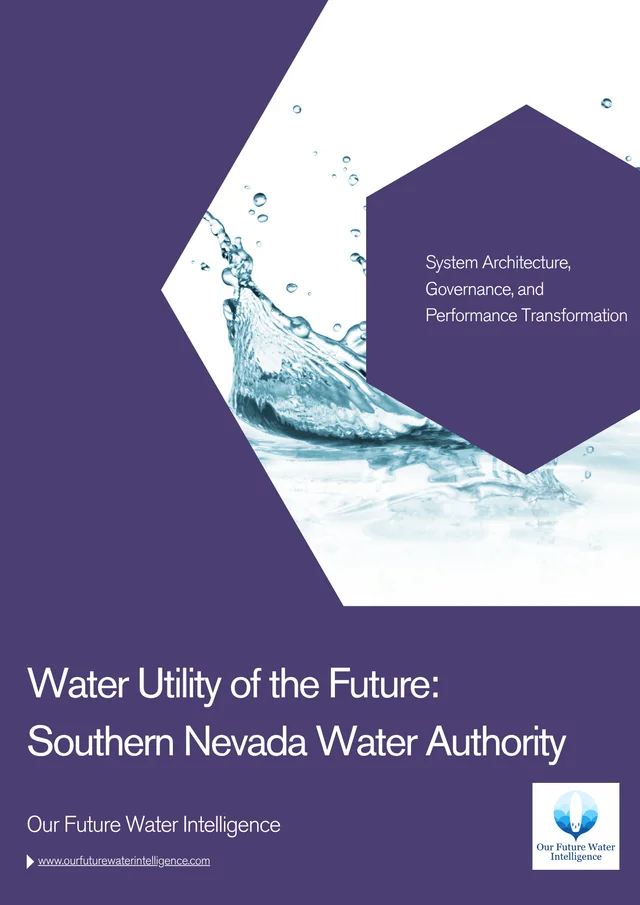
Water Utility of the Future: Southern Nevada Water Authority
- Format
- Digital report · PDF
- Length
- 23 pages
- Edition
- 2026
- Price
- USD 499
09
Report details
Publication details
- Publisher
- Our Future Water Intelligence
- Report family
- Water Utility Intelligence Report
- Report type
- Water Utility of the Future
- Edition
- 2026
- Format
- Digital report · PDF
- Length
- 23 pages
- Reference
- OFW-SNWA-US-WUTF-2026
12
Explore this report family
More Water Utility of the Future reports
Explore the same report family covering other utilities.
Water Utility of the Future
Water Utility of the Future: Department of Energy, Abu Dhabi Emirate
- Geography
- Abu Dhabi, United Arab Emirates
- Edition
- November 2026, New edition
- Length
- 16 pages
Water Utility of the Future
Water Utility of the Future: Water and Sanitation Directorate, City of Cape Town
- Geography
- Cape Town, South Africa
- Edition
- November 2026, New edition
- Length
- 14 pages
Water Utility of the Future
Water Utility of the Future: Electricity and Water Authority
- Geography
- Bahrain, Middle East
- Edition
- November 2026, New edition
- Length
- 15 pages