
01
Executive overview
Key findings
100% groundwater: from about 660 wells feeding nine waterworks; around 60% is bank filtrate drawn from beside the Spree and Havel
1.1 million m³/day against about 600,000 m³/day: waterworks capacity against average daily demand
EUR 1.694/m³: net drinking-water charge, unchanged since 1 January 2014 and held for 2026 by forgoing EUR 82.6 million of state profit
About 7 m³/s: the addition to Spree flow from lignite mining that will cease when the Lausitz mines close, against an average Spree inflow to the Havel at Berlin of 38 m³/s
02
Buyer relevance
Who the report is for
Treatment and process-technology suppliers
Size BWB's EUR 1.5 billion treatment programme and the ozonation plans at four plants against their 2027 and 2032 timelines.
Lenders and public-finance analysts
Track BWB's equity ratio, which fell from 27.1% to 24.3% in 2025, while charges stay frozen by forgone state profit.
Consultancies entering the Berlin market
Identify the Senate departments that license abstraction, approve charges and supervise BWB before a first approach.
Regional water planners in Berlin-Brandenburg
Compare waterworks reactivation at Jungfernheide and Johannisthal with the expected loss of Spree flow after the lignite phase-out.
03
Decision scope
Questions answered
Where does Berlin's drinking water come from?
All of it is groundwater from about 660 wells feeding nine waterworks; around 60% is bank filtrate from beside the Spree and Havel.
How much have Berlin's water charges changed?
The net drinking-water charge has been EUR 1.694/m³ since 1 January 2014; the state gave up EUR 82.6 million of profit to hold it for 2026.
How much is BWB investing?
BWB invested EUR 589 million in 2025, and it plans EUR 1.5 billion for its treatment plants.
What is the main threat to supply?
When Lausitz lignite mining ends, by 2038, the Spree will lose about 7 m³/s of mining-related flow, against an average inflow to the Havel at Berlin of 38 m³/s.
Where will new water come from?
Jungfernheide waterworks, with about 20 million m³/year planned and construction from 2030, and Johannisthal, with about 12.8 million m³/year and operation from 2036 (reported).
04
Inside the report
Inside the complete report
Executive Snapshot
1. City Water Profile
2. Water Resources and Supply
3. Institutions and Utilities
4. Infrastructure and Major Projects
5. Tariffs and Finance
6. Climate and Resilience
7. Outlook and What to Watch
Source Register
05
Public preview
What to watch next
3. Institutions and Utilities
The coalition agreement's position on water charges and BWB's profit transfer, and the allocation of the public-enterprises and environment portfolios.
4. Infrastructure and Major Projects
Commissioning of the Waßmannsdorf sludge plant; contract awards for ozonation at the three remaining plants; Jungfernheide needs planning and a licence application.
5. Tariffs and Finance
The decision on 2027 charges and the profit transfer; the 2026 results (due in 2027), especially liabilities and equity; any follow-on EIB loan after the 2023–2027 programme.
7. Outlook and What to Watch
The coalition agreement, BWB's 2026 business plan and results, and Senate or BWB statements on the Waßmannsdorf, Jungfernheide and Johannisthal schedules.
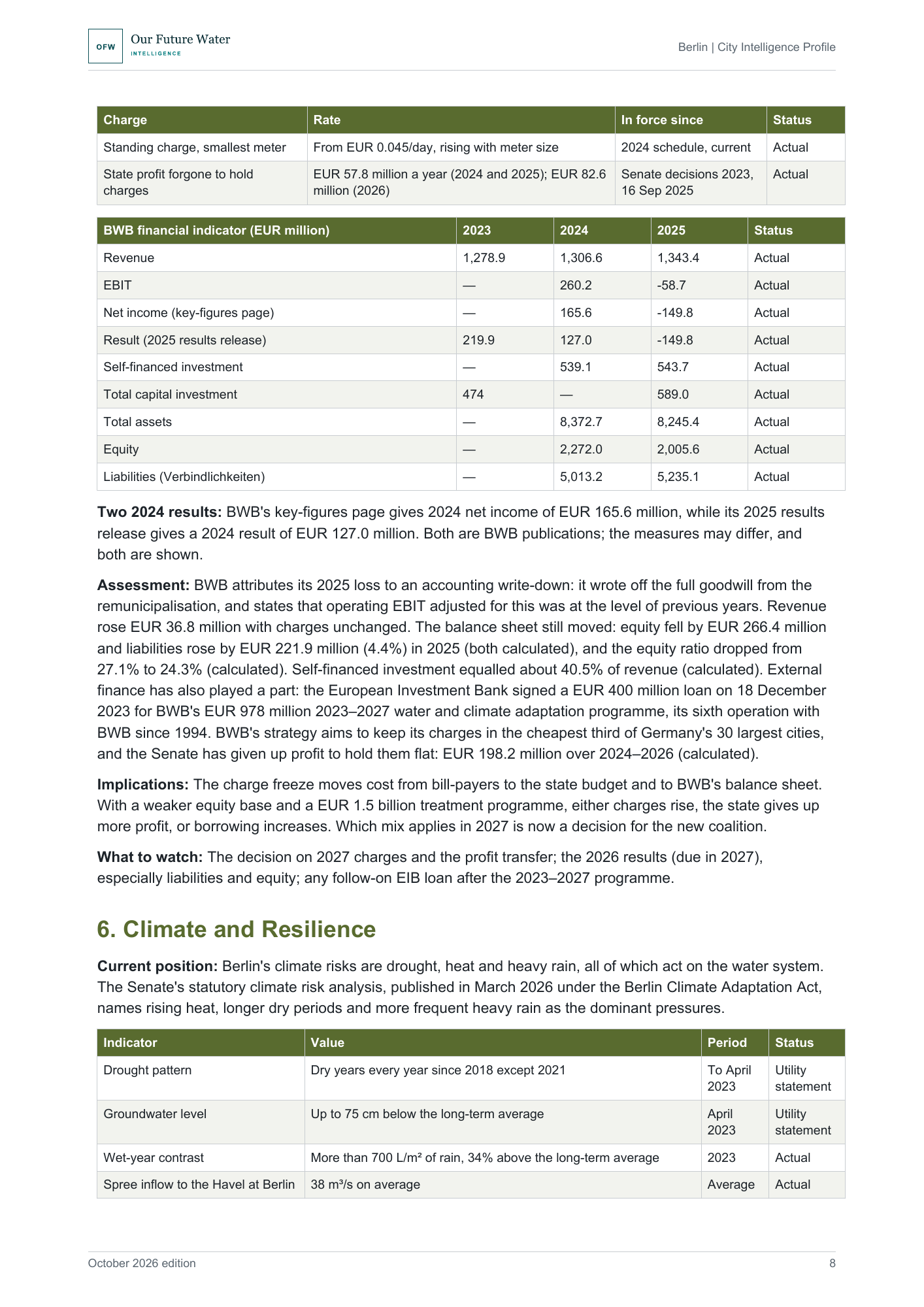
Charges and BWB financial indicators for 2023–2025, from Section 5, Tariffs and Finance.
06
Included
What you receive
The complete PDF report: 12 pages, 9 sections, 12 tables and a register of 32 sources.
This edition
October 2026, New edition. Covers BWB's 2025 financial year, including its EUR 149.8 million loss after the goodwill write-down and its balance sheet at the end of 2025. Includes the charges in force for 2026 and the Senate's decision of 16 September 2025 to forgo EUR 82.6 million of profit. Reports the 20 September 2026 state election and the coalition talks that will decide 2027 charges. Project status re-checked on 26 October 2026, including the Waßmannsdorf sludge plant, Münchehofe and the Johannisthal reactivation. New edition, October 2026, with evidence current to 26 October 2026. Replaces the earlier edition for new buyers; buyers of an earlier edition keep access to the edition they bought.
07
Evidence & method
Evidence and method
The profile draws on BWB's 2025 annual report, key figures and results release, its charge schedules, and Senate strategies, including the Masterplan Wasser. It also uses official population and economic statistics, parliamentary answers on waterworks reactivation, and the European Investment Bank's project record for BWB's investment programme.
Sources
32 sources, listed in the report's source register. Evidence current to 26 October 2026. Principal data periods: Berliner Wasserbetriebe (BWB) financial year 2025 (calendar year) results and operating figures; official population at 31 December 2025; charges in force for the 2026 billing period; project and policy status re-checked on 26 October 2026. All currency is euros (EUR)..
Evidence boundaries
This report uses authoritative source material available at the stated research cutoff. It distinguishes published facts, calculated values and analytical interpretation. No independent modelling is performed. Forward-looking analysis reflects published plans, documented trends and stated uncertainties. It does not constitute legal, financial, investment or engineering advice.
08
Lead analyst
Robert C. Brears
Founder, Our Future Water Intelligence
Robert C. Brears is a water-security specialist and author whose work examines utility governance, infrastructure investment, climate resilience and long-term water-system change for executive and policy audiences.
- Decision-focused utility intelligence
- Published water-policy author
- Evidence-grounded system analysis
09
Buyer FAQs
Before you purchase
Who can use the report?
Licensed for internal use within one purchasing organization. The PDF and its contents may be shared with colleagues within that organization. External redistribution, resale and public publication are prohibited without permission.
How is the report delivered?
The PDF is available to download immediately after confirmed payment, through our secure delivery system.
Can my organization buy wider access?
Institutional purchasing: For invoice enquiries, multi-organization licensing or broader access requirements, contact Our Future Water Intelligence.
10
Berlin City Intelligence Profile
- Format
- Length
- 12 pages
- Edition
- October 2026, New edition
- Price
- USD 99
11
Report details
Publication details
- Publisher
- Our Future Water Intelligence
- Report family
- City Intelligence Profile
- Report type
- Urban Water Research and Reference
- Edition
- October 2026, New edition
- Format
- Length
- 12 pages
- Reference
- ofw-profile-city-de-berlin_c4ded1051d3b
- Evidence current to
- 26 October 2026
14
Explore this report family
More City Intelligence Profiles
Explore the same report family covering other cities.
Muscat City Intelligence Profile
- Geography
- Oman
- Edition
- November 2026, New edition
- Length
- 13 pages
Jeddah City Intelligence Profile
- Geography
- Saudi Arabia
- Edition
- November 2026, First edition
- Length
- 13 pages
Doha City Intelligence Profile
- Geography
- Qatar
- Edition
- November 2026, First edition
- Length
- 13 pages