
01
Executive overview
Key findings
-15.8% (RCP4.5) to -47.0% (RCP8.5): projected change in precipitation by the end of the century (Fourth National Communication)
15%: projected fall in surface and groundwater availability by 2040, taking conventional resources from 680 MCM to 580 MCM (Updated NDC, citing RICCAR)
27%: share of original storage capacity lost to sediment in four major dams, 39 MCM (National Water Strategy)
USD 295m: Green Climate Fund finance for the National Water Carrier (approved October 2025), GCF's largest commitment for a single country
02
Buyer relevance
Who the report is for
Climate funds and development lenders
Identify where adaptation finance has gone, from GCF's USD 295m for the carrier to a EUR 10m watershed grant, and where preparedness gaps remain.
Government advisers and planners
Compare the official climate projections side by side, including 4NC rainfall changes of -15.8% (RCP4.5) and -47.0% (RCP8.5).
Investors and insurers
Assess hydrological and policy risk for water-dependent assets, including a projected destructive flood every 25-30 years in Aqaba's Wadi Al-Yutm watershed in 2030-2059.
Utilities and operators
Plan for storage loss and energy exposure: 27% of capacity lost to sediment in four major dams and 6.6 kWh per billed m³ in 2019.
03
Decision scope
Questions answered
What do the official projections say about rainfall?
The Fourth National Communication projects end-of-century precipitation falling 15.8% under RCP4.5 and 47.0% under RCP8.5; the National Climate Change Policy gives -21% under RCP4.5.
How much water could Jordan lose to climate change?
Its updated NDC, citing RICCAR, projects a 15% fall in surface and groundwater availability by 2040, from 680 MCM to 580 MCM of conventional resources.
Does Jordan have a drought plan?
The National Drought Action Plan v1.24 was a draft, not approved as official policy, as of 5 February 2023.
What is being done to adapt?
The main measure is the 300 MCM-a-year National Water Carrier, with USD 295m of GCF finance, alongside a USD 250m World Bank efficiency project and a EUR 10m King Talal watershed project.
04
Inside the report
Inside the complete report
Executive Snapshot
1. Why This Matters Now in Jordan
2. Current Position
3. Key Programmes, Projects and Investment
4. Policy, Regulation and Institutions
5. Risks and Constraints
6. Strategic Implications
7. What to Watch
Source Register
05
Public preview
What to watch next
2. Current Position
Any update of the national climate projections in Jordan's next UNFCCC submission; dam storage and sediment surveys.
3. Key Programmes, Projects and Investment
Carrier construction progress; the King Talal project's results; new EIB, GCF or World Bank adaptation financing.
4. Policy, Regulation and Institutions
Cabinet approval of the drought plan; how Jordan's NDC 3.0 submission treats water-sector adaptation.
5. Risks and Constraints
Seasonal rainfall; carrier milestones; any published progress on water-sector energy targets.
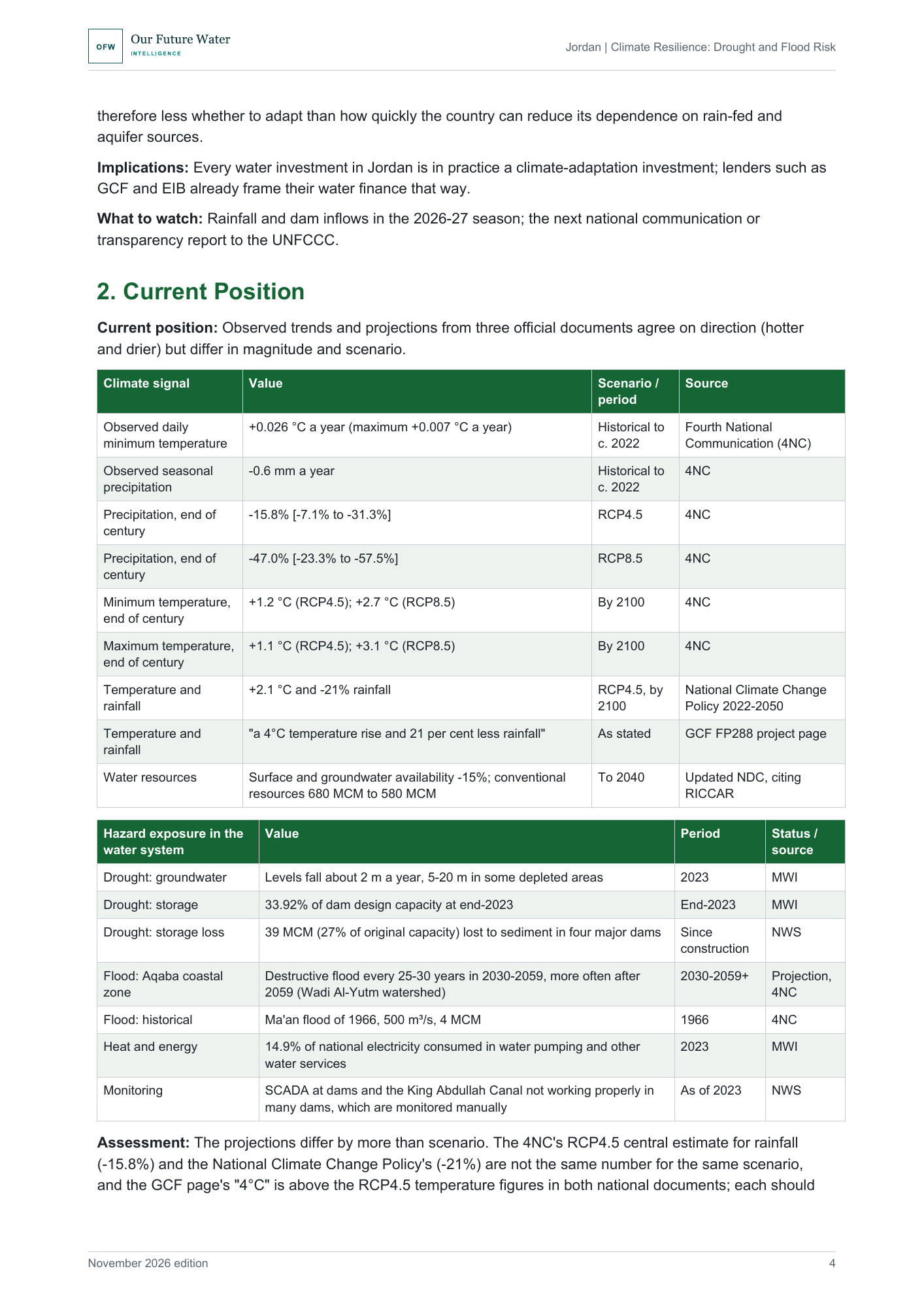
Section 2: Jordan's observed climate trends and projections by source and scenario, and the hazard exposure of its water system.
06
Included
What you receive
The complete PDF report: 10 pages, 9 sections, 9 tables and a register of 19 sources.
This edition
November 2026, First edition.
07
Evidence & method
Evidence and method
The brief draws on Jordan's Fourth National Communication, updated NDC and NDC 3.0 Vision, the National Climate Change Policy 2022-2050, the Ministry of Water and Irrigation's strategy, bulletins and draft National Drought Action Plan, and lender disclosures for adaptation projects re-checked on 29 November 2026.
Sources
19 sources, listed in the report's source register. Evidence current to 29 November 2026. Principal data periods: Fourth National Communication on Climate Change (2022); Updated NDC (2021) and NDC 3.0 Vision (2025); National Climate Change Policy 2022-2050; National Water Strategy 2023-2040; MWI Facts and Figures 2023; draft National Drought Action Plan (2022-23); adaptation projects re-checked 29 November 2026. Volumes in million cubic metres (MCM); currency US dollars (USD) and euros (EUR) as sources give them.
Evidence boundaries
This report uses authoritative source material available at the stated research cutoff. It distinguishes published facts, calculated values and analytical interpretation. No independent modelling is performed. Forward-looking analysis reflects published plans, documented trends and stated uncertainties. It does not constitute legal, financial, investment or engineering advice.
08
Lead analyst
Robert C. Brears
Founder, Our Future Water Intelligence
Robert C. Brears is a water-security specialist and author whose work examines utility governance, infrastructure investment, climate resilience and long-term water-system change for executive and policy audiences.
- Decision-focused utility intelligence
- Published water-policy author
- Evidence-grounded system analysis
09
Buyer FAQs
Before you purchase
Who can use the report?
Licensed for internal use within one purchasing organization. The PDF and its contents may be shared with colleagues within that organization. External redistribution, resale and public publication are prohibited without permission.
How is the report delivered?
The PDF is available to download immediately after confirmed payment, through our secure delivery system.
Can my organization buy wider access?
Institutional purchasing: For invoice enquiries, multi-organization licensing or broader access requirements, contact Our Future Water Intelligence.
10
Climate Resilience: Drought and Flood Risk in Jordan
- Format
- Length
- 10 pages
- Edition
- November 2026, First edition
- Price
- USD 249
11
Report details
Publication details
- Publisher
- Our Future Water Intelligence
- Report family
- Insight Brief
- Edition
- November 2026, First edition
- Format
- Length
- 10 pages
- Reference
- OFW_EXT_CLIMATE_RESILIENCE_DROUGHT_AND_FLOOD_RISK_IN_JORDAN_47a08384b586
- Evidence current to
- 29 November 2026
14
Explore this report family
More Climate Resilience: Drought and Flood Risk briefs
Explore the same report family covering other countries.
Climate Resilience: Drought and Flood Risk in Denmark
- Geography
- Denmark
- Edition
- November 2026, First edition
- Length
- 10 pages
Climate Resilience: Drought and Flood Risk in Germany
- Geography
- Germany
- Edition
- November 2026, First edition
- Length
- 11 pages
Climate Resilience: Drought and Flood Risk in Netherlands
- Geography
- Netherlands
- Edition
- November 2026, First edition
- Length
- 10 pages