
01
Executive overview
Key findings
202.2 million m³: water produced in Muscat Governorate in 2025, down from 233.3 million m³ in 2024, while water distributed held at 133.4 million m³ (NCSI, data from APSR; actual)
300,000 m³ a day: Ghubrah III desalination plant, 93% complete in November 2026, with operations expected in Q2 2027
RO 173.651 million: government subsidy within Nama Water Services' RO 428.663 million operating revenue in 2024, about 40.5% (calculated; licensed area), when current liabilities exceeded current assets by RO 338 million
About RO 900 million (NWS) / €2 billion (SUEZ) / US$2.3 billion (Zawya): 15-year performance-based operations contract for water and wastewater in Muscat and North and South Al Sharqiyah, awarded in June 2026 to a SUEZ-led consortium, with a non-revenue water target of 11% by 2040 from 34%
02
Buyer relevance
Who the report is for
Desalination, pumping and transmission suppliers
Size the Muscat Zone supply gap plant by plant, from Ghubrah II's 191,000 m³ a day to Ghubrah III's 300,000, against peak demand projected at 774,000 m³ a day in 2032.
Wastewater contractors and PPP developers
Prepare for the Al Ansab and Al Amerat BOOT expansion, bids due 5 January 2027, alongside the RO 64.9 million Al Seeb and about OMR 123 million Bawshar programmes.
Lenders and investors assessing Nama Water Services as a counterparty
Read the 2024 position: a subsidy of RO 173.651 million in operating revenue, short-term borrowings of RO 269 million and capital commitments of RO 458.6 million.
Operators and advisers following the Cluster 1 contract
Compare the three published non-revenue water baselines, 40.7%, 37.1% and 34%, with the contract's 11% target for 2040.
03
Decision scope
Questions answered
Can Muscat's own plants meet its demand?
Not yet: local capacity of about 431,000 m³ a day covers about 64% of 2025 peak demand, with about 242,000 m³ a day available from the Barka Zone.
What does 2027 add?
Ghubrah III (300,000 m³ a day, operations expected in Q2 2027) and the Wadi Dayqah plant (35,000 m³ a day potable, expected May 2027; PWP plans for 2028).
How dependent is the utility on the state?
Government subsidy was about 40.5% of Nama Water Services' 2024 operating revenue, and current liabilities exceeded current assets by RO 338 million.
What are customers charged?
OMR 0.66 for citizen households with two accounts or fewer, OMR 0.770 for other residential customers and OMR 1.320 for commercial and government customers.
How exposed is the capital to floods?
Nearly 45% of the capital's areas were reported vulnerable to wadi floods; the Wadi Adai dam in Muttrah was 53.7% complete in June 2026.
04
Inside the report
Inside the complete report
Executive Snapshot
1. Introduction and City Water Context
2. Water Demand and Consumption
3. Water Infrastructure and Supply Systems
4. Utility Performance, Finance, and Customer Services
5. Governance, Regulation, and Digital Transformation
6. Climate Resilience and Sustainability
7. Strategic Outlook and Recommendations
Source Register
05
Public preview
What to watch next
2.6 Future Demand Pressures
The next PWP 7-Year Statement's Muscat Zone growth rate; NCSI production for late 2026; MIS actual demand against forecast.
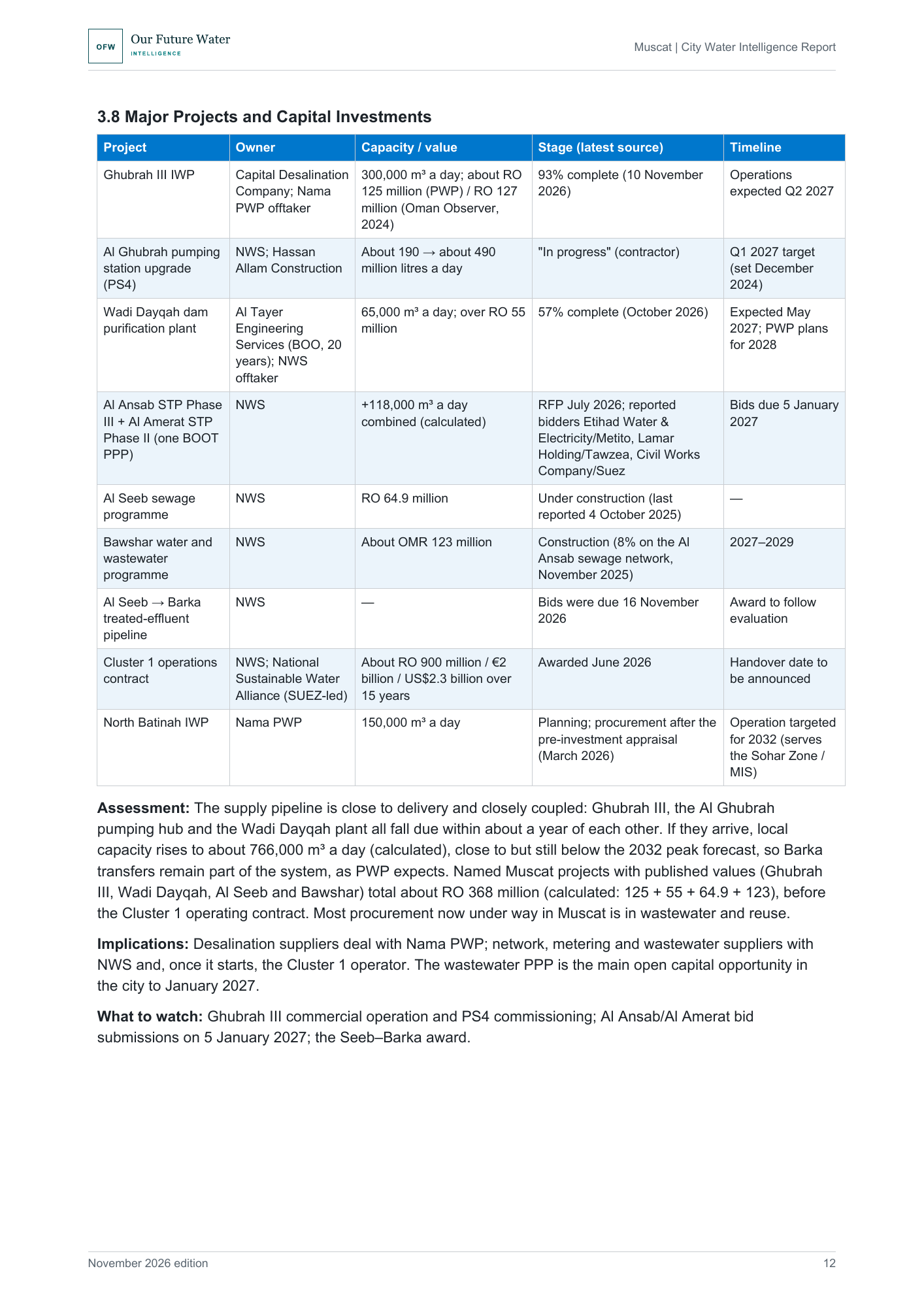
3.8 Major Projects and Capital Investments
Ghubrah III commercial operation and PS4 commissioning; Al Ansab/Al Amerat bid submissions on 5 January 2027; the Seeb–Barka award.
4.8 Capital Investment Programmes and Financing Requirements
NWS's 2025 audited financial statements (liquidity, borrowings, subsidy); the 2027 bulk supply tariff; a dated retail tariff or subsidy-reform decision; any first issuance under the Sustainable Finance Framework.
5.9 International Benchmarking and Performance Comparisons
Publication of Cluster 1 KPI results; APSR's tariff strategy; any NWS participation in an international benchmarking round.
Section 3.8: Muscat's major projects with owner, capacity or value, latest stage and timeline, followed by the assessment of the supply outlook.
06
Included
What you receive
The complete PDF report: 31 pages, 9 sections, 48 tables and a register of 48 sources.
This edition
November 2026, First edition.
07
Evidence & method
Evidence and method
The report draws on NCSI population and water statistics compiled from APSR data, Nama PWP's 2026–2032 Water 7-Year Statement and bulk tariffs, Nama Water Services' 2025 annual report, 2024 audited financial statements and tariff page, Oman's NDC 3.0, and project, procurement and contract announcements checked to 23 November 2026.
Sources
48 sources, listed in the report's source register. Evidence current to 23 November 2026. Principal data periods: 2025 water and population statistics (NCSI, water data supplied by APSR) with population and production to September 2026; Nama Water Services 2025 annual report and 2024 audited financial statements; Nama PWP Water 7-Year Statement 2026–2032; Oman NDC 3.0 (July 2026); project, procurement and tariff status as of 23 November 2026. Currency: Omani rial (RO; written OMR in some sources; 1,000 baisa = 1 rial); US dollars (US$) and euros (€) where sources report them.
Evidence boundaries
This report uses authoritative source material available at the stated research cutoff. It distinguishes published facts, calculated values and analytical interpretation. No independent modelling is performed. Forward-looking analysis reflects published plans, documented trends and stated uncertainties. It does not constitute legal, financial, investment or engineering advice.
08
Lead analyst
Robert C. Brears
Founder, Our Future Water Intelligence
Robert C. Brears is a water-security specialist and author whose work examines utility governance, infrastructure investment, climate resilience and long-term water-system change for executive and policy audiences.
- Decision-focused utility intelligence
- Published water-policy author
- Evidence-grounded system analysis
09
Buyer FAQs
Before you purchase
Who can use the report?
Licensed for internal use within one purchasing organization. The PDF and its contents may be shared with colleagues within that organization. External redistribution, resale and public publication are prohibited without permission.
How is the report delivered?
The PDF is available to download immediately after confirmed payment, through our secure delivery system.
Can my organization buy wider access?
Institutional purchasing: For invoice enquiries, multi-organization licensing or broader access requirements, contact Our Future Water Intelligence.
10
Muscat Water Intelligence Report
- Format
- Length
- 31 pages
- Edition
- November 2026, First edition
- Price
- USD 799
11
Report details
Publication details
- Publisher
- Our Future Water Intelligence
- Report family
- City Intelligence Report
- Edition
- November 2026, First edition
- Format
- Length
- 31 pages
- Reference
- OFW_EXT_MUSCAT_WATER_INTELLIGENCE_REPORT_392f2960b8c0
- Evidence current to
- 23 November 2026
14
Explore this report family
More City Water Intelligence reports
Explore the same report family covering other cities.
City Water Intelligence
Dubai Water Intelligence Report
- Geography
- Dubai, United Arab Emirates
- Edition
- November 2026, New edition
- Length
- 32 pages
City Water Intelligence
Abu Dhabi Water Intelligence Report
- Geography
- Abu Dhabi, United Arab Emirates
- Edition
- November 2026, New edition
- Length
- 30 pages
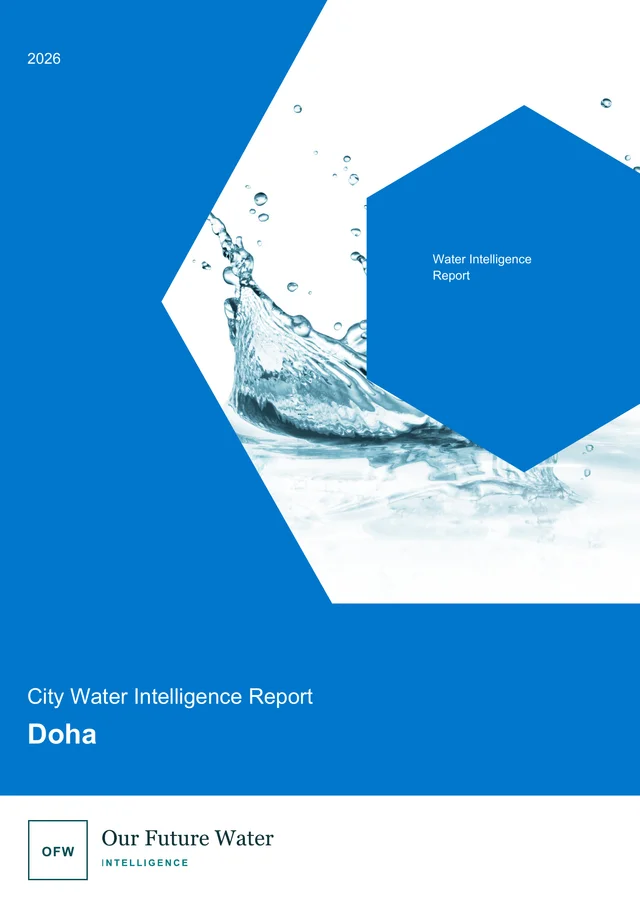
City Water Intelligence
Doha Water Intelligence Report
- Geography
- Doha, Qatar
- Edition
- November 2026, New edition
- Length
- 32 pages