01
Executive overview
Key findings
10 million m³ a year: drinking water capacity from two Waternet measures planned before 2030 (2024 regional action plan), with Weesperkarspel's +6 million now expected in 2031
EUR 54 million: estimated value of the Weesperkarspel slow sand filter build-team contract, excluding VAT
EUR 160.8 million: water authority investment planned for 2026 across its 20-municipality area, against about EUR 70 million a year delivered in recent years
EUR 388.0 million: water authority wastewater investment planned for 2026–2030, whole area (calculated)
02
Buyer relevance
Who the report is for
Civil and process contractors
Time bids for the RWZI Amsterdam-West sludge dewatering works, planned for construction in 2027 to 2029, and the Weesperkarspel filter.
Treatment equipment suppliers
Identify packages such as prefab elements for 12 new filter beds and the micropollutant steps at Amstelveen, Uithoorn and De Ronde Venen.
Engineering consultants
Track the post-2030 drinking water options, including the Weesperkarspel/Loenderveen expansion of 8 million m³ a year in 2031.
Investors and lenders
Weigh the water authority's net debt ratio, projected to rise from 248% in 2026 to 303% in 2030, against its investment plan.
03
Decision scope
Questions answered
How much does the water authority serving Amsterdam plan to invest?
EUR 160.8 million in 2026 and about EUR 158.2 million a year on average from 2027 to 2030, across its whole 20-municipality area.
What drinking water capacity is being added before 2030?
Two Waternet measures totalling 10 million m³ a year: +5 at Leiduin and +5 through a new bulk supply from PWN. Weesperkarspel's +6 is now expected in use in 2031.
What is the largest risk to these projects?
Delivery: planned investment of EUR 160.8 million compares with about EUR 70 million a year delivered recently, and several projects are already delayed by capacity shortages.
How much does the city spend on sewers?
The City of Amsterdam's sewer, stormwater and groundwater programme totals EUR 384.0 million of investment over 2022 to 2027, peaking at EUR 77.2 million in 2024.
04
Inside the report
Inside the complete report
Executive Snapshot
1. Why This Matters Now in Amsterdam
2. Current Position
3. Key Programmes, Projects and Investment
4. Policy, Regulation and Institutions
5. Risks and Constraints
6. Strategic Implications
7. What to Watch
Source Register
05
Public preview
What to watch next
1. Why This Matters Now in Amsterdam
The water authority's 2027 budget, expected in late 2026, and whether it keeps the 2026 investment level.
2. Current Position
Actual water authority investment for 2026 against the EUR 160.8 million plan; a successor to the city's sewer programme, which ends in 2027.
3. Key Programmes, Projects and Investment
The execution credit for Amsterdam-West sludge dewatering; award of the Weesperkarspel contracts; selection of a preferred option for the Weesperkarspel/Loenderveen expansion and WAAG.
4. Policy, Regulation and Institutions
Any government response to the Rli on financing rules; national Belastingplan 2027 changes to the tap water tax, which affect bills but not utility revenue; decisions on the water authority's 2027 levies.
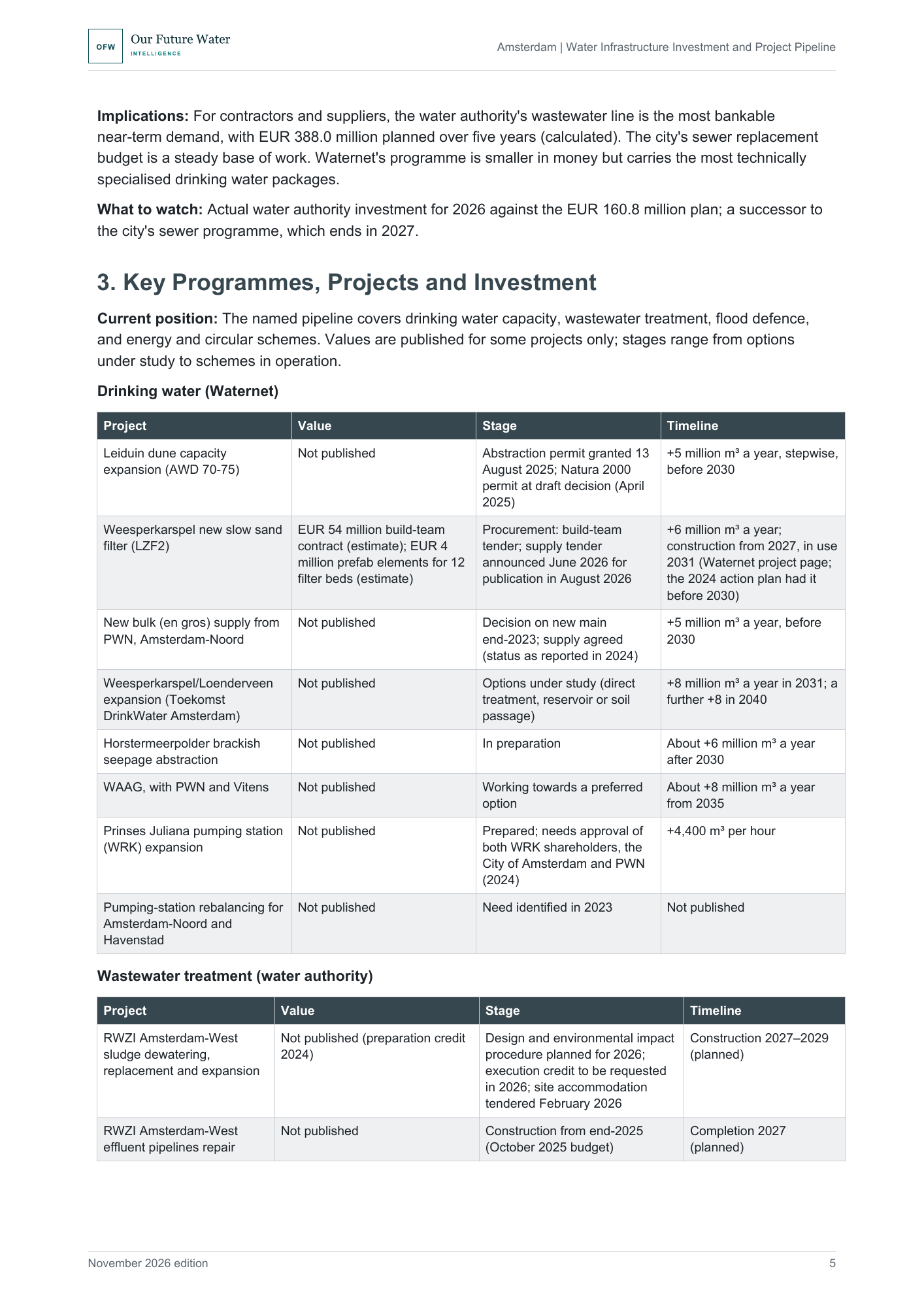
Section 3: the drinking water and wastewater project tables, with value, stage and timeline for each named scheme.
06
Included
What you receive
The complete PDF report: 11 pages, 9 sections, 11 tables and a register of 18 sources.
This edition
November 2026, First edition.
07
Evidence & method
Evidence and method
The report draws on the water authority's 2026 budget and five-year investment programme, Waternet's regional capacity plan and procurement notices to June 2026, the city's sewer programme 2022–2027, ACM and ILT regulatory reviews, provincial permits and the city's climate-adaptation study.
Sources
18 sources, listed in the report's source register. Evidence current to 1 November 2026. Principal data periods: water authority budget and investment programme 2026–2030 (October 2025); municipal sewer programme 2022–2027; drinking water capacity plan published 2024; procurement notices to June 2026; regulatory cost figures for 2023–2025. All currency is euros (EUR)..
Evidence boundaries
This report uses authoritative source material available at the stated research cutoff. It distinguishes published facts, calculated values and analytical interpretation. No independent modelling is performed. Forward-looking analysis reflects published plans, documented trends and stated uncertainties. It does not constitute legal, financial, investment or engineering advice.
08
Lead analyst
Robert C. Brears
Founder, Our Future Water Intelligence
Robert C. Brears is a water-security specialist and author whose work examines utility governance, infrastructure investment, climate resilience and long-term water-system change for executive and policy audiences.
- Decision-focused utility intelligence
- Published water-policy author
- Evidence-grounded system analysis
09
Buyer FAQs
Before you purchase
Who can use the report?
Licensed for internal use within one purchasing organization. The PDF and its contents may be shared with colleagues within that organization. External redistribution, resale and public publication are prohibited without permission.
How is the report delivered?
The PDF is available to download immediately after confirmed payment, through our secure delivery system.
Can my organization buy wider access?
Institutional purchasing: For invoice enquiries, multi-organization licensing or broader access requirements, contact Our Future Water Intelligence.
10
Water Infrastructure Investment and Project Pipeline in Amsterdam
- Format
- Length
- 11 pages
- Edition
- November 2026, First edition
- Price
- USD 249
11
Report details
Publication details
- Publisher
- Our Future Water Intelligence
- Report family
- Insight Brief
- Edition
- November 2026, First edition
- Format
- Length
- 11 pages
- Reference
- OFW_EXT_WATER_INFRASTRUCTURE_INVESTMENT_AND_PROJECT_PIPELINE_IN_AMSTERDAM_9143549e3547
- Evidence current to
- 1 November 2026