01
Executive overview
Key findings
95 million m³: drinking water produced by Waternet in 2024, of which 69 million m³ was sold in its own supply area
70 → 75 million m³ a year: permitted abstraction ceiling for the dune system, raised by the Province of North Holland on 13 August 2025
107 million m³ a year: drinking water production capacity required by 2030 (projection, 2024 regional action plan)
EUR 1.04 billion: investment needed to make Amsterdam climate-resilient by 2050 (needs assessment, not adopted)
02
Buyer relevance
Who the report is for
Consultants and advisers new to the Dutch water sector
Get a quick briefing on which of the two post-2026 bodies, Waternet or the Amstel, Gooi en Vecht water authority, holds each task, charge and asset.
Treatment and construction suppliers
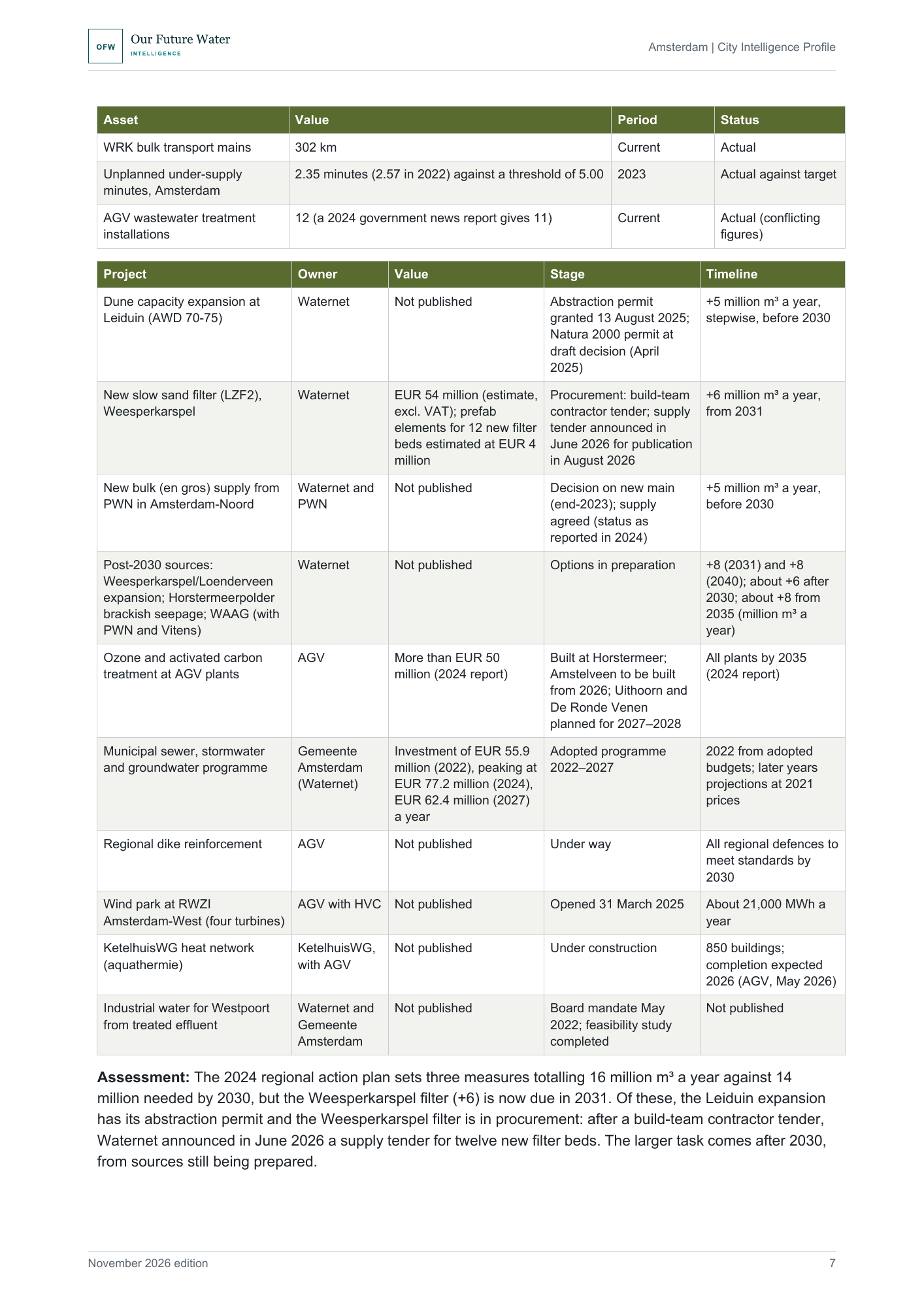
See the project table, including the EUR 54 million Weesperkarspel slow sand filter and the AGV ozone and activated carbon programme.
Investors and analysts following Dutch utilities
Compare Waternet's 2024 turnover of EUR 140 million and its 2026 tariff cuts with the capacity programme that will raise future costs.
City and regional policy teams
Set the city's EUR 1.04 billion adaptation need and the 2030 capacity requirement against the national outlook and pending decisions.
03
Decision scope
Questions answered
Where does Amsterdam's drinking water come from?
From Rhine water passed through the Amsterdamse Waterleidingduinen, which supplies 66% of the city's drinking water, and from Bethunepolder seepage water treated at Weesperkarspel.
Is Amsterdam running short of supply capacity?
Waternet's 2024 regional action plan puts regular capacity at 95 million m³ a year, with 107 million m³ required by 2030 and about 126 million m³ by 2050 on Waternet's 2024 forecast (122 million m³ on its 2023 forecast); two measures due before 2030 add about 10 million m³ a year against 14 million m³ needed, and the Weesperkarspel slow sand filter (+6 million m³ a year) is expected in use in 2031.
What does a household pay for water in 2026?
Waternet's standing charge is EUR 90.55 a year plus EUR 1.18 per m³, about EUR 341 a year for a four-person household before VAT and tap water tax, with separate water authority charges on top.
Who runs water in Amsterdam since the split?
Since 1 January 2026, Stichting Watermaatschappij Amsterdam, trading as Waternet, runs drinking water and the city's sewers, and the Amstel, Gooi en Vecht water authority runs wastewater treatment and flood defence.
04
Inside the report
Inside the complete report
Executive Snapshot
1. City Water Profile
2. Water Resources and Supply
3. Institutions and Utilities
4. Infrastructure and Major Projects
5. Tariffs and Finance
6. Climate and Resilience
7. Outlook and What to Watch
Source Register
05
Public preview
What to watch next
3. Institutions and Utilities
The study on where Amsterdam's sewer and water tasks will eventually sit; the final cost of the separation against the July 2025 estimates; how quickly the temporary shared services are unwound.
4. Infrastructure and Major Projects
Award of the Weesperkarspel contracts; the next AGV plants to receive ozone treatment; permit applications for the post-2030 sources.
5. Tariffs and Finance
Waternet's 2027 tariff announcement; the parliamentary votes on the Belastingplan 2027; AGV's 2027 levy decisions.
6. Climate and Resilience
Any council decision to fund the adaptation programme; progress on AGV dike reinforcement towards 2030; national drought measures in the Delta Programme cycle.
Section 4: the major projects table, with owner, value, stage and timeline for drinking water, wastewater and energy schemes.
06
Included
What you receive
The complete PDF report: 12 pages, 9 sections, 13 tables and a register of 30 sources.
This edition
November 2026, First edition.
07
Evidence & method
Evidence and method
The report draws on regulator publications from the ILT and ACM, the Province of North Holland's 2025 abstraction permit, Waternet's regional action plan and tariff pages, the water authority's levy ordinances and sustainability report, CBS statistics and the city's climate-adaptation study.
Sources
30 sources, listed in the report's source register. Evidence current to 1 November 2026. Principal data periods: population at 1 January 2026; drinking water operations for 2024; tariffs for 2026; capacity forecasts published in 2024; climate-adaptation estimates of September 2025. All currency is euros (EUR)..
Evidence boundaries
This report uses authoritative source material available at the stated research cutoff. It distinguishes published facts, calculated values and analytical interpretation. No independent modelling is performed. Forward-looking analysis reflects published plans, documented trends and stated uncertainties. It does not constitute legal, financial, investment or engineering advice.
08
Lead analyst
Robert C. Brears
Founder, Our Future Water Intelligence
Robert C. Brears is a water-security specialist and author whose work examines utility governance, infrastructure investment, climate resilience and long-term water-system change for executive and policy audiences.
- Decision-focused utility intelligence
- Published water-policy author
- Evidence-grounded system analysis
09
Buyer FAQs
Before you purchase
Who can use the report?
Licensed for internal use within one purchasing organization. The PDF and its contents may be shared with colleagues within that organization. External redistribution, resale and public publication are prohibited without permission.
How is the report delivered?
The PDF is available to download immediately after confirmed payment, through our secure delivery system.
Can my organization buy wider access?
Institutional purchasing: For invoice enquiries, multi-organization licensing or broader access requirements, contact Our Future Water Intelligence.
10
Amsterdam City Intelligence Profile
- Format
- Length
- 12 pages
- Edition
- November 2026, First edition
- Price
- USD 99
11
Report details
Publication details
- Publisher
- Our Future Water Intelligence
- Report family
- City Intelligence Profile
- Edition
- November 2026, First edition
- Format
- Length
- 12 pages
- Reference
- OFW_EXT_AMSTERDAM_CITY_INTELLIGENCE_PROFILE_d015befbe2e1
- Evidence current to
- 1 November 2026
14
Explore this report family
More City Intelligence Profiles
Explore the same report family covering other cities.
Urban Water Research and Reference
Riyadh City Intelligence Profile
- Geography
- Riyadh, Saudi Arabia
- Edition
- October 2026, New edition
- Length
- 12 pages
Urban Water Research and Reference
Berlin City Intelligence Profile
- Geography
- Berlin, Germany
- Edition
- October 2026, New edition
- Length
- 12 pages
Urban Water Research and Reference
Guangzhou City Intelligence Profile
- Geography
- Guangzhou, China
- Edition
- October 2026, New edition
- Length
- 12 pages