
01
Executive overview
Key findings
46%, 42%, 11% and 1%: shares of national water demand met by groundwater, desalinated seawater, treated wastewater and surface water (MOEI and EAD, December 2023), against total demand of about 5 billion m³ a year
Around 2.3 billion m³ vs 0.15 billion m³: groundwater extracted each year (u.ae, undated) against renewable internal freshwater resources (World Bank, 2022)
487 MIG vs 555 MIGD: Dubai's daily peak desalinated water demand in 2025 against DEWA's installed capacity after Hassyan Block A came online in Q1 2026
2 days of normal storage, equal to 16 days in emergencies and more than 45 days in extreme emergencies: Water Security Strategy 2036 storage target (Arabic edition; English edition gives "up to 2 days")
02
Buyer relevance
Who the report is for
Desalination developers and suppliers
Dubai's peak-to-capacity margin by year, EWEC's 805 MIGD peak projection for 2029 and the stage of each new reverse osmosis plant.
Storage and aquifer recharge specialists
Abu Dhabi's reservoir storage of about 1.25 days of consumption (2019), the Liwa reserve and DEWA's 6 billion gallon aquifer target.
Agricultural and groundwater advisers
Abu Dhabi's target to cut extraction by up to 650 million m³ by 2030 and the national farm supply target of 7.1 million m³ a day by 2036.
Data-centre and industrial investors
Where water demand is growing fastest, and one published estimate of about 61 billion litres a year for the computing sector by 2030.
03
Decision scope
Questions answered
How much of the UAE's water comes from groundwater?
Groundwater meets 46% of national demand and 93% of farm irrigation, with around 2.3 billion m³ extracted a year.
Is Dubai's desalination capacity keeping up with demand?
The 2025 peak of 487 MIG left 8 MIGD of margin on 495 MIGD; Hassyan Block A raised capacity to 555 MIGD in Q1 2026, and DEWA targets 735 MIGD by 2030.
How much water storage does the UAE hold?
On 2019 figures Abu Dhabi's network reservoirs held about 1.25 days of desalinated consumption; the national target is 'up to 2 days' under normal conditions, which the Arabic edition says equals 16 days of supply in emergencies.
How much treated wastewater is reused?
MOEI put reuse at 73% in March 2025, against a Water Security Strategy target of 95% by 2036.
04
Inside the report
Inside the complete report
Executive Snapshot
1. Why This Matters Now in United Arab Emirates
2. Current Position
3. Key Programmes, Projects and Investment
4. Policy, Regulation and Institutions
5. Risks and Constraints
6. Strategic Implications
7. What to Watch
Source Register
05
Public preview
What to watch next
1. Why This Matters Now in United Arab Emirates
DEWA's FY2026 demand and peak; any EWEC update to the 805 MIGD projection.
2. Current Position
A national desalination capacity total after 2023; a measured groundwater abstraction series; DEWA's 2026 peak against 555 MIGD.
3. Key Programmes, Projects and Investment
Hassyan Phase 1 completion; Shuweihat 4's commercial operation; DEWA's progress toward its 6 billion gallon aquifer reserve.
4. Policy, Regulation and Institutions
A first published progress report on the Water Security Strategy 2036; EAD reporting against the 650 million m³ extraction cut.
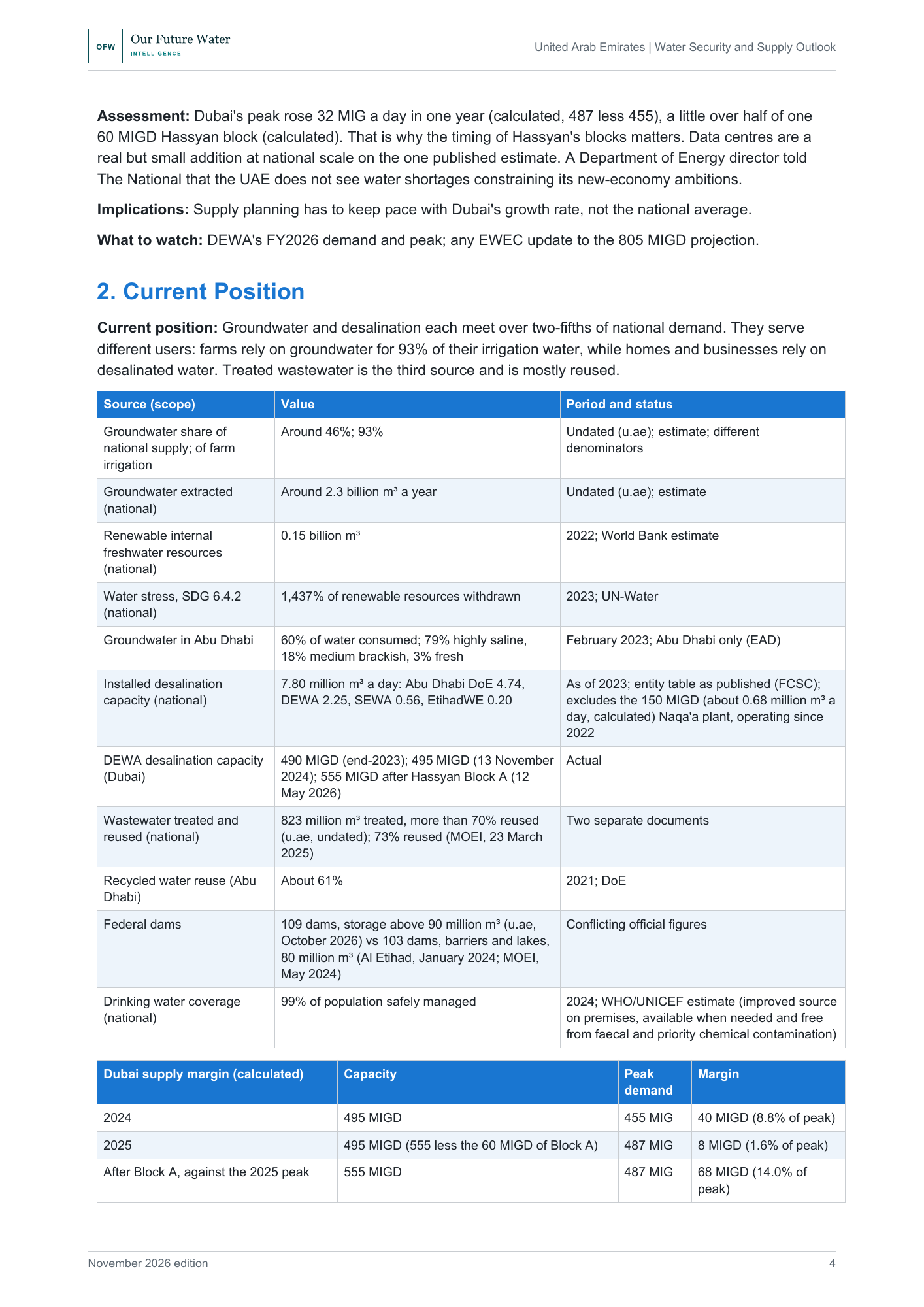
Current Position: national and emirate supply sources with periods and status, followed by Dubai's calculated supply margin for 2024, 2025 and after Hassyan Block A.
06
Included
What you receive
The complete PDF report: 11 pages, 9 sections, 8 tables and a register of 27 sources.
This edition
November 2026 edition.
07
Evidence & method
Evidence and method
Built on the UAE government portal's water and strategy pages, MOEI and Environment Agency – Abu Dhabi releases, Abu Dhabi Department of Energy technical reports and SCAD water statistics, DEWA's FY2025 and Q1 2026 results, EWEC planning documents, project announcements from offtakers and developers, the Fifth National Communication, and UN-Water and World Bank series.
Sources
27 sources, listed in the report's source register. Evidence current to 10 November 2026. Principal data periods: national source mix (December 2023 statement); installed desalination capacity as of 2023; DEWA demand and peak for 2024 and 2025 and capacity to May 2026; UN-Water and World Bank series for 2022 to 2024; plans and targets to 2036 and 2050; project status checked on 10 November 2026. Currency is UAE dirhams (AED), with US dollars (US$) where the source states them..
Evidence boundaries
This report uses authoritative source material available at the stated research cutoff. It distinguishes published facts, calculated values and analytical interpretation. No independent modelling is performed. Forward-looking analysis reflects published plans, documented trends and stated uncertainties. It does not constitute legal, financial, investment or engineering advice.
08
Lead analyst
Robert C. Brears
Founder, Our Future Water Intelligence
Robert C. Brears is a water-security specialist and author whose work examines utility governance, infrastructure investment, climate resilience and long-term water-system change for executive and policy audiences.
- Decision-focused utility intelligence
- Published water-policy author
- Evidence-grounded system analysis
09
Buyer FAQs
Before you purchase
Who can use the report?
Licensed for internal use within one purchasing organization. The PDF and its contents may be shared with colleagues within that organization. External redistribution, resale and public publication are prohibited without permission.
How is the report delivered?
The PDF is available to download immediately after confirmed payment, through our secure delivery system.
Can my organization buy wider access?
Institutional purchasing: For invoice enquiries, multi-organization licensing or broader access requirements, contact Our Future Water Intelligence.
10
Water Security and Supply Outlook in United Arab Emirates
- Format
- Length
- 11 pages
- Edition
- November 2026 edition
- Price
- USD 249
11
Report details
Publication details
- Publisher
- Our Future Water Intelligence
- Report family
- Insight Brief
- Edition
- November 2026 edition
- Format
- Length
- 11 pages
- Reference
- OFW_EXT_WATER_SECURITY_AND_SUPPLY_OUTLOOK_IN_UNITED_ARAB_EMIRATES_6113cc850e57
- Evidence current to
- 10 November 2026
14
Explore this report family
More Water Security and Supply Outlook briefs
Explore the same report family covering other countries.
Water Security and Supply Outlook in Denmark
- Geography
- Denmark
- Edition
- November 2026, First edition
- Length
- 10 pages
Water Security and Supply Outlook in Germany
- Geography
- Germany
- Edition
- November 2026, First edition
- Length
- 12 pages
Water Security and Supply Outlook in Netherlands
- Geography
- Netherlands
- Edition
- November 2026, First edition
- Length
- 11 pages