
01
Executive overview
Key findings
About 300 mgd: safe yield, against five-year average withdrawals of 203 mgd (as of April 1, 2026) and demand of less than 200 mgd (Q4 FY2026)
82.1%: Quabbin Reservoir volume on June 30, 2026, down from 93.0% a year earlier (actual)
53 water and 43 sewer communities: MWRA's wholesale customers, serving about 3 million people (FY2025)
1 and 5: FY2026 permit violations at the Deer Island and Clinton treatment plants (actual)
02
Buyer relevance
Who the report is for
Regional planners and state agency staff
Compare MWRA's 203 mgd of withdrawals and less than 200 mgd of demand with its 300 mgd safe yield when weighing new community connections.
Engineering consultants new to the Boston region
Get the full asset base in one place, from about 350 miles of aqueducts and mains to Deer Island's 1,270 mgd peak hourly design flow.
Municipal officials in member and applicant communities
Understand how assessments, about 95.5% of FY2026 revenue, and the US$200 million lead program divide costs between MWRA and towns.
Environmental and legal advisers
Track the 2005-expired Deer Island permit, the May 2026 court motion and the draft overflow plan in one framework.
03
Decision scope
Questions answered
Does MWRA have enough water?
Its safe yield is about 300 mgd, against five-year average withdrawals of 203 mgd, and supplies are projected to be sufficient through at least 2060.
How full is the Quabbin Reservoir?
It was at 82.1% of capacity on June 30, 2026, down from 93.0% on June 30, 2025.
How is MWRA's treatment performing?
Deer Island had one permit violation and the Clinton plant five in FY2026; drinking water met every state and federal standard in 2025.
Who regulates MWRA's wastewater discharge?
EPA and MassDEP issue the Deer Island NPDES permit; the current permit expired in 2005, and a May 2023 draft renewal has not been made final.
04
Inside the report
Inside the complete report
Executive Overview
1. Water Resource Profile
2. Governance and Institutional Framework
3. Infrastructure and Service Delivery
Strategic Outlook and Opportunities
Source Register
05
Public preview
What to watch next
Strategic Outlook and Opportunities
FY2027 capital spending against the US$322.1 million plan; South Tunnel procurement; the final CSO plan's cost allocation among communities; the FY2028–FY2033 capital prioritization.
2. Governance and Institutional Framework
Gulliver's start date; the court's ruling on MWRA's motion; issuance of the final Deer Island permit; the FY2028 proposed budget and the Advisory Board's response.
1. Water Resource Profile
Quabbin volume at June 30, 2027; the first community-specific interbasin transfer filings.
3. Infrastructure and Service Delivery
Clinton Treatment Plant violations in FY2027; Deer Island compliance under the 2023 draft limits once the permit is final; the next lead and copper sampling results.
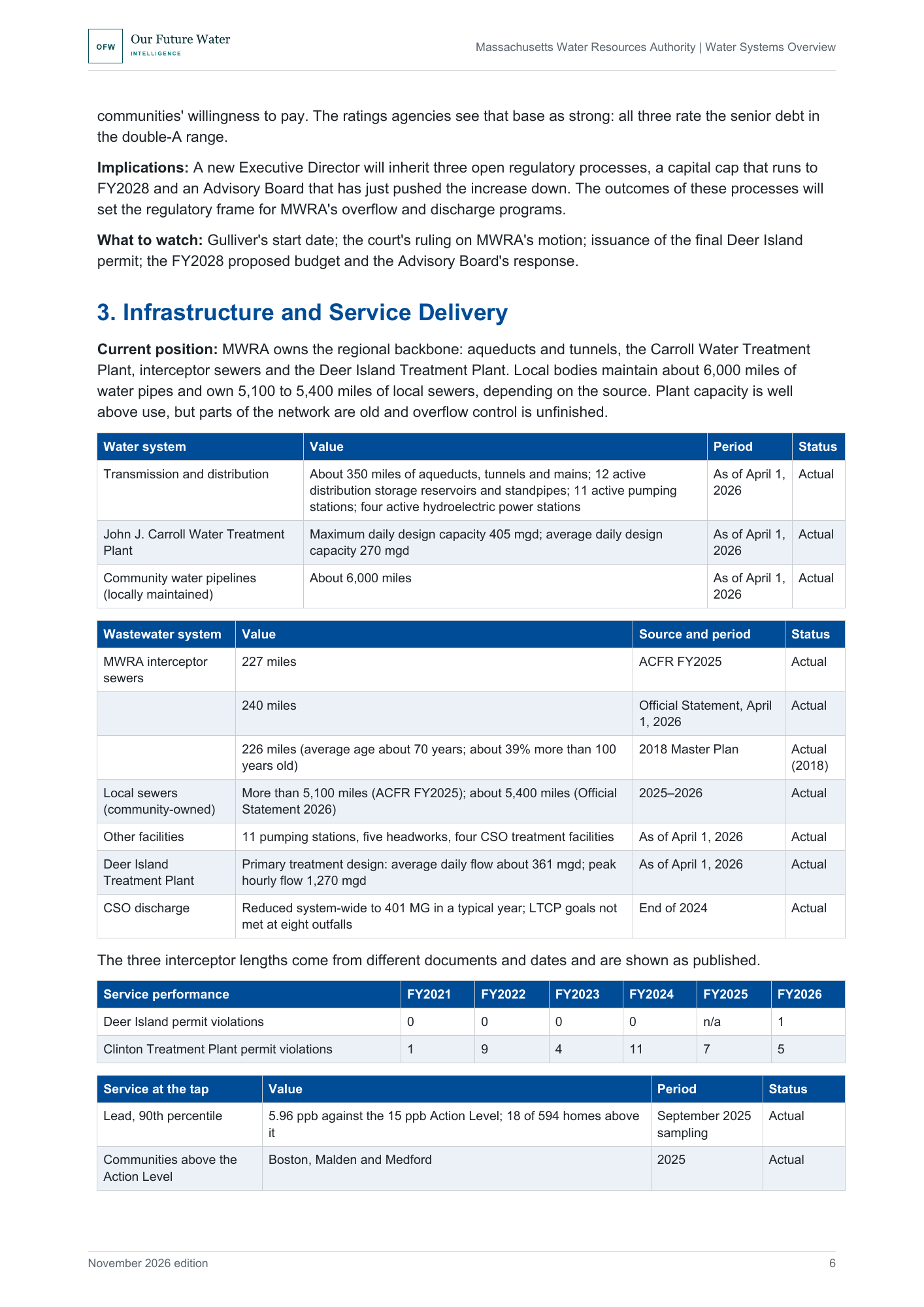
Infrastructure and Service Delivery: MWRA's water and wastewater assets, conflicting interceptor lengths shown side by side, and plant compliance by year.
06
Included
What you receive
The complete PDF report: 10 pages, 6 sections, 13 tables and a register of 22 sources.
This edition
November 2026, First edition.
07
Evidence & method
Evidence and method
The report draws on MWRA's 2026 bond Official Statement and FY2025 annual financial report, quarterly performance indicators from FY2017 to FY2026, the 2025 water quality report, the 2018 Master Plan, rating agency reports, and board papers and votes to October 21, 2026.
Sources
22 sources, listed in the report's source register. Evidence current to 9 November 2026. Principal data periods: FY2025 audited results and FY2026 performance indicators (fiscal years end June 30); reservoir data at June 30, 2026; system description as of April 1, 2026; board decisions to October 21, 2026; status checked to November 9, 2026. All currency is US dollars..
Evidence boundaries
This report uses authoritative source material available at the stated research cutoff. It distinguishes published facts, calculated values and analytical interpretation. No independent modelling is performed. Forward-looking analysis reflects published plans, documented trends and stated uncertainties. It does not constitute legal, financial, investment or engineering advice.
08
Lead analyst
Robert C. Brears
Founder, Our Future Water Intelligence
Robert C. Brears is a water-security specialist and author whose work examines utility governance, infrastructure investment, climate resilience and long-term water-system change for executive and policy audiences.
- Decision-focused utility intelligence
- Published water-policy author
- Evidence-grounded system analysis
09
Buyer FAQs
Before you purchase
Who can use the report?
Licensed for internal use within one purchasing organization. The PDF and its contents may be shared with colleagues within that organization. External redistribution, resale and public publication are prohibited without permission.
How is the report delivered?
The PDF is available to download immediately after confirmed payment, through our secure delivery system.
Can my organization buy wider access?
Institutional purchasing: For invoice enquiries, multi-organization licensing or broader access requirements, contact Our Future Water Intelligence.
10
Water Systems Overview: Massachusetts Water Resources Authority
- Format
- Length
- 10 pages
- Edition
- November 2026, First edition
- Price
- USD 499
11
Report details
Publication details
- Publisher
- Our Future Water Intelligence
- Report family
- Water Utility Intelligence Report
- Edition
- November 2026, First edition
- Format
- Length
- 10 pages
- Reference
- OFW_EXT_WATER_SYSTEMS_OVERVIEW_MASSACHUSETTS_WATER_RESOURCES_AUTHORITY_cb4805ef5917
- Evidence current to
- 9 November 2026
14
Explore this report family
More Water Systems Overview reports
Explore the same report family covering other utilities.
Water Systems Overview: Aguas Andinas
- Geography
- Greater Santiago, Metropolitan Region, Chile
- Edition
- November 2026, corrected edition
- Length
- 11 pages
Water Systems Overview: Berliner Wasserbetriebe
- Geography
- Berliner Wasserbetriebe
- Edition
- October 2026, First edition
- Length
- 11 pages
Water Systems Overview: Department of Energy, Abu Dhabi Emirate
- Geography
- Department of Energy, Abu Dhabi Emirate
- Edition
- October 2026, First edition
- Length
- 14 pages